












High chemical recyclability of vinyl lactone acrylic bioplastics
Literature Information
Publication Date
2020-07-01
DOI
10.1039/D0PY00786B
Impact Factor
5.582
Authors
Reid A. Gilsdorf, Matthew A. Nicki, Eugene Y.-X. Chen
View Original
Abstract
The depolymerization selectivity of poly(methyl methacrylate) (PMMA) under thermolysis and dynamic vacuum is inherently limited by the repeat-unit structure, leaving much (∼47%) of PMMA to fragment and carbonize to char. Here we show that renewable, high-performance alternatives to PMMA with vinyl lactone repeat units, poly(α-methylene-γ-butyrolactone) (PMBL) and poly(γ-methyl-α-methylene-γ-butyrolactone) (PγMMBL), unexpectedly depolymerize much more selectively and recover monomers with considerably higher yield and purity than PMMA (76% pure monomer isolated from PγMMBL) and are also devoid of char formation, leaving the residue as only the oligomers with a total mass balance. To uncover the origin of the unexpected high chemical recyclability of P(M)MBL, this study has ascertained their ceiling temperature (Tc) by density functional theory, trapped and analyzed both primary and tertiary macroradicals generated during the depolymerization, and probed the stability of macroradicals using Lewis acid additives and mixed plastic feeds. The evidence obtained through this study suggests that the much enhanced recyclability of P(M)MBL bioplastics relative to PMMA is not due to their differences in Tc values, but rather the linear ester and cyclic ester-imparted difference in stability and monomer-production roles of primary and tertiary macroradicals generated in the random chain scission processes.
Related Literature
In vivo measurement of the dynamics of norepinephrine in an olfactory bulb following ischemia-induced olfactory dysfunction and its responses to dexamethasone treatment
Yinghong Zhang, Lijuan Li, Tao Li, Ying Xin, Junxiu Liu, Furong Ma, Lanqun Mao
2018-09-06
Paper
DOI: 10.1039/C8AN01300D
Logical MS/MS scans: a new set of operations for tandem mass spectrometry
Dalton T. Snyder, Lucas J. Szalwinski, J. Mitchell Wells, R. Graham Cooks
2018-10-08
Paper
DOI: 10.1039/C8AN01661E
In vivo detection of drug-induced apoptosis in tumors using Raman spectroscopy
Oliver Jonas, Jeon Woong Kang, Surya P. Singh, Alex Lammers, Freddy T. Nguyen, Ramachandra R. Dasari, Peter T. C. So, Robert Langer
2018-07-30
Communication
DOI: 10.1039/C8AN00913A
Monitoring the biochemical alterations in hypertension affected salivary gland tissues using Fourier transform infrared hyperspectral imaging
Shaiju S. Nazeer, Rarinthorn Samrid, David Perez-Guaita, Parichat Prachaney, Kowit Chaisiwamongkol, Poungrat Pakdeechote, Bayden R. Wood
2017-01-25
Paper
DOI: 10.1039/C6AN02074G
Ratiometric red-emission fluorescence detection of Al3+ in pure aqueous solution and live cells by a fluorescent peptidyl probe using aggregation-induced emission
Lok Nath Neupane, Pramod Kumar Mehta, Semin Oh, See-Hyoung Park, Keun-Hyeung Lee
2018-09-04
Paper
DOI: 10.1039/C8AN01221K
Simplified identification of disulfide, trisulfide, and thioether pairs with 213 nm UVPD
James Bonner, Lance E. Talbert, Nicholas Akkawi, Ryan R. Julian
2018-09-21
Paper
DOI: 10.1039/C8AN01582A
Ion mobility mass spectrometry provides novel insights into the expression and structure of gangliosides in the normal adult human hippocampus
Mirela Sarbu, Željka Vukelić, David E. Clemmer
2018-09-06
Paper
DOI: 10.1039/C8AN01118D
Nicotinamide adenine dinucleotide detection based on silver nanoclusters stabilized by a dumbbell-shaped probe
Hong-Ya Wang, Jin-Liang Ma, Bin-Cheng Yin
2017-04-12
Paper
DOI: 10.1039/C7AN00293A
An efficient two-photon fluorescent probe for measuring γ-glutamyltranspeptidase activity during the oxidative stress process in tumor cells and tissues
Peng Wang, Jing Zhang, Hong-Wen Liu, Xiao-Xiao Hu, Xia Yin, Xiao-Bing Zhang
2017-04-12
Paper
DOI: 10.1039/C7AN00229G
You might also like
Compound Q&A
What is the market or research trend for N-(4-Methoxybenzyl)-2-pyridinamine (CAS: 52818-63-0)?
N-(4-Methoxybenzyl)-2-pyridinamine (CAS: 52818-63-0) is increasingly being used ...
52818-63-0N-(4-Methoxybenzyl)-...
Compound Q&A
What precautions should be taken when handling Ethyl 4-(2-chlorophenyl)-1,3-thiazole-2-carboxylate (CAS: 1050507-06-6)?
When handling Ethyl 4-(2-chlorophenyl)-1,3-thiazole-2-carboxylate, appropriate p...
1050507-06-6Ethyl 4-(2-chlorophe...
Compound Q&A
What regulatory guidelines apply to diethyldiselane (CAS: 628-39-7)?
Diethyldiselane (CAS: 628-39-7) is classified under the Globally Harmonized Syst...
628-39-7Diethyldiselane
Compound Q&A
What is the market or research trend for oxocopper (CAS: 12053-18-8)?
The market for oxocopper (CAS: 12053-18-8) is primarily driven by its use in cat...
12053-18-8oxocopper; oxo-(oxoc...
Compound Q&A
What is the market or research trend for 5-{[(2-Methyl-2-propanyl)oxy]carbonyl}-5-azaspiro[2.4]heptane-7-carboxylic acid?
The market for 5-{[(2-Methyl-2-propanyl)oxy]carbonyl}-5-azaspiro[2.4]heptane-7-c...
1268519-54-55-{[(2-Methyl-2-prop...
Compound Q&A
What is 2-(1-Pyrrolidinyl)-4-pyridinamine (CAS: 35981-63-6)?
2-(1-Pyrrolidinyl)-4-pyridinamine is a chemical compound with the CAS number 359...
35981-63-62-(1-Pyrrolidinyl)-4...
Compound Q&A
What are the physical and chemical properties of 2-(3-Pyridinyl)-1-azabicyclo[2.2.2]octane (CAS: 91556-75-1)?
2-(3-Pyridinyl)-1-azabicyclo[2.2.2]octane (CAS: 91556-75-1) is a crystalline sol...
91556-75-12-(3-Pyridinyl)-1-az...
Compound Q&A
How is (S)-Alpha-allyl-proline hydrochloride (CAS: 129704-91-2) typically synthesized?
(S)-Alpha-allyl-proline hydrochloride is usually synthesized via a Wittig reacti...
129704-91-2(S)-Alpha-allyl-prol...
Compound Q&A
What is 3-Methyl-1,2-oxazole-5-carboxylic acid (CAS: 4857-42-5)?
3-Methyl-1,2-oxazole-5-carboxylic acid (CAS: 4857-42-5) is an organic compound w...
4857-42-53-Methyl-1,2-oxazole...
Compound Q&A
How is Lys-SMCC-DM1 (CAS: 1281816-04-3) typically synthesized?
Lys-SMCC-DM1 is synthesized via a multi-step process involving the coupling of S...
1281816-04-3Lys-SMCC-DM1
Source Journal
Polymer Chemistry

CiteScore:
8.6
Self-citation Rate:
7.3%
Articles per Year:
457
Polymer Chemistry welcomes submissions in all areas of polymer science that have a strong focus on macromolecular chemistry. Manuscripts may cover a broad range of fields, yet no direct application focus is required.
Recommended Compounds
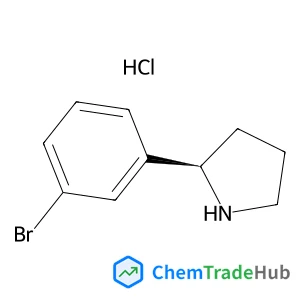
(2R)-2-(3-Bromophenyl)pyrrolidine hydrochloride (1:1)
CAS Number:
1391550-13-2
Molecular Formula:
C10H13BrClN
![1-[6-(1H-Imidazol-1-yl)-3-pyridinyl]methanamine structure](https://static.chemtradehub.com/structs/914/914637-08-4-8825.webp "1-[6-(1H-Imidazol-1-yl)-3-pyridinyl]methanamine structure")
Recommended Suppliers







Disclaimer
This page provides academic journal information for reference and research purposes only. We are not affiliated with any journal publishers and do not handle publication submissions. For publication-related inquiries, please contact the respective journal publishers directly.
If you notice any inaccuracies in the information displayed, please contact us at support@chemtradehub.com. We will promptly review and address your concerns.