












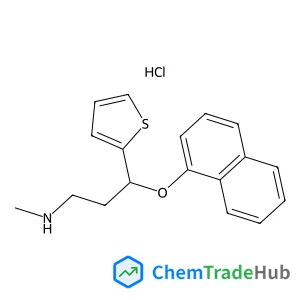
N-Methyl-3-(1-naphthyloxy)-3-(2-thienyl)-1-propanamine hydrochloride (1:1)
CAS Number:
1188266-11-6
Molecular Formula:
C18H20ClNOS
Hong-Mei Yang, Zhi-Hao Chen, Jun-Fang Li, Xiu-Li Sun, Xiao-Yan Wang, Yong Tang
Highly branched polymers are very promising and suitable for a variety of applications. Herein, a series of oil-soluble and branched polymethacrylates are synthesized efficiently via atom transfer radical copolymerization of 2-ethylhexyl methacrylate (EHMA) with different divinyl branchers. More remarkably, for the first time, it is found that the brancher significantly affects not only the branching degree, but also the branch structure, thus determining the application performance of the branched polymethacrylates. The order of branching degree from high to low with the brancher is p-divinylbenzene (DVB) > ethylene glycol dimethacrylate > p-vinylbenzyl methacrylate. In addition, only the brancher DVB provides branched polymers with negligible linear components, further indicating that DVB is the most effective brancher. More interestingly, it is deduced that the brancher DVB produces branched polymers possessing “X”-like branch-linkages, while the other two branchers provide “T”-like linkages. These brancher effects could be well explained by the reactivity ratios of the different double bonds in the polymerization system. The polymethacrylates with “X”-like branch-linkages exhibit superiority in comprehensive performance as viscosity index improvers (VIIs) of lubricants compared to those with “T”-like linkages and linear polymers, including a commercial analogue. Among the branched polymers of EHMA, the EHMA/DVB copolymer achieves the best VI improving power and viscosity thickening capacity. More notably, this sample exhibits a unique performance of shear thickening and a negative shear stability index, which make it ideal for the potential applications as an additive of premium lubricants involving high shear stress.
Luis Manuel Aguilera-Sáez, José Raúl Belmonte-Sánchez, Roberto Romero-González, José Luis Martínez Vidal, Francisco Javier Arrebola, Antonia Garrido Frenich, Ignacio Fernández
DOI: 10.1039/C8AN00505B
M. R. Johnston, J. R. Gascooke, A. V. Ellis, S. C. Leterme
DOI: 10.1039/C8AN00948A
Yunlei Zhou, Huanshun Yin, Yue Wang, Chengji Sui, Minghui Wang, Shiyun Ai
DOI: 10.1039/C8AN01356J
Jie Xu, Yuchen Wei, Wu Yang, Lulu Yang, Zhongsheng Yi
DOI: 10.1039/C8AN00435H
Lin Ma, Mengyue Zhang, Aijun Yang, Qin Wang, Fei Qu, Fengli Qu, Rong-Mei Kong
DOI: 10.1039/C8AN01556B
Guolan Tian, Lan Chen, Renxiao Liu, Guanglu Ge
DOI: 10.1039/C8AN01068D
Sang-Yong Lee, Xihuan Luo, Vigneshwaran Namasivayam, Jennifer Geiss, Salahuddin Mirza, Julie Pelletier, Holger Stephan, Christa E. Müller
DOI: 10.1039/C8AN01108G
Guobin Mao, Mingyuan Du, Xinxin Wang, Xinghu Ji, Zhike He
DOI: 10.1039/C8AN01640B
A. F. Payam, W. Trewby, K. Voïtchovsky
DOI: 10.1039/C6AN02674E
N-(4-Methoxybenzyl)-2-pyridinamine (CAS: 52818-63-0) is increasingly being used ...
When handling Ethyl 4-(2-chlorophenyl)-1,3-thiazole-2-carboxylate, appropriate p...
Diethyldiselane (CAS: 628-39-7) is classified under the Globally Harmonized Syst...
The market for oxocopper (CAS: 12053-18-8) is primarily driven by its use in cat...
The market for 5-{[(2-Methyl-2-propanyl)oxy]carbonyl}-5-azaspiro[2.4]heptane-7-c...
2-(1-Pyrrolidinyl)-4-pyridinamine is a chemical compound with the CAS number 359...
2-(3-Pyridinyl)-1-azabicyclo[2.2.2]octane (CAS: 91556-75-1) is a crystalline sol...
(S)-Alpha-allyl-proline hydrochloride is usually synthesized via a Wittig reacti...
3-Methyl-1,2-oxazole-5-carboxylic acid (CAS: 4857-42-5) is an organic compound w...
Lys-SMCC-DM1 is synthesized via a multi-step process involving the coupling of S...

Polymer Chemistry welcomes submissions in all areas of polymer science that have a strong focus on macromolecular chemistry. Manuscripts may cover a broad range of fields, yet no direct application focus is required.
![N-{15-[(2,5-Dioxo-1-pyrrolidinyl)oxy]-15-oxo-3,6,9,12-tetraoxapentadec-1-yl}-2-(2-propyn-1-yloxy)acetamide structure](https://static.chemtradehub.com/structs/210/2101206-92-0-2eb5.webp "N-{15-[(2,5-Dioxo-1-pyrrolidinyl)oxy]-15-oxo-3,6,9,12-tetraoxapentadec-1-yl}-2-(2-propyn-1-yloxy)acetamide structure")
![1-{3-[4-Amino-3-(4-phenoxyphenyl)-1H-pyrazolo[3,4-d]pyrimidin-1-yl]-1-piperidinyl}-2,3-dihydroxy-1-propanone structure](https://static.chemtradehub.com/structs/122/1226872-27-0-e037.webp "1-{3-[4-Amino-3-(4-phenoxyphenyl)-1H-pyrazolo[3,4-d]pyrimidin-1-yl]-1-piperidinyl}-2,3-dihydroxy-1-propanone structure")
![1,10-bis(3,5-dimethylphenyl)-12-hydroxy-4,5,6,7-tetrahydroiindeno[7,1-de:1',7'-fg][1,3,2]dioxaphosphocine 12-oxide structure](https://static.chemtradehub.com/structs/141/1412439-82-7-b9a9.webp "1,10-bis(3,5-dimethylphenyl)-12-hydroxy-4,5,6,7-tetrahydroiindeno[7,1-de:1',7'-fg][1,3,2]dioxaphosphocine 12-oxide structure")





