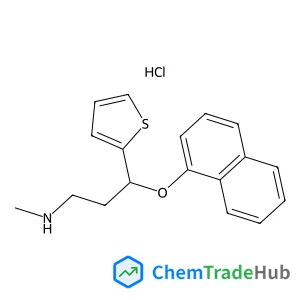
N-Methyl-3-(1-naphthyloxy)-3-(2-thienyl)-1-propanamine hydrochloride (1:1)
CAS Number:
1188266-11-6
Molecular Formula:
C18H20ClNOS
Yi-Cong Wang, Pei-Yi Cheng, Zhi-Qian Zhang, Ke-Xin Fan, Rui-Qi Lu, Shu Zhang, Yi-Xian Wu
Highly efficient terpolymerizations of ethylene, propylene and 5-ethylidene-2-norbornene (ENB) using a half-titanocene containing iminoimidazolidine (T5) catalyst with a methylaluminoxane (MAO) cocatalyst could be achieved in the presence of small amounts of triisobutylaluminium (TIBA) and 2,6-ditertbutyl-4-methyl-phenol (BHT) at TIBA : BHT : Ti = 20 : 20 : 1 (molar ratio). The catalytic activity reached 2.20 × 10⁷ g polymer per mol of Ti per h for the copolymerization of ethylene and propylene and the ethylene–propylene copolymer with a high incorporation ratio of propylene (39.1 mol%) was afforded by using the T5/TIBA/BHT/MAO catalytic system. Interestingly, the catalytic activity, the incorporation ratio of propylene into the copolymer chains and the percentage of randomly distributed sequences could be improved by an increase in the BHT/Ti molar ratio from 0 to 20. Very importantly, the ENB conversion could reach more than 95%, indicating that this T5/TIBA/BHT/MAO catalytic system exhibits excellent copolymerization ability for ENB with ethylene and propylene. The content of ENB units in the resulting ethylene–propylene–diene rubbers (EPDMs) could be increased up to 6.8 mol% (20.8 wt%) by increasing the ENB concentration in the monomer feed without sacrificing the catalytic activity and ENB conversion. The extremely high ENB conversion was significant for the highly efficient production of EPDMs with relatively low cost and short processes. The EPDM with a high content of ENB units is critical for rapid vulcanization during the processing and for the preparation of a functionalized EPDM. The CC double bonds in the ENB units in the above EPDM can be cleanly converted into carboxylic functional groups via light-mediated thiol–ene reaction, leading to the production of the functionalized EPDM with various contents of carboxylic side groups. The functionalized EPDMs exhibit enhanced hydrophilicity, which may result in good compatibility with inorganic fillers and strong interaction between inorganic fillers and organic terpolymers.
Ye Zhang, Bai Cui, Chunsong Zhao, Hong Lin
DOI: 10.1039/C3CP50202C
Qian Gou, Gang Feng, Luca Evangelisti, Alberto Lesarri, Emilio J. Cocinero, Walther Caminati
DOI: 10.1039/C3CP50306B
Xin Zeng, Stevin S. Pramana, Sudip K. Batabyal, Xiaodong Chen, K. B. Jinesh
DOI: 10.1039/C3CP43470B
Rebecca C. Quardokus, Natalie A. Wasio, Ryan P. Forrest, Craig S. Lent, Steven A. Corcelli, John A. Christie, Kenneth W. Henderson, S. Alex Kandel
DOI: 10.1039/C3CP50225B
Sunghyun Uhm
DOI: 10.1039/C3CP50885D
Paul E. Crider, Matthias Vonderach, Patrick Weis
DOI: 10.1039/C2CP43808A
Giancarlo Cicero, Bruno Camino, Stefano Bianco, Anna Maria Ferrari, Barbara Ballarin, Claudia Barolo
DOI: 10.1039/C3CP50559F
V. Epp, Ö. Gün, H.-J. Deiseroth, M. Wilkening
DOI: 10.1039/C3CP44379E
Bethany R. Lettiere, Gareth Seward, Nisha Verma, Yichi Zhang
DOI: 10.1039/C3CP50918D
N-(4-Methoxybenzyl)-2-pyridinamine (CAS: 52818-63-0) is increasingly being used ...
When handling Ethyl 4-(2-chlorophenyl)-1,3-thiazole-2-carboxylate, appropriate p...
Diethyldiselane (CAS: 628-39-7) is classified under the Globally Harmonized Syst...
The market for oxocopper (CAS: 12053-18-8) is primarily driven by its use in cat...
The market for 5-{[(2-Methyl-2-propanyl)oxy]carbonyl}-5-azaspiro[2.4]heptane-7-c...
2-(1-Pyrrolidinyl)-4-pyridinamine is a chemical compound with the CAS number 359...
2-(3-Pyridinyl)-1-azabicyclo[2.2.2]octane (CAS: 91556-75-1) is a crystalline sol...
(S)-Alpha-allyl-proline hydrochloride is usually synthesized via a Wittig reacti...
3-Methyl-1,2-oxazole-5-carboxylic acid (CAS: 4857-42-5) is an organic compound w...
Lys-SMCC-DM1 is synthesized via a multi-step process involving the coupling of S...

Polymer Chemistry welcomes submissions in all areas of polymer science that have a strong focus on macromolecular chemistry. Manuscripts may cover a broad range of fields, yet no direct application focus is required.
![1,10-bis(3,5-dimethylphenyl)-12-hydroxy-4,5,6,7-tetrahydroiindeno[7,1-de:1',7'-fg][1,3,2]dioxaphosphocine 12-oxide structure](https://static.chemtradehub.com/structs/141/1412439-82-7-b9a9.webp "1,10-bis(3,5-dimethylphenyl)-12-hydroxy-4,5,6,7-tetrahydroiindeno[7,1-de:1',7'-fg][1,3,2]dioxaphosphocine 12-oxide structure")
![1-oxaspiro[4.4]nonan-6-one structure](https://static.chemtradehub.com/structs/134/134179-01-4-e051.webp "1-oxaspiro[4.4]nonan-6-one structure")