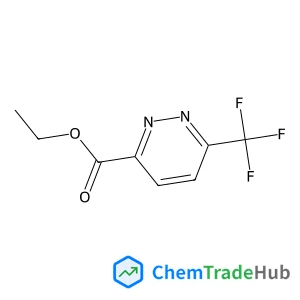
Ethyl 6-(trifluoromethyl)pyridazine-3-carboxylate
CAS Number:
1192155-06-8
Molecular Formula:
C8H7F3N2O2
Alexandra Milenkovic, Marc Lemaire
A new method has been recently developed for the hydrodesulfurization of gasoils based on the formation of charge transfer complexes. This method is highly selective towards the removal of alkyldibenzothiophenes from other aromatic compounds present in gasoils. Total energy calculations based on density-functional theory have been performed to study the complexation phenomenon and clarify its high selectivity. DFT calculations improve the understanding of the process and they are also useful for the design of more efficient acceptor derivatives for the desulfurization process. Five charge transfer complexes between a given acceptor and five representative donor compounds present in gasoils have been studied. Three main criteria have been used to characterize the optimized complexes: their complexation energy, their geometry and their electronic structure. The decomposition of total energy showed that the main contribution to the complexation energy comes from the Pauli repulsion and the electrostatic interactions. Hence the charge transfer complexes are not only ruled by charge transfer but also by electrostatic contributions. However, the selectivity of the complexation phenomenon is controlled by the orbital interactions.
Christian Heiss, Jay Anderson
DOI: 10.1039/B208910F
Mu Chen, Jia-Qing Cao, Song Ang, Ting-Ni Zeng, Ni-Ping Li, Tang-Jia Yang, Jun-Shan Liu, Yan Wu, Wen-Cai Ye, Lei Wang
DOI: 10.1039/D1QO01629F
Christophe Frixa, Mary F. Mahon, Andrew S. Thompson, Michael D. Threadgill
DOI: 10.1039/B209534C
Jason P. Holland, Harald Scherer, Stephan Maus, Tobias Stemler, Hendrik Bohnenberger, Samer Ezziddin, Philipp Kurz
DOI: 10.1039/C8OB01981A
J. E. Tungen, M. Aursnes, S. Ramon, R. A. Colas, C. N. Serhan, S. Nuruddin, F. Willoch, T. V. Hansen
DOI: 10.1039/C8OB01232F
Yadong Pang, Ryoto Kojima, Hajime Ito
DOI: 10.1039/C8OB01778F
Haichao Huang, Hailong Wang, Chao Gong, Zhenjing Zhuang, Wenmin Feng, Si-Hai Wu, Lianhui Wang
DOI: 10.1039/D1QO01478A
Eugenius Butkus, Julė Malinauskienė, Sigitas Stončius
DOI: 10.1039/B208422H
Yuping Zhu, Tianqi Liu, Bingxin Liu, Houguang Shi, Qitao Tan
DOI: 10.1039/D1QO01574E
Talal F. Al-Azemi, Mickey Vinodh, Fatemeh H. Alipour, Abdirahman A. Mohamod
DOI: 10.1039/C8OB02074D
6-(3-Fluorophenyl)picolinic acid is generally considered safe for laboratory use...
(3R)-3-Pyrrolidinol is used in the pharmaceutical industry as a precursor for dr...
When handling (4R,5R)-4,5-Diethoxycarbonyl-2,2-dimethyldioxolane (CAS: 59779-75-...
1-(6-Chloroimidazo[1,2-b]pyridazin-3-yl)ethanone is often synthesized via a mult...
The market for N-Ethyl-3,4-dimethylbenzylamine (CAS: 39180-83-1) remains steady,...
Tert-butyl 3-(pyrrolidin-1-yl)azetidine-1-carboxylate is a chemical compound wit...
1-Bromo-3-chloro-2,4-dimethoxybenzene (CAS: 1228956-93-1) falls under the classi...
The safety of 8-Bromo-2-methyl-3,4-dihydroisoquinolin-1(2H)-one (CAS: 1368622-07...
Benzyl [(3S)-2,6-dioxo-3-piperidinyl]carbamate is generally safe when handled wi...
1-{[4-(4,4,5,5-Tetramethyl-1,3,2-dioxaborolan-2-yl)phenyl]sulfonyl}pyrrolidine s...

Physical Chemistry Chemical Physics (PCCP) is an international journal co-owned by 19 physical chemistry and physics societies from around the world. This journal publishes original, cutting-edge research in physical chemistry, chemical physics and biophysical chemistry. To be suitable for publication in PCCP, articles must include significant innovation and/or insight into physical chemistry; this is the most important criterion that reviewers and Editors will judge against when evaluating submissions. The journal has a broad scope and welcomes contributions spanning experiment, theory, computation and data science. Topical coverage includes spectroscopy, dynamics, kinetics, statistical mechanics, thermodynamics, electrochemistry, catalysis, surface science, quantum mechanics, quantum computing and machine learning. Interdisciplinary research areas such as polymers and soft matter, materials, nanoscience, energy, surfaces/interfaces, and biophysical chemistry are welcomed if they demonstrate significant innovation and/or insight into physical chemistry. Joined experimental/theoretical studies are particularly appreciated when complementary and based on up-to-date approaches.
![Benzyl spiro[indole-3,4'-piperidine]-1(2H)-carboxylate hydrochloride (1:1) structure](https://static.chemtradehub.com/structs/159/159635-46-8-8de0.webp "Benzyl spiro[indole-3,4'-piperidine]-1(2H)-carboxylate hydrochloride (1:1) structure")