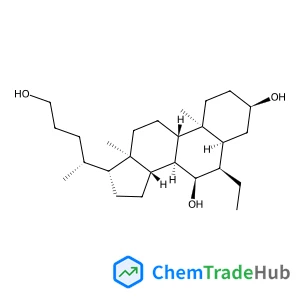
(3alpha,5beta,6alpha,7alpha)-6-Ethylcholane-3,7,24-triol
CAS Number:
1537866-49-1
Molecular Formula:
C26H46O3
Hui-Jing Li, Hong-Yu Tian, Yong-Jun Chen, Dong Wang, Chao-Jun Li
Asymmetric Mukaiyama aldol reactions in aqueous media (water–ethanol = 9:1) were catalyzed by chiral gallium catalysts with semi-crown ligands to give aldol products with good yields, syn-diastereoselectivities and enantioselectivities.
E. Isotta, N. Ataollahi, A. Chiappini, C. Malerba, S. Luong, V. Trifiletti, O. Fenwick, P. Scardi
DOI: 10.1039/D1CP90124A
Junli Zhu, Liquan Wang, Jiaping Lin, Lei Du, Qixin Zhuang
DOI: 10.1039/D0CP05580H
Fenfen Ma, Xiaoyan Zheng, Zesheng Li
DOI: 10.1039/D1CP01326B
Matthew Szydagis, Cecilia Levy, Yujia Huang, Alvine C. Kamaha, Corwin C. Knight, Gregory R. C. Rischbieter
DOI: 10.1039/D1CP01083B
Anne-Laure Barra, Johan van Tol, Sabine Hediger, Daniel Lee, Gaël De Paëpe
DOI: 10.1039/D1CP90117F
Keiji Naka
DOI: 10.1039/D0CP06604D
Dongdong Zhang, Yi Cao, Pan Zhang, Jiankang Liang, Ke Xue, Yong Xia, Zhengjian Qi
DOI: 10.1039/D1CP01526E
Lihong Zhang, Shunqing Wu, Jianwei Shuai, Zhufeng Hou
DOI: 10.1039/D1CP02539B
Rui Tang, Ling Han, Jing Yang, Min Xu, Min Ge, Yuanyuan Tang, Xiaobin Fu, Hongtao Liu, Yuan Qian
DOI: 10.1039/D1CP02769G
James D. Fletcher, Lucia Lanfri, Grant A. D. Ritchie, Gus Hancock, Meez Islam, Graham Richmond
DOI: 10.1039/D1CP03360C
N-(4-Methoxybenzyl)-2-pyridinamine (CAS: 52818-63-0) is increasingly being used ...
When handling Ethyl 4-(2-chlorophenyl)-1,3-thiazole-2-carboxylate, appropriate p...
Diethyldiselane (CAS: 628-39-7) is classified under the Globally Harmonized Syst...
The market for oxocopper (CAS: 12053-18-8) is primarily driven by its use in cat...
The market for 5-{[(2-Methyl-2-propanyl)oxy]carbonyl}-5-azaspiro[2.4]heptane-7-c...
2-(1-Pyrrolidinyl)-4-pyridinamine is a chemical compound with the CAS number 359...
2-(3-Pyridinyl)-1-azabicyclo[2.2.2]octane (CAS: 91556-75-1) is a crystalline sol...
(S)-Alpha-allyl-proline hydrochloride is usually synthesized via a Wittig reacti...
3-Methyl-1,2-oxazole-5-carboxylic acid (CAS: 4857-42-5) is an organic compound w...
Lys-SMCC-DM1 is synthesized via a multi-step process involving the coupling of S...

ChemComm publishes urgent research which is of outstanding significance and interest to experts in the field, while also appealing to the journal’s broad chemistry readership. Our communication format is ideally suited to short, urgent studies that are of such importance that they require accelerated publication. Our scope covers all topics in chemistry, and research at the interface of chemistry and other disciplines (such as materials science, nanoscience, physics, engineering and biology) where there is a significant novelty in the chemistry aspects. Major topic areas covered include: Analytical Chemistry Catalysis Chemical Biology and medicinal chemistry Computational Chemistry and Machine Learning Energy and sustainable chemistry Environmental Chemistry Green Chemistry Inorganic Chemistry Materials Chemistry Nanoscience Organic Chemistry Physical Chemistry Polymer Chemistry Supramolecular Chemistry