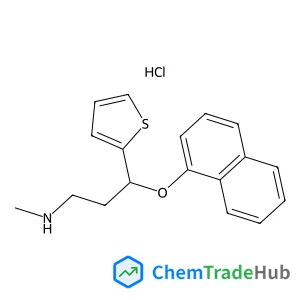
N-Methyl-3-(1-naphthyloxy)-3-(2-thienyl)-1-propanamine hydrochloride (1:1)
CAS Number:
1188266-11-6
Molecular Formula:
C18H20ClNOS
Anne-Laure Barra, Johan van Tol, Sabine Hediger, Daniel Lee, Gaël De Paëpe
Correction for ‘De novo prediction of cross-effect efficiency for magic angle spinning dynamic nuclear polarization’ by Frédéric Mentink-Vigier et al., Phys. Chem. Chem. Phys., 2019, 21, 2166–2176, DOI: 10.1039/C8CP06819D.
Frédéric Fraïsse, Jean-Marie Nedelec, Jean Pierre E. Grolier
DOI: 10.1039/B618701C
Christian Antonio, Rowan T. Deam
DOI: 10.1039/B617358F
DOI: 10.1039/B617068D
Stefan Laubach, Peter C. Schmidt, Andreas Thißen, Francisco Javier Fernandez-Madrigal, Qi-Hui Wu, Wolfram Jaegermann, Matthias Klemm, Siegfried Horn
DOI: 10.1039/B612489E
James A. Elliott, Stephen J. Paddison
DOI: 10.1039/B701234A
Pekka Pyykkö, Cong Wang, Michal Straka, Juha Vaara
DOI: 10.1039/B704695B
Tatsuo Shibata, Nobuyuki Sakai, Katsutoshi Fukuda, Yasuo Ebina, Takayoshi Sasaki
DOI: 10.1039/B618448K
Cornelis A. van Walree, Alwin W. Marsman, Joop H. van Lenthe, Leonardus W. Jenneskens
DOI: 10.1039/B616893K
F. Leonori, N. Balucani, G. Capozza, E. Segoloni, D. Stranges, P. Casavecchia
DOI: 10.1039/B618971G
N-(4-Methoxybenzyl)-2-pyridinamine (CAS: 52818-63-0) is increasingly being used ...
When handling Ethyl 4-(2-chlorophenyl)-1,3-thiazole-2-carboxylate, appropriate p...
Diethyldiselane (CAS: 628-39-7) is classified under the Globally Harmonized Syst...
The market for oxocopper (CAS: 12053-18-8) is primarily driven by its use in cat...
The market for 5-{[(2-Methyl-2-propanyl)oxy]carbonyl}-5-azaspiro[2.4]heptane-7-c...
2-(1-Pyrrolidinyl)-4-pyridinamine is a chemical compound with the CAS number 359...
2-(3-Pyridinyl)-1-azabicyclo[2.2.2]octane (CAS: 91556-75-1) is a crystalline sol...
(S)-Alpha-allyl-proline hydrochloride is usually synthesized via a Wittig reacti...
3-Methyl-1,2-oxazole-5-carboxylic acid (CAS: 4857-42-5) is an organic compound w...
Lys-SMCC-DM1 is synthesized via a multi-step process involving the coupling of S...

Physical Chemistry Chemical Physics (PCCP) is an international journal co-owned by 19 physical chemistry and physics societies from around the world. This journal publishes original, cutting-edge research in physical chemistry, chemical physics and biophysical chemistry. To be suitable for publication in PCCP, articles must include significant innovation and/or insight into physical chemistry; this is the most important criterion that reviewers and Editors will judge against when evaluating submissions. The journal has a broad scope and welcomes contributions spanning experiment, theory, computation and data science. Topical coverage includes spectroscopy, dynamics, kinetics, statistical mechanics, thermodynamics, electrochemistry, catalysis, surface science, quantum mechanics, quantum computing and machine learning. Interdisciplinary research areas such as polymers and soft matter, materials, nanoscience, energy, surfaces/interfaces, and biophysical chemistry are welcomed if they demonstrate significant innovation and/or insight into physical chemistry. Joined experimental/theoretical studies are particularly appreciated when complementary and based on up-to-date approaches.
![(2R,6S)-6-[(Benzyloxy)methyl]-4-{[(2-methyl-2-propanyl)oxy]carbonyl}-2-morpholinecarboxylic acid structure](https://static.chemtradehub.com/structs/109/1093085-91-6-3382.webp "(2R,6S)-6-[(Benzyloxy)methyl]-4-{[(2-methyl-2-propanyl)oxy]carbonyl}-2-morpholinecarboxylic acid structure")