












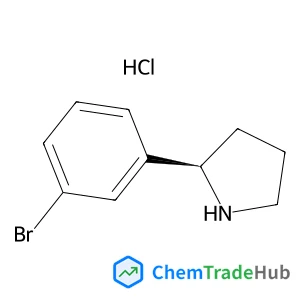
(2R)-2-(3-Bromophenyl)pyrrolidine hydrochloride (1:1)
CAS Number:
1391550-13-2
Molecular Formula:
C10H13BrClN
Dongdong Zhang, Yi Cao, Pan Zhang, Jiankang Liang, Ke Xue, Yong Xia, Zhengjian Qi
The multiple thermal decomposition channels of glycerol are calculated at the M06-2X-D3/6-311+G(d,p) level. In addition, the CAM-B3LYP and ωB97X-D functionals are used to show the functional influence on the free energy barrier. For the highly competitive primary channels, the DLPNO-CCSD(T)/CBS method is applied for the energy calculations. The results show that the dominant paths are: (1) breakage of the C–C, C–O, and O–H bonds of glycerol successively to form carbonyl and alkene, and then generation of water, formaldehyde, and acetaldehyde; (2) glycerol undergoing an intramolecular dehydration reaction and producing 3-hydroxypropionaldehyde; it has two subsequent reactions: ① C–C bond fracture occurring to form formaldehyde, acetaldehyde, and water; and ② intramolecular dehydration forming acrolein and water. The ΔG1 is 65.6 kcal mol−1 while the ΔG2 is 65.5 kcal mol−1 at 101 kPa and 298 K, and fitted rate equations are 1.09 × 10¹³ exp[65.6 × 10³/RT] s−1 and 8.07 × 10¹² exp[65.4 × 10³/RT] s−1, respectively. Besides, UPLC and TG-GC/MS are applied complementarily to investigate the anaerobic pyrolysis products of glycerol at different temperatures. The experimental results are consistent with theoretical calculations.
Fabio Ramondo, Luigi Bencivenni, Ruggero Caminiti, Andrea Pieretti, Lorenzo Gontrani
DOI: 10.1039/B617837E
Sebastian Sinnecker, Marco Flores, Wolfgang Lubitz
DOI: 10.1039/B612568A
Sylwia Ptasińska, Léon Sanche
DOI: 10.1039/B616619A
Patricia A. Cleary, Maria Teresa Baeza Romero, Mark A. Blitz, Dwayne E. Heard, Michael J. Pilling, Paul W. Seakins, Liming Wang
DOI: 10.1039/B612127F
N. A. Ramsahye, G. Maurin, S. Bourrelly, P. Llewellyn, T Loiseau, G. Ferey
DOI: 10.1039/B613378A
Amjad B. Mohammad, Kok Hwa Lim, Konstantin M. Neyman, Notker Rösch
DOI: 10.1039/B616675J
David C. Clary
DOI: 10.1039/B615660F
Pekka Pyykkö, Cong Wang, Michal Straka, Juha Vaara
DOI: 10.1039/B704695B
S. Yu. Grebenshchikov, Z.-W. Qu, H. Zhu, R. Schinke
DOI: 10.1039/B701020F
N-(4-Methoxybenzyl)-2-pyridinamine (CAS: 52818-63-0) is increasingly being used ...
When handling Ethyl 4-(2-chlorophenyl)-1,3-thiazole-2-carboxylate, appropriate p...
Diethyldiselane (CAS: 628-39-7) is classified under the Globally Harmonized Syst...
The market for oxocopper (CAS: 12053-18-8) is primarily driven by its use in cat...
The market for 5-{[(2-Methyl-2-propanyl)oxy]carbonyl}-5-azaspiro[2.4]heptane-7-c...
2-(1-Pyrrolidinyl)-4-pyridinamine is a chemical compound with the CAS number 359...
2-(3-Pyridinyl)-1-azabicyclo[2.2.2]octane (CAS: 91556-75-1) is a crystalline sol...
(S)-Alpha-allyl-proline hydrochloride is usually synthesized via a Wittig reacti...
3-Methyl-1,2-oxazole-5-carboxylic acid (CAS: 4857-42-5) is an organic compound w...
Lys-SMCC-DM1 is synthesized via a multi-step process involving the coupling of S...

Physical Chemistry Chemical Physics (PCCP) is an international journal co-owned by 19 physical chemistry and physics societies from around the world. This journal publishes original, cutting-edge research in physical chemistry, chemical physics and biophysical chemistry. To be suitable for publication in PCCP, articles must include significant innovation and/or insight into physical chemistry; this is the most important criterion that reviewers and Editors will judge against when evaluating submissions. The journal has a broad scope and welcomes contributions spanning experiment, theory, computation and data science. Topical coverage includes spectroscopy, dynamics, kinetics, statistical mechanics, thermodynamics, electrochemistry, catalysis, surface science, quantum mechanics, quantum computing and machine learning. Interdisciplinary research areas such as polymers and soft matter, materials, nanoscience, energy, surfaces/interfaces, and biophysical chemistry are welcomed if they demonstrate significant innovation and/or insight into physical chemistry. Joined experimental/theoretical studies are particularly appreciated when complementary and based on up-to-date approaches.
![1-[6-(1H-Imidazol-1-yl)-3-pyridinyl]methanamine structure](https://static.chemtradehub.com/structs/914/914637-08-4-8825.webp "1-[6-(1H-Imidazol-1-yl)-3-pyridinyl]methanamine structure")





