












Effect of curing reaction types on the structures and properties of acetylene-containing thermosets: towards optimization of curing procedure
Literature Information
Publication Date
2021-06-01
DOI
10.1039/D0CP05580H
Impact Factor
3.676
Authors
Junli Zhu, Liquan Wang, Jiaping Lin, Lei Du, Qixin Zhuang
View Original
Abstract
High-temperature thermosets are usually prepared from resins containing alkynyl groups, and their properties depend much upon the curing process containing various types of curing reactions. However, how the curing process affects the properties remains unclear due to the complicated curing reactions. We used molecular dynamics simulations to investigate the effect of curing reaction types, including cyclotrimerization, Diels–Alder reaction, and radical reaction, on the structures and properties of imide oligomers terminated with alkynyl groups. The results show that the cycloadditions such as cyclotrimerization and Diels–Alder reaction endow the thermosets with rigid structures and high moduli. Compared with the cycloadditions, the radical reaction enables the formation of flexible cured structures, which can enhance the toughness of thermosets. The differences in thermal and mechanical properties caused by different curing types were elucidated by the relaxation processes of fragments in these cured systems and were explained by the variation of torsion energy in different curing forms. As this work aims to optimize the curing procedure to obtain high-performance resins with desired properties, different curing procedures were finally designed according to the theoretical studies, and the obtained cured polymers show significant differences in the properties from different curing ways. The results can guide the preparation of desired thermosetting resins by tuning the curing procedure.
Recommended Journals
Related Literature
Theoretical and experimental determination of the electronic structure of V2O5, reduced V2O5−x and sodium intercalated NaV2O5
Stefan Laubach, Peter C. Schmidt, Andreas Thißen, Francisco Javier Fernandez-Madrigal, Qi-Hui Wu, Wolfram Jaegermann, Matthias Klemm, Siegfried Horn
2007-03-21
Paper
DOI: 10.1039/B612489E
Particle size dependent adsorption and reaction kinetics on reduced and partially oxidized Pd nanoparticles
T. Schalow, B. Brandt, D. E. Starr, M. Laurin, S. K. Shaikhutdinov, S. Schauermann, J. Libuda, H.-J. Freund
2007-01-23
Paper
DOI: 10.1039/B614546A
The dynamics of water exchange in gadolinium DOTA complexes studied by transition path sampling and potential of mean force methods
2007-01-30
Paper
DOI: 10.1039/B617068D
Proton transfer in hydrogen-bonded pyridine/acid systems: the role of higher aggregation
Vytautas Balevicius, Ruta Bariseviciute, Kestutis Aidas, Ingrid Svoboda, Helmut Ehrenberg, Hartmut Fuess
2007-04-16
Paper
DOI: 10.1039/B701775H
Energy selective excision of CN− following electron attachment to hexafluoroacetone azine ((CF3)2CN–NC(CF3)2)
Ilko Bald, Iwona Dąbkowska, Eugen Illenberger, Oddur Ingólfsson
2007-04-23
Paper
DOI: 10.1039/B702482G
Thrombin allostery‡
Enrico Di Cera, Michael J. Page, Alaji Bah, Leslie A. Bush-Pelc, Laura C. Garvey
2007-01-12
Invited Article
DOI: 10.1039/B616819A
You might also like
Compound Q&A
What is the market or research trend for N-(4-Methoxybenzyl)-2-pyridinamine (CAS: 52818-63-0)?
N-(4-Methoxybenzyl)-2-pyridinamine (CAS: 52818-63-0) is increasingly being used ...
52818-63-0N-(4-Methoxybenzyl)-...
Compound Q&A
What precautions should be taken when handling Ethyl 4-(2-chlorophenyl)-1,3-thiazole-2-carboxylate (CAS: 1050507-06-6)?
When handling Ethyl 4-(2-chlorophenyl)-1,3-thiazole-2-carboxylate, appropriate p...
1050507-06-6Ethyl 4-(2-chlorophe...
Compound Q&A
What regulatory guidelines apply to diethyldiselane (CAS: 628-39-7)?
Diethyldiselane (CAS: 628-39-7) is classified under the Globally Harmonized Syst...
628-39-7Diethyldiselane
Compound Q&A
What is the market or research trend for oxocopper (CAS: 12053-18-8)?
The market for oxocopper (CAS: 12053-18-8) is primarily driven by its use in cat...
12053-18-8oxocopper; oxo-(oxoc...
Compound Q&A
What is the market or research trend for 5-{[(2-Methyl-2-propanyl)oxy]carbonyl}-5-azaspiro[2.4]heptane-7-carboxylic acid?
The market for 5-{[(2-Methyl-2-propanyl)oxy]carbonyl}-5-azaspiro[2.4]heptane-7-c...
1268519-54-55-{[(2-Methyl-2-prop...
Compound Q&A
What is 2-(1-Pyrrolidinyl)-4-pyridinamine (CAS: 35981-63-6)?
2-(1-Pyrrolidinyl)-4-pyridinamine is a chemical compound with the CAS number 359...
35981-63-62-(1-Pyrrolidinyl)-4...
Compound Q&A
What are the physical and chemical properties of 2-(3-Pyridinyl)-1-azabicyclo[2.2.2]octane (CAS: 91556-75-1)?
2-(3-Pyridinyl)-1-azabicyclo[2.2.2]octane (CAS: 91556-75-1) is a crystalline sol...
91556-75-12-(3-Pyridinyl)-1-az...
Compound Q&A
How is (S)-Alpha-allyl-proline hydrochloride (CAS: 129704-91-2) typically synthesized?
(S)-Alpha-allyl-proline hydrochloride is usually synthesized via a Wittig reacti...
129704-91-2(S)-Alpha-allyl-prol...
Compound Q&A
What is 3-Methyl-1,2-oxazole-5-carboxylic acid (CAS: 4857-42-5)?
3-Methyl-1,2-oxazole-5-carboxylic acid (CAS: 4857-42-5) is an organic compound w...
4857-42-53-Methyl-1,2-oxazole...
Compound Q&A
How is Lys-SMCC-DM1 (CAS: 1281816-04-3) typically synthesized?
Lys-SMCC-DM1 is synthesized via a multi-step process involving the coupling of S...
1281816-04-3Lys-SMCC-DM1
Source Journal
Physical Chemistry Chemical Physics

CiteScore:
5.5
Self-citation Rate:
10.3%
Articles per Year:
3036
Physical Chemistry Chemical Physics (PCCP) is an international journal co-owned by 19 physical chemistry and physics societies from around the world. This journal publishes original, cutting-edge research in physical chemistry, chemical physics and biophysical chemistry. To be suitable for publication in PCCP, articles must include significant innovation and/or insight into physical chemistry; this is the most important criterion that reviewers and Editors will judge against when evaluating submissions. The journal has a broad scope and welcomes contributions spanning experiment, theory, computation and data science. Topical coverage includes spectroscopy, dynamics, kinetics, statistical mechanics, thermodynamics, electrochemistry, catalysis, surface science, quantum mechanics, quantum computing and machine learning. Interdisciplinary research areas such as polymers and soft matter, materials, nanoscience, energy, surfaces/interfaces, and biophysical chemistry are welcomed if they demonstrate significant innovation and/or insight into physical chemistry. Joined experimental/theoretical studies are particularly appreciated when complementary and based on up-to-date approaches.
Recommended Compounds
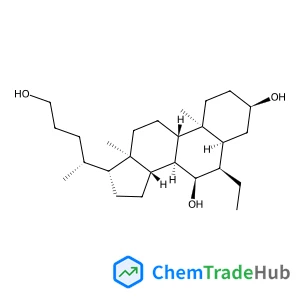
(3alpha,5beta,6alpha,7alpha)-6-Ethylcholane-3,7,24-triol
CAS Number:
1537866-49-1
Molecular Formula:
C26H46O3
Recommended Suppliers






Disclaimer
This page provides academic journal information for reference and research purposes only. We are not affiliated with any journal publishers and do not handle publication submissions. For publication-related inquiries, please contact the respective journal publishers directly.
If you notice any inaccuracies in the information displayed, please contact us at support@chemtradehub.com. We will promptly review and address your concerns.