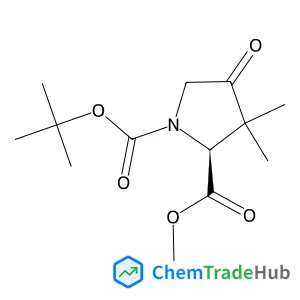
2-Methyl 1-(2-methyl-2-propanyl) (2S)-3,3-dimethyl-4-oxo-1,2-pyrrolidinedicarboxylate
CAS Number:
478698-30-5
Molecular Formula:
C13H21NO5
Jessica A. Ragas, Tracey A. Simmons, Patrick A. Limbach
Metal adducts (e.g., Na+ and K+) significantly hinder the analysis of oligonucleotides by matrix-assisted laser desorption/ionization time-of-flight mass spectrometry (MALDI-TOF-MS). Although a number of sample purification methods exist, to date no comparative study exists to determine the most efficient method for purifying oligonucleotides. The objective of this work was to perform such a study. Several different oligonucleotide samples were synthesized. Aliquots of these samples were then purposely contaminated with sodium acetate to generate representative contaminated (salted) oligonucleotide samples. A number of popular oligonucleotide purification techniques were then tested as to their effectiveness at removing Na+ from the salted samples. The effectiveness of Na+ removal was qualitatively assessed by comparing the MALDI mass spectra of the original sample, the salted sample, and the salted sample after purification. Micropipet tips packed with C18 reversed-phase packing material (e.g., Zip Tips) appear to be the most effective means of purifying the oligonucleotides investigated. Minidialysis was found to be an effective alternative for purifying higher molecular weight oligonucleotides (>10000 u).
Jianbing Huang, Hui Liang, Du Cheng, Jiang Lu
DOI: 10.1039/C5PY01656H
Vasiliki Nikolaou, Francesca Brandford-Adams, Richard Whitfield, Glen R. Jones, Gabit Nurumbetov
DOI: 10.1039/C5PY01578B
Xiang Ling, Yan Shen, Runing Sun, Mengze Zhang, Chang Li, Jinyin Mao, Jing Xing, Chunmeng Sun, Jiasheng Tu
DOI: 10.1039/C4PY01592D
Yonghang Xu, Shuanjin Wang, Limiao Lin, Min Xiao, Yuezhong Meng
DOI: 10.1039/C4PY01587H
Ze Zhang, Zi-Bin Tan, Chun-Yan Hong, De-Cheng Wu, Ye-Zi You
DOI: 10.1039/C5PY01758K
Teng Fu, De-Ming Guo, Jia-Ning Wu, Xiao-Lin Wang, Xiu-Li Wang, Li Chen, Yu-Zhong Wang
DOI: 10.1039/C5PY01938A
Marta Palacios-Cuesta, Aitziber L. Cortajarena, Olga García, Juan Rodríguez-Hernández
DOI: 10.1039/C4PY01629G
Tsukasa Hasegawa, Junya Hiyoshi, Susumu Kawauchi, Zhenan Bao, Hidetoshi Matsumoto
DOI: 10.1039/C5PY01870F
Eva Annika Weiber, David Meis, Patric Jannasch
DOI: 10.1039/C4PY01588F
2-(2-Chloroacetamido)-3-phenylpropanoic acid (CAS: 7765-11-9) is generally consi...
2-(Benzyloxy)-5-bromobenzoic acid can be handled safely if appropriate precautio...
(4-Methyl-1,2,5-oxadiazol-3-yl)methanamine hydrochloride is a chemical compound ...
2-(5-Hexylthiophen-2-yl)-4,4,5,5-tetramethyl-1,3,2-dioxaborolane (CAS: 917985-54...
While 4-(8-Methyl-9H-1,3-dioxolo[4,5-h][2,3]benzodiazepin-5-yl)benzenamine (CAS:...
The market for tert-butyl 3-hydroxy-4,5,7,8-tetrahydro-2H-pyrazolo[3,4-d]azepine...
Waste containing 3,5-Diamino-1H-pyrazole-4-carbonitrile (CAS: 6844-58-2) should ...
(6-Fluoro-3-pyridinyl)boronic acid can be synthesized through the reaction of 6-...
Dibenzyl carbonimidoylbiscarbamate (CAS: 10065-79-9) finds applications in vario...
The market for (beta,beta,2,3,4,5,6-~2~H_7_)Phenylalanine (CAS: 74228-83-4) is g...

Analyst publishes analytical and bioanalytical research that reports premier fundamental discoveries and inventions, and the applications of those discoveries, unconfined by traditional discipline barriers.