












Discrete copper(ii)-formate complexes as catalytic precursors for photo-induced reversible deactivation polymerization
Literature Information
Publication Date
2015-10-20
DOI
10.1039/C5PY01578B
Impact Factor
5.582
Authors
Vasiliki Nikolaou, Francesca Brandford-Adams, Richard Whitfield, Glen R. Jones, Gabit Nurumbetov
View Original
Abstract
Traditional copper-mediated reversible deactivation polymerization techniques (RDRP) employ various components mixed in situ (e.g. ligand, metal salt, additional deactivation species etc.) in order to achieve good control over the molecular weight distributions. In a previous communication we described a discrete copper(II)-formate/Me6-Tren complex to catalyse the polymerization of acrylates. Herein, we expand the scope of this complex by investigating the compatibility with various solvents, including acetonitrile (MeCN), dimethylformamide (DMF), methanol (MeOH), isopropanol (IPA), toluene, 2,2,2-trifluoroethanol (TFE) and water as well as mixtures thereof. A series of both hydrophilic and hydrophobic acrylic monomers are reported including n and tert butyl acrylate (n-BA and t-BA), poly ethylene glycol acrylate (PEGA), diethylene glycol ethyl ether acrylate (DEGEEA), lauryl acrylate (LA), octadecyl acrylate (ODA), hydroxyethyl acrylate (HEA), hydroxyl propyl acrylate (HPA) and solketal acrylate (SA). In most cases, narrow molecular weight distributions were attained (typically < 1.20), even when the polymerization was allowed to reach high conversions (>95%). High molecular weight polymers were targeted achieving poly(MA) with a final dispersity of 1.12 within 2 h (Mn ∼ 120 000 g mol−1) with additional NaBr being essential to obtain even higher molecular weight polymers. As Me6-Tren is relatively expensive to purchase commercially, an additional PMDETA complex was also synthesized, allowing for the polymerization of methacrylates (e.g. MMA) in addition to the polymerization of acrylates. Narrow molecular weight distributions, high monomer conversion and good spatiotemporal control could be achieved with this complex, demonstrating that it could be an efficient and less expensive alternative to obtain well-defined poly(acrylates) and poly(methacrylates).
Recommended Journals
Related Literature
Nonlinear optical imaging of single plasmonic nanoparticles with 30 nm resolution
Anke Horneber, Kai Braun, Jan Rogalski, Paul Leiderer, Alfred J. Meixner, Dai Zhang
2015-01-23
Paper
DOI: 10.1039/C4CP05342G
Magneto-electronic properties of multilayer graphenes
Chiun-Yan Lin, Jhao-Ying Wu, Yih-Jon Ou, Yu-Huang Chiu, Ming-Fa Lin
2015-09-09
Perspective
DOI: 10.1039/C5CP05013H
SERS activity of Ag decorated nanodiamond and nano-β-SiC, diamond-like-carbon and thermally annealed diamond thin film surfaces
Mohan Kumar Kuntumalla, Vadali Venkata Satya Siva Srikanth, Satyavathi Ravulapalli, Upender Gangadharini, Harish Ojha, Narayana Rao Desai, Chandrahas Bansal
2015-02-05
Paper
DOI: 10.1039/C4CP05236F
Droplet based microfluidics: spectroscopic characterization of levofloxacin and its SERS detection
I. J. Hidi, M. Jahn
2015-01-16
Paper
DOI: 10.1039/C4CP04970E
Surface-enhanced IR absorption spectroscopy of the KcsA potassium channel upon application of an electric field
Akira Yamakata, Hirofumi Shimizu, Shigetoshi Oiki
2015-06-23
Perspective
DOI: 10.1039/C5CP02681D
Glycosaminoglycans are potential pharmacological targets for classic DNA minor groove binder drugs berenil and pentamidine
2015-08-26
Communication
DOI: 10.1039/C5CP03153B
A detailed study of cholinium chloride and levulinic acid deep eutectic solvent system for CO2 capture via experimental and molecular simulation approaches
Ruh Ullah, Mert Atilhan, Baraa Anaya, Majeda Khraisheh, Gregorio García, Ahmed ElKhattat, Mohammad Tariq, Santiago Aparicio
2015-06-30
Paper
DOI: 10.1039/C5CP03364K
Six-fold-symmetry internal rotation in toluenes: the low barrier challenge of 2,6- and 3,5-difluorotoluene
K. P. Rajappan Nair, Michaela K. Jahn, Alberto Lesarri, Vadim V. Ilyushin, Jens-Uwe Grabow
2015-09-22
Paper
DOI: 10.1039/C5CP03751D
Enhanced-fluorescence correlation spectroscopy at micro-molar dye concentration around a single gold nanorod
Saumyakanti Khatua, Haifeng Yuan, Michel Orrit
2014-09-01
Paper
DOI: 10.1039/C4CP03057E
Mechanistic insights into perovskite photoluminescence enhancement: light curing with oxygen can boost yield thousandfold
Yuxi Tian, Maximilian Peter, Eva Unger, Mohamed Abdellah, Kaibo Zheng, Tõnu Pullerits, Arkady Yartsev, Villy Sundström, Ivan G. Scheblykin
2015-08-27
Paper
DOI: 10.1039/C5CP04410C
You might also like
Compound Q&A
Is 2-(2-chloroacetamido)-3-phenylpropanoic acid (CAS: 7765-11-9) safe?
2-(2-Chloroacetamido)-3-phenylpropanoic acid (CAS: 7765-11-9) is generally consi...
7765-11-92-(2-chloroacetamido...
Compound Q&A
Is 2-(Benzyloxy)-5-bromobenzoic acid (CAS: 62176-31-2) safe?
2-(Benzyloxy)-5-bromobenzoic acid can be handled safely if appropriate precautio...
62176-31-22-(Benzyloxy)-5-brom...
Compound Q&A
What is (4-Methyl-1,2,5-oxadiazol-3-yl)methanamine hydrochloride (CAS: 1159825-48-5)?
(4-Methyl-1,2,5-oxadiazol-3-yl)methanamine hydrochloride is a chemical compound ...
1159825-48-5(4-Methyl-1,2,5-oxad...
Compound Q&A
What is 2-(5-Hexylthiophen-2-yl)-4,4,5,5-tetramethyl-1,3,2-dioxaborolane (CAS: 917985-54-7)?
2-(5-Hexylthiophen-2-yl)-4,4,5,5-tetramethyl-1,3,2-dioxaborolane (CAS: 917985-54...
917985-54-72-(5-Hexylthiophen-2...
Compound Q&A
Are there alternatives to 4-(8-Methyl-9H-1,3-dioxolo[4,5-h][2,3]benzodiazepin-5-yl)benzenamine (CAS: 102771-26-6) in synthesis?
While 4-(8-Methyl-9H-1,3-dioxolo[4,5-h][2,3]benzodiazepin-5-yl)benzenamine (CAS:...
102771-26-64-(8-Methyl-9H-1,3-d...
Compound Q&A
What is the market or research trend for tert-butyl 3-hydroxy-4,5,7,8-tetrahydro-2H-pyrazolo[3,4-d]azepine-6-carboxylate (CAS: 851376-80-2)?
The market for tert-butyl 3-hydroxy-4,5,7,8-tetrahydro-2H-pyrazolo[3,4-d]azepine...
851376-80-2tert-butyl 3-hydroxy...
Compound Q&A
How should waste containing 3,5-Diamino-1H-pyrazole-4-carbonitrile (CAS: 6844-58-2) be handled?
Waste containing 3,5-Diamino-1H-pyrazole-4-carbonitrile (CAS: 6844-58-2) should ...
6844-58-23,5-Diamino-1H-pyraz...
Compound Q&A
How is (6-Fluoro-3-pyridinyl)boronic acid (CAS: 351019-18-6) typically synthesized?
(6-Fluoro-3-pyridinyl)boronic acid can be synthesized through the reaction of 6-...
351019-18-6(6-Fluoro-3-pyridiny...
Compound Q&A
What industries use Dibenzyl carbonimidoylbiscarbamate (CAS: 10065-79-9)?
Dibenzyl carbonimidoylbiscarbamate (CAS: 10065-79-9) finds applications in vario...
10065-79-9Dibenzyl carbonimido...
Compound Q&A
What is the market or research trend for (beta,beta,2,3,4,5,6-~2~H_7_)Phenylalanine (CAS: 74228-83-4)?
The market for (beta,beta,2,3,4,5,6-~2~H_7_)Phenylalanine (CAS: 74228-83-4) is g...
74228-83-4(beta,beta,2,3,4,5,6...
Source Journal
Polymer Chemistry

CiteScore:
8.6
Self-citation Rate:
7.3%
Articles per Year:
457
Polymer Chemistry welcomes submissions in all areas of polymer science that have a strong focus on macromolecular chemistry. Manuscripts may cover a broad range of fields, yet no direct application focus is required.
Recommended Compounds
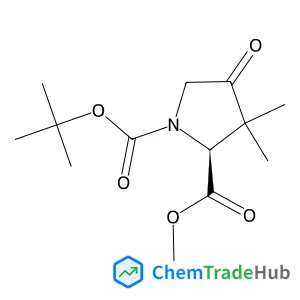
2-Methyl 1-(2-methyl-2-propanyl) (2S)-3,3-dimethyl-4-oxo-1,2-pyrrolidinedicarboxylate
CAS Number:
478698-30-5
Molecular Formula:
C13H21NO5
![(4-Methyl-1H-benzo[d]imidazol-2-yl)methanamine structure](https://static.chemtradehub.com/structs/933/933756-31-1-7b0b.webp "(4-Methyl-1H-benzo[d]imidazol-2-yl)methanamine structure")
![N-[2,6-Di(9-anthryl)-4-oxido-8,9,10,11,12,13,14,15-octahydrodinaphtho[2,1-d:1',2'-f][1,3,2]dioxaphosphepin-4-yl]-1,1,1-trifluoromethanesulfonamide structure](https://static.chemtradehub.com/structs/122/1227374-64-2-cdb5.webp "N-[2,6-Di(9-anthryl)-4-oxido-8,9,10,11,12,13,14,15-octahydrodinaphtho[2,1-d:1',2'-f][1,3,2]dioxaphosphepin-4-yl]-1,1,1-trifluoromethanesulfonamide structure")
N-[2,6-Di(9-anthryl)-4-oxido-8,9,10,11,12,13,14,15-octahydrodinaphtho[2,1-d:1',2'-f][1,3,2]dioxaphosphepin-4-yl]-1,1,1-trifluoromethanesulfonamide
CAS Number:
1227374-64-2
Molecular Formula:
C49H37F3NO5PS
Recommended Suppliers



Disclaimer
This page provides academic journal information for reference and research purposes only. We are not affiliated with any journal publishers and do not handle publication submissions. For publication-related inquiries, please contact the respective journal publishers directly.
If you notice any inaccuracies in the information displayed, please contact us at support@chemtradehub.com. We will promptly review and address your concerns.