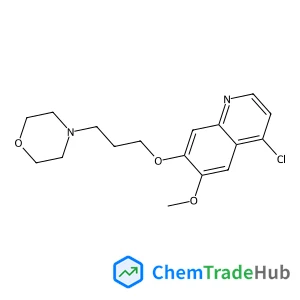
4-(3-((4-Chloro-6-methoxyquinolin-7-yl)oxy)propyl)morpholine
CAS Number:
205448-32-4
Molecular Formula:
C17H21ClN2O3
Yonghang Xu, Shuanjin Wang, Limiao Lin, Min Xiao, Yuezhong Meng
Novel semi-crystalline terpolymers with varying chain sequence structures derived from cyclohexene oxide (CHO), CO2 and ε-caprolactone (CL) have been firstly synthesized and reported. The terpolymerization is catalyzed by Schiff base tri-zinc complexes via a one-step route. The tri-zinc complexes also exhibit a very high catalytic activity for the homopolymerization of ε-caprolactone in the absence of CHO. A series of terpolymers with varying content of crystalline segments are produced by adjusting the feedstock ratio of CHO/ε-CL. The reactivity of different monomers was investigated by experimental methodology. The results indicate that ε-CL is much more active than CHO in this terpolymerization system. Therefore, the incorporation of ε-CL can dramatically improve the TONs of terpolymer containing ε-CL moieties. Moreover, the thermal properties of the resulting terpolymers were also studied by DSC and TGA. Finally, the polymerization mechanism of this ternary system is extensively discussed based on experimental phenomena. To the best of our knowledge, this is the first report on novel catalysts capable of synthesizing polycarbonates, polyesters and poly (carbonate-ester) via a one-step polymerization.

Environmental Toxicology and Pharmacology

Lab on a Chip

Foundations of Chemistry

European Journal of Organic Chemistry

Advanced Engineering Materials

Contact Lens & Anterior Eye

Mini-Reviews in Medicinal Chemistry

Journal of Medical Biochemistry

Current Pharmaceutical Biotechnology

Angewandte Chemie International Edition
Saumyakanti Khatua, Haifeng Yuan, Michel Orrit
DOI: 10.1039/C4CP03057E
Ning Zhang, Jinwen Shi, Fujun Niu, Jian Wang, Liejin Guo
DOI: 10.1039/C5CP02983J
Saravanan Kuppan, Hugues Duncan, Guoying Chen
DOI: 10.1039/C5CP04899K
J. Kozuch, N. Petrusch, U. Gernert, I. M. Weidinger
DOI: 10.1039/C4CP05015K
Akira Yamakata, Hirofumi Shimizu, Shigetoshi Oiki
DOI: 10.1039/C5CP02681D
Farshid Pashaee, Faranak Sharifi, Giovanni Fanchini, François Lagugné-Labarthet
DOI: 10.1039/C4CP05252H
Kosuke Sugawa, Tsuyoshi Akiyama, Yoshimasa Tanoue, Takashi Harumoto, Sayaka Yanagida, Atsuo Yasumori, Shohei Tomita, Joe Otsuki
DOI: 10.1039/C4CP05058D
Hai-Chou Chang, Jyh-Chiang Jiang, Meng-Hsiu Kuo, Ding-Tsai Hsu, Sheng Hsien Lin
DOI: 10.1039/C4CP04768K
Antonello Filippi, Caterina Fraschetti, Felice Grandinetti, Maurizio Speranza, Aurora Ponzi, Piero Decleva
DOI: 10.1039/C5CP01471A
Wenliang Wang, Chen Zhang, Zhongjie Du, Jianguo Mi
DOI: 10.1039/C5CP03915K
2-(2-Chloroacetamido)-3-phenylpropanoic acid (CAS: 7765-11-9) is generally consi...
2-(Benzyloxy)-5-bromobenzoic acid can be handled safely if appropriate precautio...
(4-Methyl-1,2,5-oxadiazol-3-yl)methanamine hydrochloride is a chemical compound ...
2-(5-Hexylthiophen-2-yl)-4,4,5,5-tetramethyl-1,3,2-dioxaborolane (CAS: 917985-54...
While 4-(8-Methyl-9H-1,3-dioxolo[4,5-h][2,3]benzodiazepin-5-yl)benzenamine (CAS:...
The market for tert-butyl 3-hydroxy-4,5,7,8-tetrahydro-2H-pyrazolo[3,4-d]azepine...
Waste containing 3,5-Diamino-1H-pyrazole-4-carbonitrile (CAS: 6844-58-2) should ...
(6-Fluoro-3-pyridinyl)boronic acid can be synthesized through the reaction of 6-...
Dibenzyl carbonimidoylbiscarbamate (CAS: 10065-79-9) finds applications in vario...
The market for (beta,beta,2,3,4,5,6-~2~H_7_)Phenylalanine (CAS: 74228-83-4) is g...

Polymer Chemistry welcomes submissions in all areas of polymer science that have a strong focus on macromolecular chemistry. Manuscripts may cover a broad range of fields, yet no direct application focus is required.