












Inherent flame retardation of semi-aromatic polyesters via binding small-molecule free radicals and charring
Literature Information
Publication Date
2016-01-19
DOI
10.1039/C5PY01938A
Impact Factor
5.582
Authors
Teng Fu, De-Ming Guo, Jia-Ning Wu, Xiao-Lin Wang, Xiu-Li Wang, Li Chen, Yu-Zhong Wang
View Original
Abstract
Inherent flame-retardant semi-aromatic polyesters, containing special aryl ether and/or ketone structures (“Ar–CO–Ar”, “Ar–O–Ar”, “Ar–O–Ar–O–Ar” or “Ar–O–Ar–CO–Ar–O–Ar”) were synthesized successfully. Interestingly, these polyesters show different flame retardancy beyond our traditional knowledge that more benzene rings are beneficial to flame retardancy. The polyester containing “Ar–O–Ar–O–Ar” shows excellent flame retardancy, whose LOI value reaches 34.1% and the UL-94 rating is V-0. Meanwhile, the polyester with the “Ar–O–Ar–CO–Ar–O–Ar” structure does not perform expectedly well (31.6% and V-2 rating respectively). In order to make clear the effect of aryl ether and/or ketone structure units on the flame retardancy, the pyrolysis behaviours and the char residue are investigated by Py-GC/MS, TGA, and SEM. In the TGA test, the char residues of polyesters containing “Ar–CO–Ar”, “Ar–O–Ar” “Ar–O–Ar–O–Ar” or “Ar–O–Ar–CO–Ar–O–Ar” are 31.6%, 22.5%, 30.6% or 38.7%, respectively. These values do not match with the calculated results, which indicate that some special reactions occur during combustion. Furthermore, these polyesters show a common initial pyrolysis pathway and subsequent unique processes in the Py-GC/MS test. Their pyrolysis intermediate products can bind small-molecule free radicals, and eventually form different conjugated aromatic structures. In this way, inherent flame-retardant polyesters are obtained even without any traditional flame-retardant elements. And their flame retardant performance has great relationship with the amount of char formation, the microstructure of char, and the chemical structure of pyrolysis products.
Related Literature
Probing the mechanism of CO2 capture in diamine-appended metal–organic frameworks using measured and simulated X-ray spectroscopy
Walter S. Drisdell, Roberta Poloni, Thomas M. McDonald, Tod A. Pascal, Liwen F. Wan, C. Das Pemmaraju, Bess Vlaisavljevich, Samuel O. Odoh, Jeffrey B. Neaton, David Prendergast, Jeffrey B. Kortright
2015-07-23
Paper
DOI: 10.1039/C5CP02951A
Particle size dependence of the surface-enhanced Raman scattering properties of densely arranged two-dimensional assemblies of Au(core)–Ag(shell) nanospheres
Kosuke Sugawa, Tsuyoshi Akiyama, Yoshimasa Tanoue, Takashi Harumoto, Sayaka Yanagida, Atsuo Yasumori, Shohei Tomita, Joe Otsuki
2014-12-19
Paper
DOI: 10.1039/C4CP05058D
Polypeptide A9K at nanoscale carbon: a simulation study
Vitaly V. Chaban, Andre Arruda, Eudes Eterno Fileti
2015-09-08
Paper
DOI: 10.1039/C5CP04565G
Specific ion effects on the hydrophobic interaction of benzene self-assembled monolayers
S. Dobberschütz, M. Rimmen, T. Hassenkam, M. P. Andersson, S. L. S. Stipp
2015-07-22
Paper
DOI: 10.1039/C5CP01803J
CTAB micelles assisted rGO–AgNP hybrids for SERS detection of polycyclic aromatic hydrocarbons
Meng Jiang, Zhijiang Qian, Xufeng Zhou, Xing Xin, Jinghua Wu, Chao Chen, Gongjun Zhang, Gaojie Xu, Yuchuan Cheng
2014-11-28
Paper
DOI: 10.1039/C4CP04888A
The catalyzed hydrogen sorption mechanism in alkali alanates
Züleyha Özlem Kocabas Atakli, Shin-Ichi Orimo
2015-07-13
Paper
DOI: 10.1039/C5CP01684C
A cocatalyst-free Eosin Y-sensitized p-type of Co3O4 quantum dot for highly efficient and stable visible-light-driven water reduction and hydrogen production
Ning Zhang, Jinwen Shi, Fujun Niu, Jian Wang, Liejin Guo
2015-07-20
Communication
DOI: 10.1039/C5CP02983J
Preparation of a silver nanoparticle-based dual-functional sensor using a complexation–reduction method
Shao-Jung Wu, Wen-Qi Zhong, Cheng-Yu Huang
2015-01-20
Paper
DOI: 10.1039/C4CP05012F
Controlling side reactions and self-discharge in high-voltage spinel cathodes: the critical role of surface crystallographic facets
Saravanan Kuppan, Hugues Duncan, Guoying Chen
2015-09-08
Paper
DOI: 10.1039/C5CP04899K
Wavelength resolved specific optical rotations and homochiral equilibria
P. L. Polavarapu, C. L. Covington
2015-07-24
Paper
DOI: 10.1039/C5CP01834J
You might also like
Compound Q&A
Is 2-(2-chloroacetamido)-3-phenylpropanoic acid (CAS: 7765-11-9) safe?
2-(2-Chloroacetamido)-3-phenylpropanoic acid (CAS: 7765-11-9) is generally consi...
7765-11-92-(2-chloroacetamido...
Compound Q&A
Is 2-(Benzyloxy)-5-bromobenzoic acid (CAS: 62176-31-2) safe?
2-(Benzyloxy)-5-bromobenzoic acid can be handled safely if appropriate precautio...
62176-31-22-(Benzyloxy)-5-brom...
Compound Q&A
What is (4-Methyl-1,2,5-oxadiazol-3-yl)methanamine hydrochloride (CAS: 1159825-48-5)?
(4-Methyl-1,2,5-oxadiazol-3-yl)methanamine hydrochloride is a chemical compound ...
1159825-48-5(4-Methyl-1,2,5-oxad...
Compound Q&A
What is 2-(5-Hexylthiophen-2-yl)-4,4,5,5-tetramethyl-1,3,2-dioxaborolane (CAS: 917985-54-7)?
2-(5-Hexylthiophen-2-yl)-4,4,5,5-tetramethyl-1,3,2-dioxaborolane (CAS: 917985-54...
917985-54-72-(5-Hexylthiophen-2...
Compound Q&A
Are there alternatives to 4-(8-Methyl-9H-1,3-dioxolo[4,5-h][2,3]benzodiazepin-5-yl)benzenamine (CAS: 102771-26-6) in synthesis?
While 4-(8-Methyl-9H-1,3-dioxolo[4,5-h][2,3]benzodiazepin-5-yl)benzenamine (CAS:...
102771-26-64-(8-Methyl-9H-1,3-d...
Compound Q&A
What is the market or research trend for tert-butyl 3-hydroxy-4,5,7,8-tetrahydro-2H-pyrazolo[3,4-d]azepine-6-carboxylate (CAS: 851376-80-2)?
The market for tert-butyl 3-hydroxy-4,5,7,8-tetrahydro-2H-pyrazolo[3,4-d]azepine...
851376-80-2tert-butyl 3-hydroxy...
Compound Q&A
How should waste containing 3,5-Diamino-1H-pyrazole-4-carbonitrile (CAS: 6844-58-2) be handled?
Waste containing 3,5-Diamino-1H-pyrazole-4-carbonitrile (CAS: 6844-58-2) should ...
6844-58-23,5-Diamino-1H-pyraz...
Compound Q&A
How is (6-Fluoro-3-pyridinyl)boronic acid (CAS: 351019-18-6) typically synthesized?
(6-Fluoro-3-pyridinyl)boronic acid can be synthesized through the reaction of 6-...
351019-18-6(6-Fluoro-3-pyridiny...
Compound Q&A
What industries use Dibenzyl carbonimidoylbiscarbamate (CAS: 10065-79-9)?
Dibenzyl carbonimidoylbiscarbamate (CAS: 10065-79-9) finds applications in vario...
10065-79-9Dibenzyl carbonimido...
Compound Q&A
What is the market or research trend for (beta,beta,2,3,4,5,6-~2~H_7_)Phenylalanine (CAS: 74228-83-4)?
The market for (beta,beta,2,3,4,5,6-~2~H_7_)Phenylalanine (CAS: 74228-83-4) is g...
74228-83-4(beta,beta,2,3,4,5,6...
Source Journal
Polymer Chemistry

CiteScore:
8.6
Self-citation Rate:
7.3%
Articles per Year:
457
Polymer Chemistry welcomes submissions in all areas of polymer science that have a strong focus on macromolecular chemistry. Manuscripts may cover a broad range of fields, yet no direct application focus is required.
Recommended Compounds
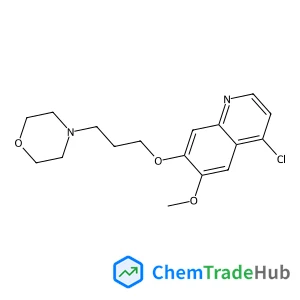
4-(3-((4-Chloro-6-methoxyquinolin-7-yl)oxy)propyl)morpholine
CAS Number:
205448-32-4
Molecular Formula:
C17H21ClN2O3
![(4-Methyl-1H-benzo[d]imidazol-2-yl)methanamine structure](https://static.chemtradehub.com/structs/933/933756-31-1-7b0b.webp "(4-Methyl-1H-benzo[d]imidazol-2-yl)methanamine structure")
Recommended Suppliers




Disclaimer
This page provides academic journal information for reference and research purposes only. We are not affiliated with any journal publishers and do not handle publication submissions. For publication-related inquiries, please contact the respective journal publishers directly.
If you notice any inaccuracies in the information displayed, please contact us at support@chemtradehub.com. We will promptly review and address your concerns.