


Direct observation of surface isocyanate (NCO) formation during the CO+NO reaction on Pt{100}
Literature Information
Publication Date
DOI
10.1039/A905548G
Impact Factor
3.676
Authors
View Original
Abstract
The NO+CO reaction on Pt{100} has been studied using in-situ vibrational spectroscopy (IRAS) under low reaction rate, non-oscillatory conditions. Using a total pressure of 7.5×10⁻⁷ mbar and a NO:CO ratio of 2:1, isocyanate (NCO) formation, characterised by an infrared absorption band at 2180 cm-1, is observed over a narrow temperature range, 400–380 K. We propose that NCO formation becomes favourable once the concentration of N atoms on the surface is low and, more importantly, when the diffusion of these atoms becomes severely hindered by the high coverage of CO. The stability of the NCO, above its normal dissociation temperature, is due to the vacant site requirement for the dissociation reaction. The fact that recombination to NCO occurs, after dissociation at 453 K, and in the absence of gas phase NO, indicates that the diffusion of N atoms is hindered even at this higher temperature.
Recommended Journals

Bioorganic & Medicinal Chemistry

NDT & E International

Journal of the Indian Institute of Science

Main Group Chemistry

Critical Reviews in Solid State and Materials Sciences

Journal of Asian Natural Products Research

Heteroatom Chemistry

Journal of Chemical Sciences

Polycyclic Aromatic Compounds

Colloid Journal
Related Literature
Swollen micelles and alcohol–surfactant co-adsorption: structures and mechanisms from liquid- and solid-state 1H–1H NMR spectroscopy
Christian Totland, Anne Marit Blokhus
2017-02-23
Paper
DOI: 10.1039/C6CP08506G
Remote-control of the enantiomeric supramolecular recognition mediated by chiral azobenzenes bound to human serum albumin
M. Deiana, S. G. Mucha, L. M. Mazur, K. Pawlik, P. Mlynarz, M. Samoc, K. Matczyszyn
2017-07-20
Communication
DOI: 10.1039/C7CP03336B
Advances in spectroscopy and dynamics of small and medium sized molecules and clusters
2017-07-10
Perspective
DOI: 10.1039/C7CP01980G
Co-assembly behaviour of Janus nanoparticles and amphiphilic block copolymers in dilute solution
Qing Li, Liquan Wang, Jiaping Lin
2017-08-11
Paper
DOI: 10.1039/C7CP04501H
Recognition of chiral zwitterionic interactions at nanoscale interfaces by chiroplasmonic nanosensors
Wenjing Zhao, Rong-Yao Wang, Hong Wei, Jingliang Li, Yinglu Ji, Xinxin Jiang, Xiaochun Wu, Xiangdong Zhang
2017-06-01
Paper
DOI: 10.1039/C7CP03004E
Controllable decomposition of Ca(BH4)2 for reversible hydrogen storage
D. Rentsch, A. Remhof
2017-02-20
Paper
DOI: 10.1039/C7CP00448F
Experimental and theoretical studies on fluvastatin primary photoproduct formation
Dorota Jarmużek, Marcin Hoffmann, Tomasz Siodła, Kinga Salus, Donata Pluskota-Karwatka
2017-06-16
Paper
DOI: 10.1039/C7CP01094J
Compositional phase diagram and microscopic mechanism of Ba1−xCaxZryTi1−yO3 relaxor ferroelectrics
Shi-Yu Liu, Yang Meng, Shiyang Liu, De-Jun Li, Yaping Li, Yingdi Liu, Yaogen Shen, Sanwu Wang
2017-07-27
Paper
DOI: 10.1039/C7CP04530A
Mechanistic insights into the catalytic reaction of ferulic acid decarboxylase from Aspergillus niger: a QM/MM study
Ge Tian, Yongjun Liu
2017-02-20
Paper
DOI: 10.1039/C6CP08811B
Modulation of in:out and out:out conformations in [X.X′.X′′] phosphatranes by Lewis acids
Goar Sánchez-Sanz, Cristina Trujillo, Ibon Alkorta, José Elguero
2017-07-07
Paper
DOI: 10.1039/C7CP03661B
You might also like
Compound Q&A
What are the main uses of 4-Nitrophenyl phosphate disodium salt hexahydrate (CAS: 333338-18-4)?
4-Nitrophenyl phosphate disodium salt hexahydrate is primarily used as a substra...
333338-18-44-Nitrophenyl phosph...
Compound Q&A
What are the main uses of 2-(Trifluoromethyl)-1,3-oxazole-4-carboxylic Acid (CAS: 1060816-01-4)?
2-(Trifluoromethyl)-1,3-oxazole-4-carboxylic Acid (CAS: 1060816-01-4) is widely ...
1060816-01-42-(Trifluoromethyl)-...
Compound Q&A
How should 2-Fluoro-4-biphenylcarboxylic acid (CAS: 137045-30-8) be stored?
2-Fluoro-4-biphenylcarboxylic acid should be stored in a cool, dry place at room...
137045-30-82-Fluoro-4-biphenylc...
Compound Q&A
What industries use Prednisolone-21-Carboxylic Acid (CAS: 61549-70-0)?
Prednisolone-21-Carboxylic Acid is primarily used in the pharmaceutical industry...
61549-70-0Prednisolone-21-Carb...
Compound Q&A
How should 4-(Hydrazinomethyl)-1,2,3-benzenetriol (CAS: 3614-72-0) be stored?
4-(Hydrazinomethyl)-1,2,3-benzenetriol (CAS: 3614-72-0) should be stored in a co...
3614-72-04-(Hydrazinomethyl)-...
Compound Q&A
What industries use 4-Amino-1-methyl-1H-pyrazole-5-carboxylic acid hydrochloride (CAS: 92534-70-8)?
4-Amino-1-methyl-1H-pyrazole-5-carboxylic acid hydrochloride (CAS: 92534-70-8) i...
92534-70-84-Amino-1-methyl-1H-...
Compound Q&A
What regulatory guidelines apply to dehydropachymic acid (CAS: 77012-31-8)?
Dehydropachymic acid (CAS: 77012-31-8) is regulated by various agencies. It fall...
77012-31-8Dehydropachymic acid
Compound Q&A
What is the market or research trend for 6-[(2,2-Dimethylpropanoyl)amino]nicotinic acid (CAS: 898561-66-5)?
The market and research trends for 6-[(2,2-Dimethylpropanoyl)amino]nicotinic aci...
898561-66-56-[(2,2-Dimethylprop...
Compound Q&A
How should 1,10-Phenanthroline-2,9-dicarbaldehyde (CAS: 57709-62-3) be stored?
1,10-Phenanthroline-2,9-dicarbaldehyde should be stored in a cool, dry place awa...
57709-62-31,10-Phenanthroline-...
Compound Q&A
How is 5-Carbamoyl-11-oxo-10,11-dihydro-5H-dibenzo[b,f]azepin-10-yl acetate (CAS: 113952-21-9) typically synthesized?
5-Carbamoyl-11-oxo-10,11-dihydro-5H-dibenzo[b,f]azepin-10-yl acetate can be synt...
113952-21-95-Carbamoyl-11-oxo-1...
Source Journal
Physical Chemistry Chemical Physics

CiteScore:
5.5
Self-citation Rate:
10.3%
Articles per Year:
3036
Physical Chemistry Chemical Physics (PCCP) is an international journal co-owned by 19 physical chemistry and physics societies from around the world. This journal publishes original, cutting-edge research in physical chemistry, chemical physics and biophysical chemistry. To be suitable for publication in PCCP, articles must include significant innovation and/or insight into physical chemistry; this is the most important criterion that reviewers and Editors will judge against when evaluating submissions. The journal has a broad scope and welcomes contributions spanning experiment, theory, computation and data science. Topical coverage includes spectroscopy, dynamics, kinetics, statistical mechanics, thermodynamics, electrochemistry, catalysis, surface science, quantum mechanics, quantum computing and machine learning. Interdisciplinary research areas such as polymers and soft matter, materials, nanoscience, energy, surfaces/interfaces, and biophysical chemistry are welcomed if they demonstrate significant innovation and/or insight into physical chemistry. Joined experimental/theoretical studies are particularly appreciated when complementary and based on up-to-date approaches.
Recommended Compounds
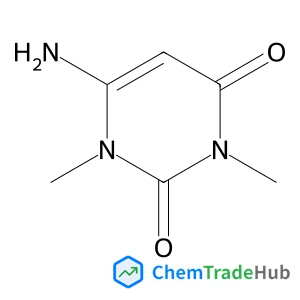
6-amino-1,3-dimethyl-1,2,3,4-tetrahydropyrimidine-2,4-dione
CAS Number:
6642-31-5
Molecular Formula:
C6H9N3O2
Recommended Suppliers




Disclaimer
This page provides academic journal information for reference and research purposes only. We are not affiliated with any journal publishers and do not handle publication submissions. For publication-related inquiries, please contact the respective journal publishers directly.
If you notice any inaccuracies in the information displayed, please contact us at support@chemtradehub.com. We will promptly review and address your concerns.