













Advances in spectroscopy and dynamics of small and medium sized molecules and clusters
Literature Information
Publication Date
2017-07-10
DOI
10.1039/C7CP01980G
Impact Factor
3.676
Authors
View Original
Abstract
Investigations of the spectroscopy and dynamics of small- and medium-sized molecules and clusters represent a hot topic in atmospheric chemistry, biology, physics, atto- and femto-chemistry and astrophysics. Nowadays, outstanding developments, both theoretical and experimental, have been achieved. The most recent results of these achievements are reviewed here. These molecular systems are studied by means of high-resolution spectroscopic techniques in either the frequency or the time domains. However, they still represent complex molecular systems since they may undergo processes that are still not fully understood in sufficient details. Indeed, electronic and nuclear motions may lead to complex features that are observed experimentally. From a theoretical point of view, these features can only be interpreted if the quantum nature of the atomic nuclei is considered together with the possible couplings between nuclear and electronic degrees of freedom. New developments, from both theoretical and experimental sides, are needed for modeling and engineering applications of outstanding importance. Possible future research directions are discussed.
Related Literature
Self-assembly and functionalization of alternating copolymer vesicles
Chuanlong Li, Chuanshuang Chen, Shanlong Li, Tahir Rasheed, Ping Huang, Tong Huang, Yinglin Zhang, Wei Huang, Yongfeng Zhou
2017-07-10
Paper
DOI: 10.1039/C7PY00908A
Synthesis and characterization of bead-like poly(N-isopropylacrylamide) copolymers with double decker silsesquioxane in the main chains
Kun Wei, Lei Wang, Lei Li, Sixun Zheng
2014-09-22
Paper
DOI: 10.1039/C4PY00786G
Amphiphilic dendrons with a pyrene functional group at the focal point: synthesis, self-assembly and generation-dependent DNA condensation
Yi Han, Bo Zhu, Ying Chen, Zhishan Bo, Yulan Chen
2017-07-26
Paper
DOI: 10.1039/C7PY01052D
Poly(acrylamide-homocysteine thiolactone) as a synthetic platform for the preparation of polymeric ionic liquids by post ring-opening-orthogonal modifications
Silvia Montolio, Oleksandr Zagorodko, Raúl Porcar, M. Isabel Burguete, Santiago V. Luis, Heikki Tenhu
2017-07-19
Paper
DOI: 10.1039/C7PY01067B
Long-subchain Janus-dendritic copolymers from locally confined click reaction and generation-dependent micro-phase separation
Peng-Yun Li, Jia-Min Li, Lian-Wei Li, Xiao-Dong Ye, Wei-Dong He
2017-06-06
Paper
DOI: 10.1039/C7PY00551B
Correction: Thermoresponsive gels directly obtained via visible light-mediated polymerization-induced self-assembly with oxygen tolerance
Kaixuan Ren
2017-06-05
Correction
DOI: 10.1039/C7PY90088K
Poly(glycerol sebacate) nanoparticles for encapsulation of hydrophobic anti-cancer drugs
Benoit Louage, Liesa Tack, Yadong Wang, Bruno G. De Geest
2017-01-31
Paper
DOI: 10.1039/C6PY02192A
Stereochemical effects on the mechanical and viscoelastic properties of renewable polyurethanes derived from isohexides and hydroxymethylfurfural
Robert J. Kieber, III, Samantha A. Silver, Justin G. Kennemur
2017-07-24
Paper
DOI: 10.1039/C7PY00949F
You might also like
Compound Q&A
What are the main uses of 4-Nitrophenyl phosphate disodium salt hexahydrate (CAS: 333338-18-4)?
4-Nitrophenyl phosphate disodium salt hexahydrate is primarily used as a substra...
333338-18-44-Nitrophenyl phosph...
Compound Q&A
What are the main uses of 2-(Trifluoromethyl)-1,3-oxazole-4-carboxylic Acid (CAS: 1060816-01-4)?
2-(Trifluoromethyl)-1,3-oxazole-4-carboxylic Acid (CAS: 1060816-01-4) is widely ...
1060816-01-42-(Trifluoromethyl)-...
Compound Q&A
How should 2-Fluoro-4-biphenylcarboxylic acid (CAS: 137045-30-8) be stored?
2-Fluoro-4-biphenylcarboxylic acid should be stored in a cool, dry place at room...
137045-30-82-Fluoro-4-biphenylc...
Compound Q&A
What industries use Prednisolone-21-Carboxylic Acid (CAS: 61549-70-0)?
Prednisolone-21-Carboxylic Acid is primarily used in the pharmaceutical industry...
61549-70-0Prednisolone-21-Carb...
Compound Q&A
How should 4-(Hydrazinomethyl)-1,2,3-benzenetriol (CAS: 3614-72-0) be stored?
4-(Hydrazinomethyl)-1,2,3-benzenetriol (CAS: 3614-72-0) should be stored in a co...
3614-72-04-(Hydrazinomethyl)-...
Compound Q&A
What industries use 4-Amino-1-methyl-1H-pyrazole-5-carboxylic acid hydrochloride (CAS: 92534-70-8)?
4-Amino-1-methyl-1H-pyrazole-5-carboxylic acid hydrochloride (CAS: 92534-70-8) i...
92534-70-84-Amino-1-methyl-1H-...
Compound Q&A
What regulatory guidelines apply to dehydropachymic acid (CAS: 77012-31-8)?
Dehydropachymic acid (CAS: 77012-31-8) is regulated by various agencies. It fall...
77012-31-8Dehydropachymic acid
Compound Q&A
What is the market or research trend for 6-[(2,2-Dimethylpropanoyl)amino]nicotinic acid (CAS: 898561-66-5)?
The market and research trends for 6-[(2,2-Dimethylpropanoyl)amino]nicotinic aci...
898561-66-56-[(2,2-Dimethylprop...
Compound Q&A
How should 1,10-Phenanthroline-2,9-dicarbaldehyde (CAS: 57709-62-3) be stored?
1,10-Phenanthroline-2,9-dicarbaldehyde should be stored in a cool, dry place awa...
57709-62-31,10-Phenanthroline-...
Compound Q&A
How is 5-Carbamoyl-11-oxo-10,11-dihydro-5H-dibenzo[b,f]azepin-10-yl acetate (CAS: 113952-21-9) typically synthesized?
5-Carbamoyl-11-oxo-10,11-dihydro-5H-dibenzo[b,f]azepin-10-yl acetate can be synt...
113952-21-95-Carbamoyl-11-oxo-1...
Source Journal
Physical Chemistry Chemical Physics

CiteScore:
5.5
Self-citation Rate:
10.3%
Articles per Year:
3036
Physical Chemistry Chemical Physics (PCCP) is an international journal co-owned by 19 physical chemistry and physics societies from around the world. This journal publishes original, cutting-edge research in physical chemistry, chemical physics and biophysical chemistry. To be suitable for publication in PCCP, articles must include significant innovation and/or insight into physical chemistry; this is the most important criterion that reviewers and Editors will judge against when evaluating submissions. The journal has a broad scope and welcomes contributions spanning experiment, theory, computation and data science. Topical coverage includes spectroscopy, dynamics, kinetics, statistical mechanics, thermodynamics, electrochemistry, catalysis, surface science, quantum mechanics, quantum computing and machine learning. Interdisciplinary research areas such as polymers and soft matter, materials, nanoscience, energy, surfaces/interfaces, and biophysical chemistry are welcomed if they demonstrate significant innovation and/or insight into physical chemistry. Joined experimental/theoretical studies are particularly appreciated when complementary and based on up-to-date approaches.
Recommended Compounds
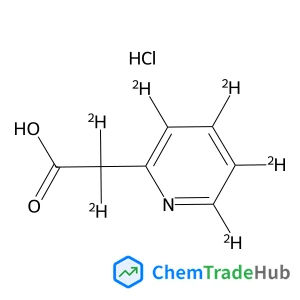
2,2-dideuterio-2-(3,4,5,6-tetradeuterio-2-pyridyl)acetic acid;hydrochloride
CAS Number:
1329799-67-8
Molecular Formula:
C7H2ClD6NO2


Recommended Suppliers





Disclaimer
This page provides academic journal information for reference and research purposes only. We are not affiliated with any journal publishers and do not handle publication submissions. For publication-related inquiries, please contact the respective journal publishers directly.
If you notice any inaccuracies in the information displayed, please contact us at support@chemtradehub.com. We will promptly review and address your concerns.