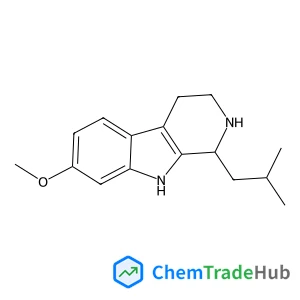
1-Isobutyl-7-methoxy-2,3,4,9-tetrahydro-1H-beta-carboline
CAS Number:
175975-76-5
Molecular Formula:
C16H22N2O
Sheila N. Baker, T. Mark McCleskey, Siddharth Pandey, Gary A. Baker
Using the single tryptophan residue in the sweet protein monellin as a spectroscopic handle, we show the extreme thermodynamic stabilization offered by an ionic liquid; Tun ∼ 105 °C in [C4mpy][Tf2N] compared to 40 °C in bulk water.
Brendan L. Darby, Pablo G. Etchegoin, Eric C. Le Ru
DOI: 10.1039/C4CP03422H
Thomas J. Penfold, Maarten Nachtegaal, Chris J. Milne, Majed Chergui
DOI: 10.1039/C4CP03301A
Yuesheng Wang, Pin Liu, Lin Gu, Yong-Sheng Hu, Hong Li, George P. Demopoulos, Liquan Chen
DOI: 10.1039/C4CP02957G
Natcha Injan, Jakkapan Sirijaraensre
DOI: 10.1039/C4CP02728K
Athira K. V. Raj, P. Prabhakar Rao, T. S. Sreena, S. Sameera, Vineetha James, U. A. Renju
DOI: 10.1039/C4CP03311F
Mohammad Farkhondeh, Mark Pritzker, Michael Fowler, Mohammadhosein Safari, Charles Delacourt
DOI: 10.1039/C4CP03530E
Marie Humbert-Droz, Patric Oulevey, Latévi Max Lawson Daku, Sandra Luber, Hans Hagemann, Thomas Bürgi
DOI: 10.1039/C4CP02145B
Yong-Lei Wang
DOI: 10.1039/C4CP03077J
Shoshi Terada, Toshihiko Mandai, Risa Nozawa, Kazuki Yoshida, Kazuhide Ueno, Seiji Tsuzuki, Masayoshi Watanabe
DOI: 10.1039/C4CP00746H
N-(4-Methoxybenzyl)-2-pyridinamine (CAS: 52818-63-0) is increasingly being used ...
When handling Ethyl 4-(2-chlorophenyl)-1,3-thiazole-2-carboxylate, appropriate p...
Diethyldiselane (CAS: 628-39-7) is classified under the Globally Harmonized Syst...
The market for oxocopper (CAS: 12053-18-8) is primarily driven by its use in cat...
The market for 5-{[(2-Methyl-2-propanyl)oxy]carbonyl}-5-azaspiro[2.4]heptane-7-c...
2-(1-Pyrrolidinyl)-4-pyridinamine is a chemical compound with the CAS number 359...
2-(3-Pyridinyl)-1-azabicyclo[2.2.2]octane (CAS: 91556-75-1) is a crystalline sol...
(S)-Alpha-allyl-proline hydrochloride is usually synthesized via a Wittig reacti...
3-Methyl-1,2-oxazole-5-carboxylic acid (CAS: 4857-42-5) is an organic compound w...
Lys-SMCC-DM1 is synthesized via a multi-step process involving the coupling of S...

ChemComm publishes urgent research which is of outstanding significance and interest to experts in the field, while also appealing to the journal’s broad chemistry readership. Our communication format is ideally suited to short, urgent studies that are of such importance that they require accelerated publication. Our scope covers all topics in chemistry, and research at the interface of chemistry and other disciplines (such as materials science, nanoscience, physics, engineering and biology) where there is a significant novelty in the chemistry aspects. Major topic areas covered include: Analytical Chemistry Catalysis Chemical Biology and medicinal chemistry Computational Chemistry and Machine Learning Energy and sustainable chemistry Environmental Chemistry Green Chemistry Inorganic Chemistry Materials Chemistry Nanoscience Organic Chemistry Physical Chemistry Polymer Chemistry Supramolecular Chemistry