


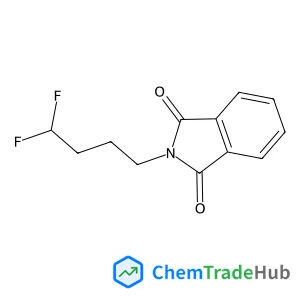
2-(4,4-Difluorobutyl)-1H-isoindole-1,3(2H)-dione
CAS Number:
1265341-14-7
Molecular Formula:
C12H11F2NO2
Lu-Yu Yan, Tian-Zhen Zhang, Ze-Zhong Lv, Ming-Chen Fu
The development of novel radical precursors for the preparation of structurally diverse gem-difluoroalkenes is still in great demand, especially those enabled by metal-free catalysis. In this context, a metal-free photoinduced method for the synthesis of gem-difluoroalkenes was established, in which various carbonyl derivatives were successfully used as alkyl radical precursors via C–C bond cleavage to react with available α-trifluoromethylstyrenes. In particular, the successful gram-scale synthesis and late-stage modification for biologically active molecules highlights their potential value in drug discovery.

Journal of Medical Biochemistry

Angewandte Chemie International Edition

Current Pharmaceutical Biotechnology

Molecular Diversity

Contact Lens & Anterior Eye

CrystEngComm

Journal of Enzyme inhibition and Medicinal Chemistry

Environmental Toxicology and Pharmacology

Photochemical & Photobiological Sciences

Mini-Reviews in Medicinal Chemistry
Hong-Guang Xu, Wei-Jun Zheng, Jun Li
DOI: 10.1039/C3CP54478H
Ioannis Skarmoutsos, Tom Welton, Patricia A. Hunt
DOI: 10.1039/C3CP54551B
Matthias Vonderach, Marc-Oliver Winghart, Luke MacAleese, Fabien Chirot, Rodolphe Antoine, Philippe Dugourd, Patrick Weis
DOI: 10.1039/C3CP54596B
Fengqiao Zhang, Dong Zhu, Xi'an Chen, Xin Xu, Zhi Yang, Chao Zou, Keqin Yang, Shaoming Huang
DOI: 10.1039/C3CP54334J
Zahid Farooq, Dimitri A. Chestakov, Bin Yan, Gerrit C. Groenenboom, Wim J. van der Zande, David H. Parker
DOI: 10.1039/C3CP54696A
Ying Wang, Blake J. Plowman, Kristina Tschulik, Kristopher R. Ward, Robert G. Palgrave, Christine Damm, Richard G. Compton
DOI: 10.1039/C3CP55306J
Helmuth Möhwald, Kenneth Suslick
DOI: 10.1039/C3CP52850B
Elijah G. Schnitzler, Wolfgang Jäger
DOI: 10.1039/C3CP54486A
Yunxi Yao, D. Wayne Goodman
DOI: 10.1039/C3CP54997F
Sudip K. Saha, Asim Guchhait, Amlan J. Pal
DOI: 10.1039/C3CP52227J
N-(4-Methoxybenzyl)-2-pyridinamine (CAS: 52818-63-0) is increasingly being used ...
When handling Ethyl 4-(2-chlorophenyl)-1,3-thiazole-2-carboxylate, appropriate p...
Diethyldiselane (CAS: 628-39-7) is classified under the Globally Harmonized Syst...
The market for oxocopper (CAS: 12053-18-8) is primarily driven by its use in cat...
The market for 5-{[(2-Methyl-2-propanyl)oxy]carbonyl}-5-azaspiro[2.4]heptane-7-c...
2-(1-Pyrrolidinyl)-4-pyridinamine is a chemical compound with the CAS number 359...
2-(3-Pyridinyl)-1-azabicyclo[2.2.2]octane (CAS: 91556-75-1) is a crystalline sol...
(S)-Alpha-allyl-proline hydrochloride is usually synthesized via a Wittig reacti...
3-Methyl-1,2-oxazole-5-carboxylic acid (CAS: 4857-42-5) is an organic compound w...
Lys-SMCC-DM1 is synthesized via a multi-step process involving the coupling of S...

Organic Chemistry Frontiers publishes high-quality research from across organic chemistry. Emphases are placed on studies that make significant contributions to the field of organic chemistry by reporting either new or significantly improved protocols or methodologies. Topics include, but are not limited to the following: Organic synthesis Development of synthetic methodologies Catalysis Natural products Functional organic materials Supramolecular and macromolecular chemistry Physical and computational organic chemistry
![1-(1-Benzyl-1,2,3,6-tetrahydropyridin-4-yl)-1H-benzo[d]imidazol-2(3H)-one structure](https://static.chemtradehub.com/structs/603/60373-71-9-7dfb.webp "1-(1-Benzyl-1,2,3,6-tetrahydropyridin-4-yl)-1H-benzo[d]imidazol-2(3H)-one structure")
![1-oxaspiro[4.4]nonan-6-one structure](https://static.chemtradehub.com/structs/134/134179-01-4-e051.webp "1-oxaspiro[4.4]nonan-6-one structure")


