


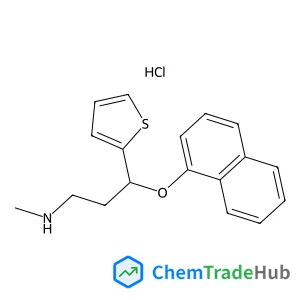
N-Methyl-3-(1-naphthyloxy)-3-(2-thienyl)-1-propanamine hydrochloride (1:1)
CAS Number:
1188266-11-6
Molecular Formula:
C18H20ClNOS
Zahid Farooq, Dimitri A. Chestakov, Bin Yan, Gerrit C. Groenenboom, Wim J. van der Zande, David H. Parker
Photodissociation of singlet oxygen, O2 a1Δg, by ultraviolet radiation in the region from 200 to 240 nm has been investigated using velocity map imaging of the atomic oxygen photofragments. Singlet oxygen molecules are generated in a pulsed discharge and studied by one-laser photodissociation and detection around 226 nm as well as two color photodissociation at various wavelengths in the range from 200 to 240 nm. A simple model of the discharge on and off signal indicates efficient conversion of O2 X3Σg−(v = 0) in the parent beam to O2 a1Δg(v = 0–2). Minute amounts of highly excited vibrational levels of ground state O2 X3Σg−(v > 0) are detected but no evidence is found for production of the O2 b1Σg+ state. Over the decreasing wavelength range 240–200 nm the a1Δg-state signal relative to the X3Σg−(v = 0) signal decreases strongly. Around 226 nm the a1Δg(v = 0–2) states averaged branching ratio percentage for O(3Pjj = 2 : 1 : 0) is found to be 56 : 36 : 8 (±5%), respectively. The anisotropy parameter for photodissociation of a1Δg(v = 0–2) averages to β = 1.3 ± 0.4. The a1Δg(v = 0) photodissociation cross section is found to 3–10 times stronger than theory predicts. Furthermore, the photodissociation image shows a strong parallel character, (i.e., transition moment parallel to the molecular axis) while theory predicts a predominantly negative character.

Acta Metallurgica Sinica-English Letters

Biocatalysis and Biotransformation

NDT & E International

Critical Reviews in Solid State and Materials Sciences

Herald of the Russian Academy of Sciences

Chinese Journal of Chemistry

Cellulose

Journal of Asian Natural Products Research

Polycyclic Aromatic Compounds

Main Group Chemistry
Ying-Feng Han, Yue-Jian Lin, Wei-Guo Jia, Guo-Liang Wang, Guo-Xin Jin
DOI: 10.1039/B717554J
Curtis J. Rieder, Ryan J. Fradette, F. G. West
DOI: 10.1039/B800800K
Alejandro Díaz-Moscoso, Patricia Balbuena, Marta Gómez-García, Carmen Ortiz Mellet, Juan M. Benito, Loïc Le Gourriérec, Christophe Di Giorgio, Pierre Vierling, Antonino Mazzaglia, Norberto Micali, Jacques Defaye, José M. García Fernández
DOI: 10.1039/B718672J
Werner Fudickar, Torsten Linker
DOI: 10.1039/B719637G
Shik Chi Tsang, Stan Golunski, Paul Collier
DOI: 10.1039/B718956G
Rui Wen, Hong-Xia Zhang, Cun-Ji Yan, Hui-Juan Yan, Ge-Bo Pan, Li-Jun Wan
DOI: 10.1039/B719888D
Elisa Biavardi, Gionata Battistini, Marco Montalti, Roger M. Yebeutchou, Luca Prodi, Enrico Dalcanale
DOI: 10.1039/B801729H
Suk-Wah Tam-Chang, Liming Huang
DOI: 10.1039/B714319B
N-(4-Methoxybenzyl)-2-pyridinamine (CAS: 52818-63-0) is increasingly being used ...
When handling Ethyl 4-(2-chlorophenyl)-1,3-thiazole-2-carboxylate, appropriate p...
Diethyldiselane (CAS: 628-39-7) is classified under the Globally Harmonized Syst...
The market for oxocopper (CAS: 12053-18-8) is primarily driven by its use in cat...
The market for 5-{[(2-Methyl-2-propanyl)oxy]carbonyl}-5-azaspiro[2.4]heptane-7-c...
2-(1-Pyrrolidinyl)-4-pyridinamine is a chemical compound with the CAS number 359...
2-(3-Pyridinyl)-1-azabicyclo[2.2.2]octane (CAS: 91556-75-1) is a crystalline sol...
(S)-Alpha-allyl-proline hydrochloride is usually synthesized via a Wittig reacti...
3-Methyl-1,2-oxazole-5-carboxylic acid (CAS: 4857-42-5) is an organic compound w...
Lys-SMCC-DM1 is synthesized via a multi-step process involving the coupling of S...

Physical Chemistry Chemical Physics (PCCP) is an international journal co-owned by 19 physical chemistry and physics societies from around the world. This journal publishes original, cutting-edge research in physical chemistry, chemical physics and biophysical chemistry. To be suitable for publication in PCCP, articles must include significant innovation and/or insight into physical chemistry; this is the most important criterion that reviewers and Editors will judge against when evaluating submissions. The journal has a broad scope and welcomes contributions spanning experiment, theory, computation and data science. Topical coverage includes spectroscopy, dynamics, kinetics, statistical mechanics, thermodynamics, electrochemistry, catalysis, surface science, quantum mechanics, quantum computing and machine learning. Interdisciplinary research areas such as polymers and soft matter, materials, nanoscience, energy, surfaces/interfaces, and biophysical chemistry are welcomed if they demonstrate significant innovation and/or insight into physical chemistry. Joined experimental/theoretical studies are particularly appreciated when complementary and based on up-to-date approaches.
![1,10-bis(3,5-dimethylphenyl)-12-hydroxy-4,5,6,7-tetrahydroiindeno[7,1-de:1',7'-fg][1,3,2]dioxaphosphocine 12-oxide structure](https://static.chemtradehub.com/structs/141/1412439-82-7-b9a9.webp "1,10-bis(3,5-dimethylphenyl)-12-hydroxy-4,5,6,7-tetrahydroiindeno[7,1-de:1',7'-fg][1,3,2]dioxaphosphocine 12-oxide structure")



