












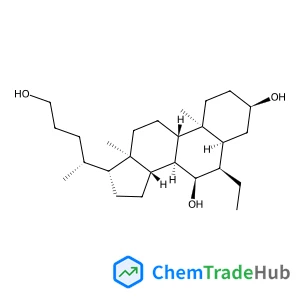
(3alpha,5beta,6alpha,7alpha)-6-Ethylcholane-3,7,24-triol
CAS Number:
1537866-49-1
Molecular Formula:
C26H46O3
Sudip K. Saha, Asim Guchhait, Amlan J. Pal
We report the formation and characterization of hybrid pn-junction solar cells based on a layer of copper diffused silver indium disulfide (AgInS2@Cu) nanoparticles and another layer of copper phthalocyanine (CuPc) molecules. With copper diffusion in the nanocrystals, their optical absorption and hence the activity of the hybrid pn-junction solar cells was extended towards the near-IR region. To decrease the particle-to-particle separation for improved carrier transport through the inorganic layer, we replaced the long-chain ligands of copper-diffused nanocrystals in each monolayer with short-ones. Under illumination, the hybrid pn-junctions yielded a higher short-circuit current as compared to the combined contribution of the Schottky junctions based on the components. A wider depletion region at the interface between the two active layers in the pn-junction device as compared to that of the Schottky junctions has been considered to analyze the results. Capacitance–voltage characteristics under a dark condition supported such a hypothesis. We also determined the width of the depletion region in the two layers separately so that a pn-junction could be formed with a tailored thickness of the two materials. Such a “fully-depleted” device resulted in an improved photovoltaic performance, primarily due to lessening of the internal resistance of the hybrid pn-junction solar cells.
Junwon Kim, Hye-Young Park, Jaeseung Kim, Jiyoung Ryu, Do Yoon Kwon, Regis Grailhe, Rita Song
DOI: 10.1039/B719434J
Wellington Pham, Lauren Cassell, Amelie Gillman, Dmitry Koktysh, John C. Gore
DOI: 10.1039/B719028J
Ali Abou Hassan, Olivier Sandre, Valérie Cabuil, Patrick Tabeling
DOI: 10.1039/B719550H
Shinobu Takizawa, Tomomi Katayama, Chiaki Kameyama, Kiyotaka Onitsuka, Takeyuki Suzuki, Takeshi Yanagida, Tomoji Kawai, Hiroaki Sasai
DOI: 10.1039/B717068H
Shik Chi Tsang, Stan Golunski, Paul Collier
DOI: 10.1039/B718956G
You-Rim Yoon, Yong-beom Lim, Eunji Lee, Myongsoo Lee
DOI: 10.1039/B719868J
Jian Zhang, Xianhui Bu
DOI: 10.1039/B719368H
N-(4-Methoxybenzyl)-2-pyridinamine (CAS: 52818-63-0) is increasingly being used ...
When handling Ethyl 4-(2-chlorophenyl)-1,3-thiazole-2-carboxylate, appropriate p...
Diethyldiselane (CAS: 628-39-7) is classified under the Globally Harmonized Syst...
The market for oxocopper (CAS: 12053-18-8) is primarily driven by its use in cat...
The market for 5-{[(2-Methyl-2-propanyl)oxy]carbonyl}-5-azaspiro[2.4]heptane-7-c...
2-(1-Pyrrolidinyl)-4-pyridinamine is a chemical compound with the CAS number 359...
2-(3-Pyridinyl)-1-azabicyclo[2.2.2]octane (CAS: 91556-75-1) is a crystalline sol...
(S)-Alpha-allyl-proline hydrochloride is usually synthesized via a Wittig reacti...
3-Methyl-1,2-oxazole-5-carboxylic acid (CAS: 4857-42-5) is an organic compound w...
Lys-SMCC-DM1 is synthesized via a multi-step process involving the coupling of S...

Physical Chemistry Chemical Physics (PCCP) is an international journal co-owned by 19 physical chemistry and physics societies from around the world. This journal publishes original, cutting-edge research in physical chemistry, chemical physics and biophysical chemistry. To be suitable for publication in PCCP, articles must include significant innovation and/or insight into physical chemistry; this is the most important criterion that reviewers and Editors will judge against when evaluating submissions. The journal has a broad scope and welcomes contributions spanning experiment, theory, computation and data science. Topical coverage includes spectroscopy, dynamics, kinetics, statistical mechanics, thermodynamics, electrochemistry, catalysis, surface science, quantum mechanics, quantum computing and machine learning. Interdisciplinary research areas such as polymers and soft matter, materials, nanoscience, energy, surfaces/interfaces, and biophysical chemistry are welcomed if they demonstrate significant innovation and/or insight into physical chemistry. Joined experimental/theoretical studies are particularly appreciated when complementary and based on up-to-date approaches.
![1,10-bis(3,5-dimethylphenyl)-12-hydroxy-4,5,6,7-tetrahydroiindeno[7,1-de:1',7'-fg][1,3,2]dioxaphosphocine 12-oxide structure](https://static.chemtradehub.com/structs/141/1412439-82-7-b9a9.webp "1,10-bis(3,5-dimethylphenyl)-12-hydroxy-4,5,6,7-tetrahydroiindeno[7,1-de:1',7'-fg][1,3,2]dioxaphosphocine 12-oxide structure")
![N-{15-[(2,5-Dioxo-1-pyrrolidinyl)oxy]-15-oxo-3,6,9,12-tetraoxapentadec-1-yl}-2-(2-propyn-1-yloxy)acetamide structure](https://static.chemtradehub.com/structs/210/2101206-92-0-2eb5.webp "N-{15-[(2,5-Dioxo-1-pyrrolidinyl)oxy]-15-oxo-3,6,9,12-tetraoxapentadec-1-yl}-2-(2-propyn-1-yloxy)acetamide structure")






