












Conformer-selective photoelectron spectroscopy of α-lactalbumin derived multianions in the gas phase
Literature Information
Publication Date
2013-12-12
DOI
10.1039/C3CP54596B
Impact Factor
3.676
Authors
Matthias Vonderach, Marc-Oliver Winghart, Luke MacAleese, Fabien Chirot, Rodolphe Antoine, Philippe Dugourd, Patrick Weis
View Original
Abstract
We have recorded conformer-selective, gas-phase photoelectron spectra of α-lactalbumin derived multianions generated by electrospraying solutions of both the native protein and its denatured form (as prepared by breaking the sulfur–sulfur bonds by chemical reduction). Three different groups of gas-phase multianion conformers have been observed and characterized. Highly-folded and partially-unfolded structures are obtained from solutions of the native protein. Only highly-elongated conformers are observed upon electrospraying the denatured protein. Adiabatic detachment energies were determined at several negative charge states for each conformer group. In comparison to highly-elongated conformations, highly-folded structures show a steeper decrease of electron binding energy with increasing negative charge. By comparing experimental detachment energies for highly-elongated structures with the predictions of a simple electrostatic model calculation, we have determined the effective dielectric shielding constant.
Recommended Journals
Related Literature
Chromonic liquid crystals: properties and applications as functional materials
Suk-Wah Tam-Chang, Liming Huang
2008-01-07
Feature Article
DOI: 10.1039/B714319B
Photoinduced CO release, cellular uptake and cytotoxicity of a tris(pyrazolyl)methane (tpm) manganese tricarbonyl complex
Johanna Niesel, Antonio Pinto, Harmel W. Peindy N'Dongo, Klaus Merz, Ingo Ott, Ronald Gust, Ulrich Schatzschneider
2008-02-08
Communication
DOI: 10.1039/B719075A
Benzo[1,2-b:4,5-b′]bis[b]benzothiophene as solution processible organic semiconductor for field-effect transistors
Peng Gao, Dirk Beckmann, Hoi Nok Tsao, Xinliang Feng, Volker Enkelmann, Wojciech Pisula, Klaus Müllen
2008-01-25
Communication
DOI: 10.1039/B717608B
Controlled regio- and chemoselective addition of isothiocyanate to the dione moiety of a cage-opened fullerene-mixed peroxide derivative
Zheming Wang
2008-02-25
Communication
DOI: 10.1039/B800722E
Cobalt promoted copper manganese oxide catalysts for ambient temperature carbon monoxide oxidation
Christopher Jones, Stuart H. Taylor, Andrew Burrows, Mandy J. Crudace, Christopher J. Kiely, Graham J. Hutchings
2008-02-01
Communication
DOI: 10.1039/B800052M
A novel mediator–polymer-modified anode for microbial fuel cells
Masanori Adachi, Tatsuo Shimomura, Makoto Komatsu, Hiroshi Yakuwa, Akiko Miya
2008-02-20
Communication
DOI: 10.1039/B717773A
Stabilization of cobalt oxyhydrate superconductor
Zhi Ren, Cao Wang, Xiang-fan Xu, Guang-han Cao, Zhu-an Xu, Yu-heng Zhang
2008-03-03
Communication
DOI: 10.1039/B800378E
A highly efficient and selective turn-on fluorescent sensor for Cu2+ ion based on calix[4]arene bearing four iminoquinoline subunits on the upper rim
Chuan-Feng Chen, Zhi-Tang Huang
2008-02-14
Communication
DOI: 10.1039/B800258D
A practical demonstration of electronic promotion in the reduction of ceria coated PGM catalysts
Shik Chi Tsang, Stan Golunski, Paul Collier
2008-02-18
Communication
DOI: 10.1039/B718956G
Chiral dinuclear vanadium(v) catalysts for oxidative coupling of 2-naphthols‡
Shinobu Takizawa, Tomomi Katayama, Chiaki Kameyama, Kiyotaka Onitsuka, Takeyuki Suzuki, Takeshi Yanagida, Tomoji Kawai, Hiroaki Sasai
2008-02-14
Communication
DOI: 10.1039/B717068H
You might also like
Compound Q&A
What is the market or research trend for N-(4-Methoxybenzyl)-2-pyridinamine (CAS: 52818-63-0)?
N-(4-Methoxybenzyl)-2-pyridinamine (CAS: 52818-63-0) is increasingly being used ...
52818-63-0N-(4-Methoxybenzyl)-...
Compound Q&A
What precautions should be taken when handling Ethyl 4-(2-chlorophenyl)-1,3-thiazole-2-carboxylate (CAS: 1050507-06-6)?
When handling Ethyl 4-(2-chlorophenyl)-1,3-thiazole-2-carboxylate, appropriate p...
1050507-06-6Ethyl 4-(2-chlorophe...
Compound Q&A
What regulatory guidelines apply to diethyldiselane (CAS: 628-39-7)?
Diethyldiselane (CAS: 628-39-7) is classified under the Globally Harmonized Syst...
628-39-7Diethyldiselane
Compound Q&A
What is the market or research trend for oxocopper (CAS: 12053-18-8)?
The market for oxocopper (CAS: 12053-18-8) is primarily driven by its use in cat...
12053-18-8oxocopper; oxo-(oxoc...
Compound Q&A
What is the market or research trend for 5-{[(2-Methyl-2-propanyl)oxy]carbonyl}-5-azaspiro[2.4]heptane-7-carboxylic acid?
The market for 5-{[(2-Methyl-2-propanyl)oxy]carbonyl}-5-azaspiro[2.4]heptane-7-c...
1268519-54-55-{[(2-Methyl-2-prop...
Compound Q&A
What is 2-(1-Pyrrolidinyl)-4-pyridinamine (CAS: 35981-63-6)?
2-(1-Pyrrolidinyl)-4-pyridinamine is a chemical compound with the CAS number 359...
35981-63-62-(1-Pyrrolidinyl)-4...
Compound Q&A
What are the physical and chemical properties of 2-(3-Pyridinyl)-1-azabicyclo[2.2.2]octane (CAS: 91556-75-1)?
2-(3-Pyridinyl)-1-azabicyclo[2.2.2]octane (CAS: 91556-75-1) is a crystalline sol...
91556-75-12-(3-Pyridinyl)-1-az...
Compound Q&A
How is (S)-Alpha-allyl-proline hydrochloride (CAS: 129704-91-2) typically synthesized?
(S)-Alpha-allyl-proline hydrochloride is usually synthesized via a Wittig reacti...
129704-91-2(S)-Alpha-allyl-prol...
Compound Q&A
What is 3-Methyl-1,2-oxazole-5-carboxylic acid (CAS: 4857-42-5)?
3-Methyl-1,2-oxazole-5-carboxylic acid (CAS: 4857-42-5) is an organic compound w...
4857-42-53-Methyl-1,2-oxazole...
Compound Q&A
How is Lys-SMCC-DM1 (CAS: 1281816-04-3) typically synthesized?
Lys-SMCC-DM1 is synthesized via a multi-step process involving the coupling of S...
1281816-04-3Lys-SMCC-DM1
Source Journal
Physical Chemistry Chemical Physics

CiteScore:
5.5
Self-citation Rate:
10.3%
Articles per Year:
3036
Physical Chemistry Chemical Physics (PCCP) is an international journal co-owned by 19 physical chemistry and physics societies from around the world. This journal publishes original, cutting-edge research in physical chemistry, chemical physics and biophysical chemistry. To be suitable for publication in PCCP, articles must include significant innovation and/or insight into physical chemistry; this is the most important criterion that reviewers and Editors will judge against when evaluating submissions. The journal has a broad scope and welcomes contributions spanning experiment, theory, computation and data science. Topical coverage includes spectroscopy, dynamics, kinetics, statistical mechanics, thermodynamics, electrochemistry, catalysis, surface science, quantum mechanics, quantum computing and machine learning. Interdisciplinary research areas such as polymers and soft matter, materials, nanoscience, energy, surfaces/interfaces, and biophysical chemistry are welcomed if they demonstrate significant innovation and/or insight into physical chemistry. Joined experimental/theoretical studies are particularly appreciated when complementary and based on up-to-date approaches.
Recommended Compounds
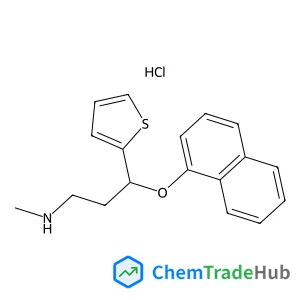
N-Methyl-3-(1-naphthyloxy)-3-(2-thienyl)-1-propanamine hydrochloride (1:1)
CAS Number:
1188266-11-6
Molecular Formula:
C18H20ClNOS
Recommended Suppliers






Disclaimer
This page provides academic journal information for reference and research purposes only. We are not affiliated with any journal publishers and do not handle publication submissions. For publication-related inquiries, please contact the respective journal publishers directly.
If you notice any inaccuracies in the information displayed, please contact us at support@chemtradehub.com. We will promptly review and address your concerns.