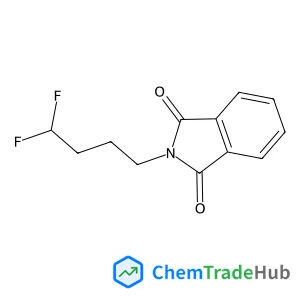
2-(4,4-Difluorobutyl)-1H-isoindole-1,3(2H)-dione
CAS Number:
1265341-14-7
Molecular Formula:
C12H11F2NO2
Cyler W. Vos, James Beament, Christopher M. Kozak
The diamino-bis(phenolate) chromium(III) complex, CrCl[L], 1 where [L] = dimethylaminoethylamino-N,N-bis(2-methylene-4,6-tert-butylphenolate) when pre-contacted with cocatalyst, bis(triphenylphosphine)iminium chloride, formed the bis(triphenylphosphine)iminium chromium(III) dichloride ate complex, 2. Complex 2 shows good activity for the ring-opening polymerization (ROP) of rac-lactide (rac-LA) and ε-caprolactone (ε-CL), ring-opening copolymerization (ROCOP) of cyclohexene oxide (CHO) and phthalic anhydride (PA), ROCOP of epoxides and CO2, and synthesis of terpolymers containing polylactide or polycaprolactone, polycarbonate, and polyester segments. For example, polyester-b-polycarbonates can be obtained through controlled ROCOP of PA and CHO, giving moderate molar mass polymers with narrow dispersity (e.g. Mn = 8.7 kg mol−1 and Đ = Mw/Mn = 1.14), followed by addition of CO2 to generate polycarbonate chains and an increase in Mn to 17.6 kg mol−1 with Đ = 1.13.

Israel Journal of Chemistry

Proceedings of the National Academy of Sciences of the United States of America

Pharmacological Reviews

Nature

Organic Preparations and Procedures International

Science Progress

Pure and Applied Chemistry

Journal of Physics and Chemistry of Solids

Journal of Catalysis

European Journal of Wood and Wood Products
DOI: 10.1039/JA9860100293
Leonie Deilmann, Oliver Winter, Bianca Cerrutti, Henrik Bradtmüller, Christopher Herzig, Andreas Limbeck, Olaf Lahayne, Christian Hellmich, Dominik Eder
DOI: 10.1039/C9TB01805K
Stefanie Kirschbaum-Harriman, Michael Mayer, Axel Duerkop, Thomas Hirsch
DOI: 10.1039/C7AN00261K
Ionut Tranca, Xin Zhou, Can Li
DOI: 10.1039/C5TA02193F
Bernadette Byrne, Sergei G. Kazarian
DOI: 10.1039/D1AN00087J
Tuanwei Liu, Jingjing Hu, Xiaoye Ma, Bing Kong, Jilan Wang, Zhide Zhang, Dian-Shun Guo, Xinlin Yang
DOI: 10.1039/C7TB01715D
Ding-Kun Ji, Yi Zang, Wang Liu, Xiongwen Zhang, Jia Li, Guo-Rong Chen, Tony D. James, Xiao-Peng He
DOI: 10.1039/C5TB02057C
Chandu V. V. Muralee Gopi, Araveeti Eswar Reddy, Hee-Je Kim
DOI: 10.1039/C8TA01141A
Imali A. Mudunkotuwa, Alaa Al Minshid, Vicki H. Grassian
DOI: 10.1039/C3AN01684F
Fang Li, Xiuming Wu, Mengmeng Gu, Guang-Li Wang
DOI: 10.1039/D0AN02438D
N-(4-Methoxybenzyl)-2-pyridinamine (CAS: 52818-63-0) is increasingly being used ...
When handling Ethyl 4-(2-chlorophenyl)-1,3-thiazole-2-carboxylate, appropriate p...
Diethyldiselane (CAS: 628-39-7) is classified under the Globally Harmonized Syst...
The market for oxocopper (CAS: 12053-18-8) is primarily driven by its use in cat...
The market for 5-{[(2-Methyl-2-propanyl)oxy]carbonyl}-5-azaspiro[2.4]heptane-7-c...
2-(1-Pyrrolidinyl)-4-pyridinamine is a chemical compound with the CAS number 359...
2-(3-Pyridinyl)-1-azabicyclo[2.2.2]octane (CAS: 91556-75-1) is a crystalline sol...
(S)-Alpha-allyl-proline hydrochloride is usually synthesized via a Wittig reacti...
3-Methyl-1,2-oxazole-5-carboxylic acid (CAS: 4857-42-5) is an organic compound w...
Lys-SMCC-DM1 is synthesized via a multi-step process involving the coupling of S...

Polymer Chemistry welcomes submissions in all areas of polymer science that have a strong focus on macromolecular chemistry. Manuscripts may cover a broad range of fields, yet no direct application focus is required.