












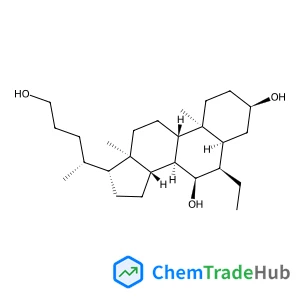
(3alpha,5beta,6alpha,7alpha)-6-Ethylcholane-3,7,24-triol
CAS Number:
1537866-49-1
Molecular Formula:
C26H46O3
Stefanie Kirschbaum-Harriman, Michael Mayer, Axel Duerkop, Thomas Hirsch
We present studies on ruthenium-based electrochemiluminescence (ECL) focusing on conditions supporting signal enhancement and low oxidation potentials. Low oxidation potentials (LOPs) are especially attractive for miniaturized ECL biosensors, as microfabricated electrodes tend to detach from their support when used with high currents and operated at high potentials. Furthermore, high potentials or current densities can lead to damage of typical biosensor surface coatings and biological probes. The possibility of generating LOP ECL signals at a potential below 900 mV was therefore studied for Ru(bpy)32+ with two typical coreactants, i.e. 2-(dibutylamino)ethanol (DBAE) and tripropylamine (TPA), as well as with the tertiary amine N-butyldiethanolamine (NBEA). Furthermore, the effect of buffer components and pH values on ECL signal generation was investigated. We could show a significant LOP ECL signal for NBEA. We found that Tris buffer, with its ability to form complexes with transition metal ions, has a positive influence on this ECL signal in terms of signal strength and LOP capabilities. Specifically, at basic pH values significant increases in ECL signals were observed at 900 mV and at 1.2 V. In fact, the ECL signal at 1.2 V was three times higher than the signal observed in phosphate buffer at a pH of 7, and it was thirty times higher than the ECL signal for TPA under these conditions. The LOP signal for NBEA in Tris buffer at pH 8.5 was similar to the signal obtained for TPA in phosphate buffer at pH 8.5 but three times higher than for TPA at pH 7.0. Interestingly, the coreactant DBAE was neither significantly influenced by the buffer system or pH nor did it present a valuable LOP ECL signal. Finally, it was found that high peak currents in cyclic voltammograms are not the indicators for high ECL signals, which should be obvious because the ECL mechanism requires more complex electron transfers. Overall, the standard TPA ECL at 1.2 V in phosphate buffer at pH 7.0 can successfully be replaced by NBEA ECL at 900 mV in Tris at pH 8.5 providing significantly higher signals accompanied by more gentle electrochemical conditions.
Olaf Köhler, Oliver Seitz
DOI: 10.1039/B308299G
Sheng Qin Xia, Jia Hong Zhou, Jing Rong Chen, Xue Song Wang, Bao Wen Zhang
DOI: 10.1039/B309024H
Catherine Dendrinou-Samara, Curtis M. Zaleski, Andri Evagorou, Jeff W. Kampf, Vincent L. Pecoraro, Dimitris P. Kessissoglou
DOI: 10.1039/B309439A
Sònia Abelló, Francisco Medina, Xavier Rodríguez, Yolanda Cesteros, Pilar Salagre, Jesús E. Sueiras, Didier Tichit, Bernard Coq
DOI: 10.1039/B401448K
Yan Zhao, Bryce Sadtler, Min Lin, Gregory H. Hockerman, Alexander Wei
DOI: 10.1039/B317061F
Mitsuo Kawasaki, Satoshi Aoyama
DOI: 10.1039/B400071D
Gregor Mali, Francis Taulelle
DOI: 10.1039/B316807G
David C. Harrowven, Nathalie L'Helias, Jonathan D. Moseley, Nigel J. Blumire, Stuart R. Flanagan
DOI: 10.1039/B309496K
Narendra N. Ghosh, Jason C. Clark, Geoffrey T. Eldridge, Craig E. Barnes
DOI: 10.1039/B316184F
Roger R. Hill, Sharon A. Moore, David R. Roberts
DOI: 10.1039/B308525B
N-(4-Methoxybenzyl)-2-pyridinamine (CAS: 52818-63-0) is increasingly being used ...
When handling Ethyl 4-(2-chlorophenyl)-1,3-thiazole-2-carboxylate, appropriate p...
Diethyldiselane (CAS: 628-39-7) is classified under the Globally Harmonized Syst...
The market for oxocopper (CAS: 12053-18-8) is primarily driven by its use in cat...
The market for 5-{[(2-Methyl-2-propanyl)oxy]carbonyl}-5-azaspiro[2.4]heptane-7-c...
2-(1-Pyrrolidinyl)-4-pyridinamine is a chemical compound with the CAS number 359...
2-(3-Pyridinyl)-1-azabicyclo[2.2.2]octane (CAS: 91556-75-1) is a crystalline sol...
(S)-Alpha-allyl-proline hydrochloride is usually synthesized via a Wittig reacti...
3-Methyl-1,2-oxazole-5-carboxylic acid (CAS: 4857-42-5) is an organic compound w...
Lys-SMCC-DM1 is synthesized via a multi-step process involving the coupling of S...

Analyst publishes analytical and bioanalytical research that reports premier fundamental discoveries and inventions, and the applications of those discoveries, unconfined by traditional discipline barriers.
![1,10-bis(3,5-dimethylphenyl)-12-hydroxy-4,5,6,7-tetrahydroiindeno[7,1-de:1',7'-fg][1,3,2]dioxaphosphocine 12-oxide structure](https://static.chemtradehub.com/structs/141/1412439-82-7-b9a9.webp "1,10-bis(3,5-dimethylphenyl)-12-hydroxy-4,5,6,7-tetrahydroiindeno[7,1-de:1',7'-fg][1,3,2]dioxaphosphocine 12-oxide structure")
![(2R,6S)-6-[(Benzyloxy)methyl]-4-{[(2-methyl-2-propanyl)oxy]carbonyl}-2-morpholinecarboxylic acid structure](https://static.chemtradehub.com/structs/109/1093085-91-6-3382.webp "(2R,6S)-6-[(Benzyloxy)methyl]-4-{[(2-methyl-2-propanyl)oxy]carbonyl}-2-morpholinecarboxylic acid structure")





