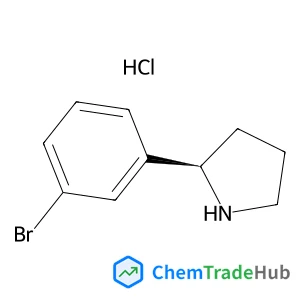
(2R)-2-(3-Bromophenyl)pyrrolidine hydrochloride (1:1)
CAS Number:
1391550-13-2
Molecular Formula:
C10H13BrClN
Twinkal Patel, Junyoung Park, Zhibin Ye, Hyunhyub Ko, Hyun Wook Jung, Jung Kwon Oh
Covalent adaptive networks (CANs) crosslinked with dynamic covalent bonds, particularly hindered urea bonds (HUBs), have gained significant attention in the development of advanced materials exhibiting self-healability and reprocessability for various applications. Multifunctional crosslinkers bearing bulky t-butylamino groups, as small molecules or macromolecules, have been incorporated into the fabrication of dynamic HUB-based CAN materials. Herein, we report a well-defined polymethacrylate homopolymer (PM) bearing t-butylamino pendants as a multifunctional bulky amine crosslinker synthesized by a controlled radical polymerization. The polyaddition of the synthesized PM with polyisocyanate and polyamine allows for the fabrication of dynamic poly(hindered urea) (PHU) networks crosslinked through the formation of reversible HUBs. Their structure–property relationship and self-healing mechanism are explored with varying amounts of PM crosslinker. The fabricated PM-PHU hybrid networks designed with excess t-butylamino pendants (e.g., more PM) exhibit rapid void-filling and network relaxation with lower activation energy, even though they possess higher mechanical strength, thus leading to excellent reprocessability with high recovery of tensile/mechanical properties upon many recycles. Our work demonstrates that the design of multifunctional polymeric crosslinkers bearing t-butylamino pendants is a promising strategy for the development of advanced HUB-based hybrid network materials with improved reprocessability.
Andrew T. Bender, Benjamin P. Sullivan, Jane Y. Zhang, David C. Juergens, Lorraine Lillis, David S. Boyle
DOI: 10.1039/D0AN02483J
Stefanie Kirschbaum-Harriman, Michael Mayer, Axel Duerkop, Thomas Hirsch
DOI: 10.1039/C7AN00261K
Mustafa Nigde, Ismail Agir, Rıdvan Yıldırım, Ibrahim Isildak
DOI: 10.1039/D1AN01754C
Yaping Zhou, Hongling Yan, Qingji Xie, Siyu Huang, Jiali Liu, Zou Li, Ming Ma
DOI: 10.1039/C3AN01437A
DOI: 10.1039/D0AN02400G
H. Schulze, G. Henihan, A. Hardie, I. Ciani, G. Giraud, J. G. Terry, A. J. Walton, R. Pethig, P. Ghazal, K. E. Templeton, A. R. Mount, T. T. Bachmann
DOI: 10.1039/C3AN01319G
Long Chuan Zhang, Yu Meng Yang, Ling Liang, Yong Jian Jiang, Chun Mei Li, Yuan Fang Li, Lei Zhan, Hong Yan Zou
DOI: 10.1039/D1AN02147H
Fang Li, Xiuming Wu, Mengmeng Gu, Guang-Li Wang
DOI: 10.1039/D0AN02438D
Manuel Otter, Gabriel Partl, Michael Noisternig, Rania Bakry
DOI: 10.1039/D1AN02005F
Yue-Ming Yu, Yuan-Yuan Niu, Ling-Yang Wang, Zhi-Yong Wu, Cui-Wei Yan
DOI: 10.1039/D1AN00171J
N-(4-Methoxybenzyl)-2-pyridinamine (CAS: 52818-63-0) is increasingly being used ...
When handling Ethyl 4-(2-chlorophenyl)-1,3-thiazole-2-carboxylate, appropriate p...
Diethyldiselane (CAS: 628-39-7) is classified under the Globally Harmonized Syst...
The market for oxocopper (CAS: 12053-18-8) is primarily driven by its use in cat...
The market for 5-{[(2-Methyl-2-propanyl)oxy]carbonyl}-5-azaspiro[2.4]heptane-7-c...
2-(1-Pyrrolidinyl)-4-pyridinamine is a chemical compound with the CAS number 359...
2-(3-Pyridinyl)-1-azabicyclo[2.2.2]octane (CAS: 91556-75-1) is a crystalline sol...
(S)-Alpha-allyl-proline hydrochloride is usually synthesized via a Wittig reacti...
3-Methyl-1,2-oxazole-5-carboxylic acid (CAS: 4857-42-5) is an organic compound w...
Lys-SMCC-DM1 is synthesized via a multi-step process involving the coupling of S...

Polymer Chemistry welcomes submissions in all areas of polymer science that have a strong focus on macromolecular chemistry. Manuscripts may cover a broad range of fields, yet no direct application focus is required.