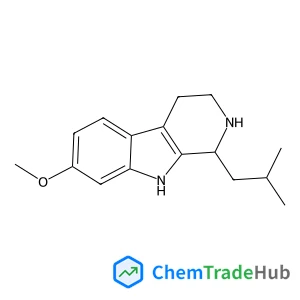
1-Isobutyl-7-methoxy-2,3,4,9-tetrahydro-1H-beta-carboline
CAS Number:
175975-76-5
Molecular Formula:
C16H22N2O
Manfred Wagner, Christine Rosenauer, Jinhuo Dai, Priya Subramanian, Alasdair McKay, Jasper J. Michels, Tanja Junkers
Diffusion-ordered NMR spectroscopy (DOSY) allows for solvent-independent molecular weight calibration with low lab variability. Methyl methacrylate standards have been used to calibrate DOSY data for various solvents. Following the Stokes–Einstein equation, a high correlation of the data was obtained when the viscosity of the solvent was taken into account. Moreover, the inter-laboratory and inter-polymer consistency was confirmed by using the pMMA calibration obtained on an NMR system in Germany, which was applied to polystyrene diffusion coefficients that were obtained in Australia. Furthermore, the molecular weight of polymers with added complexity, such as block copolymers, is determined with diffusion data. Butyl acrylate (BA), methyl acrylate (MA), PEG methyl ether acrylate (PEGMEA) and MMA are used as building blocks to synthesize the block copolymers. Firstly, DOSY calibration curves are prepared for the synthesized homopolymers pBA and pPEGMEA. Then, the diffusion data are compared to block copolymers with different compositions of pBA-b-pMA, pBA-b-pPEGMEA and pMMA-b-pPEGMEA and an accurate determination of the molecular weight of the block copolymers could be achieved using the homopolymer calibration curves.

Science

Pure and Applied Chemistry

Molecular Pharmacology

Journal of Organometallic Chemistry

Proceedings of the National Academy of Sciences of the United States of America

Israel Journal of Chemistry

Helvetica Chimica Acta

Science Progress

European Journal of Wood and Wood Products

Journal of Medicinal Chemistry
Qi Li, Guangshe Li, Chaochao Fu, Dong Luo, Jianming Fan, Dongjiu Xie, Liping Li
DOI: 10.1039/C5TA00929D
Fan Huang, Kersti Karu, Luiza C. Campos
DOI: 10.1039/D0AN02335C
Long Chuan Zhang, Yu Meng Yang, Ling Liang, Yong Jian Jiang, Chun Mei Li, Yuan Fang Li, Lei Zhan, Hong Yan Zou
DOI: 10.1039/D1AN02147H
Jianwen Hou, Runhai Chen, Zhirong Xin, Hengchong Shi, Shing-Chung Wong, Jinghua Yin, Qiang Shi
DOI: 10.1039/C6TB03385G
Dipankar Das, Rabiul Alam
DOI: 10.1039/D1AN01788H
DOI: 10.1039/C8TB90176G
Juan Ouyang, Lihe Sun, Fang Zeng, Shuizhu Wu
DOI: 10.1039/D1AN02183D
N-(4-Methoxybenzyl)-2-pyridinamine (CAS: 52818-63-0) is increasingly being used ...
When handling Ethyl 4-(2-chlorophenyl)-1,3-thiazole-2-carboxylate, appropriate p...
Diethyldiselane (CAS: 628-39-7) is classified under the Globally Harmonized Syst...
The market for oxocopper (CAS: 12053-18-8) is primarily driven by its use in cat...
The market for 5-{[(2-Methyl-2-propanyl)oxy]carbonyl}-5-azaspiro[2.4]heptane-7-c...
2-(1-Pyrrolidinyl)-4-pyridinamine is a chemical compound with the CAS number 359...
2-(3-Pyridinyl)-1-azabicyclo[2.2.2]octane (CAS: 91556-75-1) is a crystalline sol...
(S)-Alpha-allyl-proline hydrochloride is usually synthesized via a Wittig reacti...
3-Methyl-1,2-oxazole-5-carboxylic acid (CAS: 4857-42-5) is an organic compound w...
Lys-SMCC-DM1 is synthesized via a multi-step process involving the coupling of S...

Polymer Chemistry welcomes submissions in all areas of polymer science that have a strong focus on macromolecular chemistry. Manuscripts may cover a broad range of fields, yet no direct application focus is required.
![N-{15-[(2,5-Dioxo-1-pyrrolidinyl)oxy]-15-oxo-3,6,9,12-tetraoxapentadec-1-yl}-2-(2-propyn-1-yloxy)acetamide structure](https://static.chemtradehub.com/structs/210/2101206-92-0-2eb5.webp "N-{15-[(2,5-Dioxo-1-pyrrolidinyl)oxy]-15-oxo-3,6,9,12-tetraoxapentadec-1-yl}-2-(2-propyn-1-yloxy)acetamide structure")