












From RAFT emulsion polymerization to RAFT dispersion polymerization: a facile approach to tuning dispersities and behaviors of self-assembled block copolymers
Literature Information
Publication Date
2023-11-30
DOI
10.1039/D3PY01006F
Impact Factor
5.582
Authors
Junpeng Cao, Yanling Li, Yingxin Tan
View Original
Abstract
Heterogeneous reversible addition–fragmentation chain transfer (RAFT) polymerization coupled with polymerization-induced self-assembly (PISA) can be performed through either RAFT emulsion polymerization or RAFT dispersion polymerization, providing opportunities for the synthesis of block copolymers with low dispersities and polymer nanoparticles with various morphologies. In this study, we have demonstrated the successful transition from photoinitiated RAFT emulsion polymerization to photoinitiated RAFT dispersion polymerization by solely changing the solvent composition from water to water/ethanol. Kinetic studies indicated that slower polymerization was observed with higher ethanol content. Size exclusion chromatography (SEC) analysis demonstrated that narrower molecular weight distributions were achieved on increasing the ethanol content due to faster radical diffusion within the micellar core. The dispersity of block copolymers can be changed by varying the ethanol content used in photoinitiated heterogeneous RAFT polymerization. Moreover, the reaction temperature has also been explored as a parameter to control the diffusion of radicals within the micellar core and therefore dispersities of block copolymers. Finally, the morphological evolution of block copolymer nanoparticles during the transition from RAFT emulsion polymerization to RAFT dispersion polymerization was also investigated. The present study is anticipated to significantly expand the scope of heterogeneous RAFT polymerization by allowing access to a wide range of block copolymers with different dispersities and polymer nanoparticles with diverse morphologies.
Related Literature
Cell-inspired biointerfaces constructed from patterned smart hydrogels for immunoassays in whole blood
Jianwen Hou, Runhai Chen, Zhirong Xin, Hengchong Shi, Shing-Chung Wong, Jinghua Yin, Qiang Shi
2017-02-27
Paper
DOI: 10.1039/C6TB03385G
Self-assembled nanomaterials for biosensing and therapeutics: recent advances and challenges
Shan Huang, Yuexin Song, Zhimei He, Jian-Rong Zhang, Jun-Jie Zhu
2021-03-10
Minireview
DOI: 10.1039/D1AN00077B
Development of a focused high-energy macromolecular ion beam
Ming-Lee Chu, Jung-Lee Lin
2021-03-03
Paper
DOI: 10.1039/D0AN02478C
A miniaturized giant magnetic resistance system for quantitative detection of methamphetamine
Guopan Yang, Kunxue Cheng, Zhengkang Chu, Chunhui Ren, Yusheng Fu, Jinhong Guo
2021-02-17
Paper
DOI: 10.1039/D0AN02418J
Enhanced thermoelectric properties of p-type Ag2Te by Cu substitution
Hangtian Zhu, Jun Luo, Huaizhou Zhao, Jingkui Liang
2015-04-13
Paper
DOI: 10.1039/C5TA01266J
Electrochemical sensing of hepatocyte viability
Shang-heng Tsai, Wei-Jen Ting, Chao-Chin Hu, C. Bor Fuh
2014-02-21
Paper
DOI: 10.1039/C3AN02226A
Unforeseen distance-dependent SERS spectroelectrochemistry from surface-tethered Nile Blue: the role of molecular orientation
Andrew J. Wilson, Katherine A. Willets
2016-06-20
Paper
DOI: 10.1039/C6AN01266C
Simple enrichment and analysis of plasma lysophosphatidic acids
Jialu Wang, Martha Sibrian-Vazquez, Jorge O. Escobedo, Mark Lowry, Lei Wang, Yu-Hsuan Chu, Richard G. Moore, Robert M. Strongin
2013-09-26
Paper
DOI: 10.1039/C3AN01168B
Design of mesoporous silica hybrid materials as sorbents for the selective recovery of rare earth metals
Xudong Zheng, Chun Wang, Jiangdong Dai, Weidong Shi, Yongsheng Yan
2015-04-03
Paper
DOI: 10.1039/C4TA06860B
Simultaneous measurement of free and conjugated estrogens in surface water using capillary liquid chromatography tandem mass spectrometry
Fan Huang, Kersti Karu, Luiza C. Campos
2021-03-03
Paper
DOI: 10.1039/D0AN02335C
You might also like
Compound Q&A
What is the market or research trend for N-(4-Methoxybenzyl)-2-pyridinamine (CAS: 52818-63-0)?
N-(4-Methoxybenzyl)-2-pyridinamine (CAS: 52818-63-0) is increasingly being used ...
52818-63-0N-(4-Methoxybenzyl)-...
Compound Q&A
What precautions should be taken when handling Ethyl 4-(2-chlorophenyl)-1,3-thiazole-2-carboxylate (CAS: 1050507-06-6)?
When handling Ethyl 4-(2-chlorophenyl)-1,3-thiazole-2-carboxylate, appropriate p...
1050507-06-6Ethyl 4-(2-chlorophe...
Compound Q&A
What regulatory guidelines apply to diethyldiselane (CAS: 628-39-7)?
Diethyldiselane (CAS: 628-39-7) is classified under the Globally Harmonized Syst...
628-39-7Diethyldiselane
Compound Q&A
What is the market or research trend for oxocopper (CAS: 12053-18-8)?
The market for oxocopper (CAS: 12053-18-8) is primarily driven by its use in cat...
12053-18-8oxocopper; oxo-(oxoc...
Compound Q&A
What is the market or research trend for 5-{[(2-Methyl-2-propanyl)oxy]carbonyl}-5-azaspiro[2.4]heptane-7-carboxylic acid?
The market for 5-{[(2-Methyl-2-propanyl)oxy]carbonyl}-5-azaspiro[2.4]heptane-7-c...
1268519-54-55-{[(2-Methyl-2-prop...
Compound Q&A
What is 2-(1-Pyrrolidinyl)-4-pyridinamine (CAS: 35981-63-6)?
2-(1-Pyrrolidinyl)-4-pyridinamine is a chemical compound with the CAS number 359...
35981-63-62-(1-Pyrrolidinyl)-4...
Compound Q&A
What are the physical and chemical properties of 2-(3-Pyridinyl)-1-azabicyclo[2.2.2]octane (CAS: 91556-75-1)?
2-(3-Pyridinyl)-1-azabicyclo[2.2.2]octane (CAS: 91556-75-1) is a crystalline sol...
91556-75-12-(3-Pyridinyl)-1-az...
Compound Q&A
How is (S)-Alpha-allyl-proline hydrochloride (CAS: 129704-91-2) typically synthesized?
(S)-Alpha-allyl-proline hydrochloride is usually synthesized via a Wittig reacti...
129704-91-2(S)-Alpha-allyl-prol...
Compound Q&A
What is 3-Methyl-1,2-oxazole-5-carboxylic acid (CAS: 4857-42-5)?
3-Methyl-1,2-oxazole-5-carboxylic acid (CAS: 4857-42-5) is an organic compound w...
4857-42-53-Methyl-1,2-oxazole...
Compound Q&A
How is Lys-SMCC-DM1 (CAS: 1281816-04-3) typically synthesized?
Lys-SMCC-DM1 is synthesized via a multi-step process involving the coupling of S...
1281816-04-3Lys-SMCC-DM1
Source Journal
Polymer Chemistry

CiteScore:
8.6
Self-citation Rate:
7.3%
Articles per Year:
457
Polymer Chemistry welcomes submissions in all areas of polymer science that have a strong focus on macromolecular chemistry. Manuscripts may cover a broad range of fields, yet no direct application focus is required.
Recommended Compounds
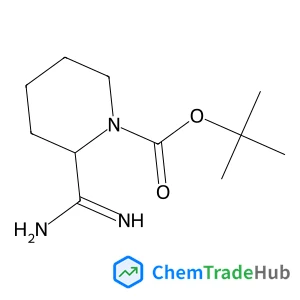
2-Methyl-2-propanyl 2-carbamimidoyl-1-piperidinecarboxylate
CAS Number:
1258640-98-0
Molecular Formula:
C11H21N3O2
![1-[6-(1H-Imidazol-1-yl)-3-pyridinyl]methanamine structure](https://static.chemtradehub.com/structs/914/914637-08-4-8825.webp "1-[6-(1H-Imidazol-1-yl)-3-pyridinyl]methanamine structure")
Recommended Suppliers



Disclaimer
This page provides academic journal information for reference and research purposes only. We are not affiliated with any journal publishers and do not handle publication submissions. For publication-related inquiries, please contact the respective journal publishers directly.
If you notice any inaccuracies in the information displayed, please contact us at support@chemtradehub.com. We will promptly review and address your concerns.