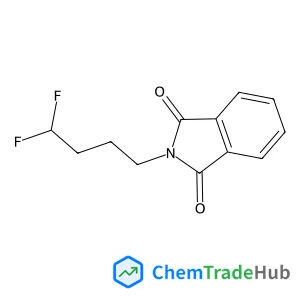
2-(4,4-Difluorobutyl)-1H-isoindole-1,3(2H)-dione
CAS Number:
1265341-14-7
Molecular Formula:
C12H11F2NO2
Shayesteh Tafazoli, Ali Shahrokhinia, Sahaj Rijal, Jaelese Garay, Randall A. Scanga, James F. Reuther
Smart, multi-stimuli-responsive nanogels that possess dynamic covalent bonds (DCBs) exhibit reversibility under equilibrium conditions allowing for controlled disassembly and release of cargo. These nanomaterials have innumerable applications in areas including drug delivery, sensors, soft actuators, smart surfaces, and environmental remediation. In this work, we implement one-pot, photo-controlled atom transfer radical polymerization-induced self-assembly (PhotoATR-PISA), mediated by UV light (λ = 365 nm) and parts per million (ppm) levels (ca. <20 ppm) of a copper(II) bromide catalyst, to fabricate dual crosslinked, polymeric nanogels with tunable orthogonal reversible covalent (TORC-NGs) core-crosslinks (CCLs). These TORC-NGs were crosslinked efficiently via coumarin photodimerization which occured simultaneously during polymerization using coumarin-functionalized methacrylate crosslinkers (CouMA). At the same time, crosslinking of nanocarriers with N,N-cystamine bismethacrylamide (CBMA) introduced orthogonal, redox-responsive, disulfide CCLs. Furthermore, incoproration of poly(glycidyl methacrylate) (PGMA) core-forming segments provided a simple handle for switchable solubility through acid-catalyzed ring-opening hydrolysis of pendant epoxide groups. In this way, the kinetics of release were tailored by the pH of the surrounding media. Thus, these TORC-NG systems showed coupled pH-, redox- and photo-responsive controlled release and disassembly behavior with full release of cargo only observed in the right sequence of stimuli and only when all three are utilized. The multi-stimuli-responsive nature of these TORC-NGs was successfully utilized herein for the controlled encapsulation and on-demand AND-gate release of hydrophobic Nile Red fluorescent reporters used as drug simulants. Various TORC-NG morphologies were synthesized in this report including nanosphere, worm-like and tubesome NGs showing variable release characteristics.
Andrew J. Wilson, Katherine A. Willets
DOI: 10.1039/C6AN01266C
Bernadette Byrne, Sergei G. Kazarian
DOI: 10.1039/D1AN00087J
Noppadol Aroonyadet, Suwussa Bamrungsap
DOI: 10.1039/D1AN00116G
Asta Žukauskaitė, Ivan Petřík, Aleš Pěnčík, Martin Hönig, Jiří Grúz, Jitka Široká, Ondřej Novák
DOI: 10.1039/D0AN02118K
Karteek Kadimisetty, Aoife M. Roche, Yanjie Yi, Frederic D. Bushman, Liang Feng
DOI: 10.1039/D0AN02482A
Yaping Zhou, Hongling Yan, Qingji Xie, Siyu Huang, Jiali Liu, Zou Li, Ming Ma
DOI: 10.1039/C3AN01437A
Ming-Lee Chu, Jung-Lee Lin
DOI: 10.1039/D0AN02478C
Shang-heng Tsai, Wei-Jen Ting, Chao-Chin Hu, C. Bor Fuh
DOI: 10.1039/C3AN02226A
Roli Verma, Banshi D. Gupta
DOI: 10.1039/C3AN01098H
N-(4-Methoxybenzyl)-2-pyridinamine (CAS: 52818-63-0) is increasingly being used ...
When handling Ethyl 4-(2-chlorophenyl)-1,3-thiazole-2-carboxylate, appropriate p...
Diethyldiselane (CAS: 628-39-7) is classified under the Globally Harmonized Syst...
The market for oxocopper (CAS: 12053-18-8) is primarily driven by its use in cat...
The market for 5-{[(2-Methyl-2-propanyl)oxy]carbonyl}-5-azaspiro[2.4]heptane-7-c...
2-(1-Pyrrolidinyl)-4-pyridinamine is a chemical compound with the CAS number 359...
2-(3-Pyridinyl)-1-azabicyclo[2.2.2]octane (CAS: 91556-75-1) is a crystalline sol...
(S)-Alpha-allyl-proline hydrochloride is usually synthesized via a Wittig reacti...
3-Methyl-1,2-oxazole-5-carboxylic acid (CAS: 4857-42-5) is an organic compound w...
Lys-SMCC-DM1 is synthesized via a multi-step process involving the coupling of S...

Polymer Chemistry welcomes submissions in all areas of polymer science that have a strong focus on macromolecular chemistry. Manuscripts may cover a broad range of fields, yet no direct application focus is required.
![1-{3-[4-Amino-3-(4-phenoxyphenyl)-1H-pyrazolo[3,4-d]pyrimidin-1-yl]-1-piperidinyl}-2,3-dihydroxy-1-propanone structure](https://static.chemtradehub.com/structs/122/1226872-27-0-e037.webp "1-{3-[4-Amino-3-(4-phenoxyphenyl)-1H-pyrazolo[3,4-d]pyrimidin-1-yl]-1-piperidinyl}-2,3-dihydroxy-1-propanone structure")