













Coordination-driven self-assembled Mn(ii)-metallostar with high relaxivity and synergistic photothermal and photodynamic effects
Literature Information
Publication Date
2023-11-15
DOI
10.1039/D3MA00762F
Impact Factor
0
Authors
Xingchi Shi, Fanglin Mi, Haiying Wang, Jiang Zhu
View Original
Abstract
A novel Mn(II)-metallostar structure (ML3Mn3, M = Fe3+, Ti4+) was synthesized through the self-assembly of high-valence transition-metal ions (Fe3+ and Ti4+) with a heteroditopic Mn(II) chelate (MnL) bearing a catechol group. UV-vis spectroscopy and variable-temperature 17O NMR reveals pH-dependent coordination modes of the FeL3Mn3 metallostar, with tris-coordination at pH 9.0 and an equilibrium between tris- and bis-coordination at pH 7.4. The heteropolymetallic Mn(II)-metallostars (ML3Mn3) demonstrated enhanced relaxivity per Mn (more than 2-fold) compared to the monomeric Mn(II) chelate (MnL). The Fe–Mn metallostar exhibited synergistic photothermal therapy (PTT) and photodynamic therapy (PDT) effects upon 808 nm laser excitation due to ligand-to-metal charge transfer (LMCT) from the metal-catechol core, with a photothermal conversion efficiency of 20.3% and a singlet oxygen quantum yield of 24.8%. In vitro phototherapy studies showed that the Fe–Mn metallostar showed effective antitumor effects in the BxPC-3 cell line. In MRI studies in normal mice, low-dose FeL3Mn3 (25 μmol kg−1) provided a superior contrast-enhancement compared to Gd-DTPA (100 μmol kg−1) with rapid blood clearance and mixed hepatobiliary and renal excretion. In summary, we have developed a novel Mn(II)-metallostar structure with high relaxivities and synergistic NIR light-irritable PTT/PDT effects, which may be a promising theranostic agent for MRI-guided phototherapy.
Related Literature
Alkyne–azide coupling of tailored poly(vinylidene fluoride) and polystyrene for the synthesis of block copolymers
Radovan Vukićević, Ulrike Schwadtke, Simon Schmücker, Philipp Schäfer, Dirk Kuckling, Sabine Beuermann
2011-12-01
Paper
DOI: 10.1039/C1PY00427A
Controlled synthesis of radiolabelled amine methacrylate water-soluble polymers with end-groups of varying hydrophobicity and studies of adsorption behaviour
Mark Long, David W. Thornthwaite, Suzanne H. Rogers, Francis R. Livens, Steve P. Rannard
2011-11-04
Paper
DOI: 10.1039/C1PY00397F
Control of morphology in olefinpolymerization catalyzed by nickel diimine complexes encapsulated into polybutadiene based support
Zdeněk Hošt'álek, Jan Merna, Bertrand Heurtefeu, Henri Cramail
2012-01-12
Paper
DOI: 10.1039/C2PY00482H
Highly thermostable rigid-rod networks constructed from an unsymmetrical bisphthalonitrile bearing phthalazinone moieties
Cheng Liu, Xiuping Li, Jinyan Wang, Xigao Jian, Chunyue Pan
2012-02-06
Paper
DOI: 10.1039/C2PY00417H
Facile glycosylation of dendrimers for eliciting specific cell–material interactions
Xiaopeng Liu, Jie Liu, Ying Luo
2011-11-29
Communication
DOI: 10.1039/C1PY00404B
Macromolecular design of poly(vinyl alcohol) by RAFT polymerization
Anton A. A. Smith, Thomas Hussmann, Joseph Elich, Almar Postma, Marie-Helene Alves, Alexander N. Zelikin
2011-10-19
Communication
DOI: 10.1039/C1PY00429H
A simple microfluidic device for fabrication of double emulsion droplets and polymer microcapsules
Gabit Nurumbetov, Nicholas Ballard, Stefan A. F. Bon
2012-02-06
Paper
DOI: 10.1039/C2PY00605G
Individual graphene oxide platelets through direct molecular exfoliation with globular amphiphilic hyperbranched polymers
Shi-Min Shau, Tzong-Yuan Juang, Han-Sheng Lin, Cheng-Liang Huang, Chi-Fa Hsieh, Jeng-Yue Wu, Ru-Jong Jeng
2012-03-14
Paper
DOI: 10.1039/C2PY00006G
Synthesis of novel cylindrical bottlebrush polypseudorotaxane via inclusion complexation of high density poly(ε-caprolactone) bottlebrush polymer and α-cyclodextrins
Qiang Fu, Jing. M. Ren, Greg. G. Qiao
2011-11-11
Paper
DOI: 10.1039/C1PY00362C
You might also like
Compound Q&A
What industries use 4-(4-tert-Butylphenyl)-1H-pyrazol-3-amine (CAS: 1015845-73-4)?
4-(4-tert-Butylphenyl)-1H-pyrazol-3-amine finds applications in various industri...
1015845-73-44-(4-tert-Butylpheny...
Compound Q&A
What industries use H3TATAB (CAS: 63557-10-8)?
H3TATAB is used in the pharmaceutical industry for the synthesis of certain orga...
63557-10-8H3TATAB
Compound Q&A
What are the main uses of 1-Ethyl-3-fluorobenzene (CAS: 696-39-9)?
1-Ethyl-3-fluorobenzene (CAS: 696-39-9) is primarily used as a precursor in the ...
696-39-91-Ethyl-3-fluorobenz...
Compound Q&A
What are the main uses of 1-(tert-Butoxycarbonyl)-4-(4-methoxyphenyl)pyrrolidine-3-carboxylic acid (CAS: 851484-94-1)?
1-(tert-Butoxycarbonyl)-4-(4-methoxyphenyl)pyrrolidine-3-carboxylic acid is prim...
851484-94-11-(tert-Butoxycarbon...
Compound Q&A
What are the physical and chemical properties of 1-Cyclobutyl-4-piperidinone (CAS: 359880-05-0)?
1-Cyclobutyl-4-piperidinone (CAS: 359880-05-0) is a colorless or white crystalli...
359880-05-01-Cyclobutyl-4-piper...
Compound Q&A
What is Pyridine-2,6-dicarboxylic acid mono-tert-butyl ester (CAS: 575433-76-0)?
Pyridine-2,6-dicarboxylic acid mono-tert-butyl ester (CAS: 575433-76-0) is a che...
575433-76-0Pyridine-2,6-dicarbo...
Compound Q&A
What is the market or research trend for 2,3-Difluorophenylalanine (CAS: 236754-62-4)?
The market for 2,3-Difluorophenylalanine (CAS: 236754-62-4) is growing with incr...
236754-62-42,3-Difluorophenylal...
Compound Q&A
How is (2-Hydroxy-1-naphthyl)boronic acid (CAS: 898257-48-2) typically synthesized?
(2-Hydroxy-1-naphthyl)boronic acid can be synthesized through the reduction of 2...
898257-48-2(2-Hydroxy-1-naphthy...
Compound Q&A
What are the physical and chemical properties of tert-Butyl (5-bromo-6-methyl-3-(4,4,5,5-tetramethyl-1,3,2-dioxaborolan-2-yl)pyridin-2-yl)carbamate (CAS: 1315351-28-0)?
This compound is a crystalline solid with a molecular weight of approximately 52...
1315351-28-0tert-Butyl (5-bromo-...
Compound Q&A
Are there alternatives to 5,7-Dihydroxy-4-oxo-2-(3,4,5-trihydroxyphenyl)-4H-chromen-3-yl beta-D-glucopyranoside (CAS: 19833-12-6) in synthesis?
While 5,7-Dihydroxy-4-oxo-2-(3,4,5-trihydroxyphenyl)-4H-chromen-3-yl beta-D-gluc...
19833-12-65,7-Dihydroxy-4-oxo-...
Source Journal
Recommended Compounds
![4-[(2-Oxo-1,2,3,4-tetrahydroquinolin-7-yl)oxy]butanoic acid structure](https://static.chemtradehub.com/structs/588/58899-27-7-1f86.webp "4-[(2-Oxo-1,2,3,4-tetrahydroquinolin-7-yl)oxy]butanoic acid structure")
4-[(2-Oxo-1,2,3,4-tetrahydroquinolin-7-yl)oxy]butanoic acid
CAS Number:
58899-27-7
Molecular Formula:
C18H24N2O7
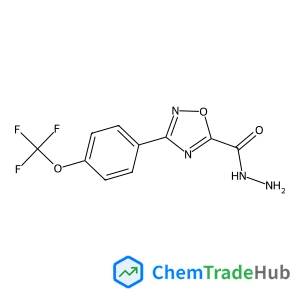
3-(4-(Trifluoromethoxy)phenyl)-1,2,4-oxadiazole-5-carbohydrazide
CAS Number:
883028-82-8
Molecular Formula:
C10H7F3N4O3
Recommended Suppliers






Disclaimer
This page provides academic journal information for reference and research purposes only. We are not affiliated with any journal publishers and do not handle publication submissions. For publication-related inquiries, please contact the respective journal publishers directly.
If you notice any inaccuracies in the information displayed, please contact us at support@chemtradehub.com. We will promptly review and address your concerns.