












Macromolecular design of poly(vinyl alcohol) by RAFT polymerization
Literature Information
Publication Date
2011-10-19
DOI
10.1039/C1PY00429H
Impact Factor
5.582
Authors
Anton A. A. Smith, Thomas Hussmann, Joseph Elich, Almar Postma, Marie-Helene Alves, Alexander N. Zelikin
View Original
Abstract
Reversible Addition–Fragmentation chain Transfer polymerization (RAFT) is employed herein to obtain the first example of poly(vinyl alcohol), PVA, with controlled molecular weight and terminal aminegroups thus presenting a flexible tool for materials design and bioconjugation. Furthermore, we demonstrate that RAFT control can be used to facilitate syndiotactic chain propagation and obtain PVA with the highest reported content of syndiotactic dyad (∼78%).
Related Literature
Doubly thermo-responsive nanoparticles constructed with two diblock copolymers prepared through the two macro-RAFT agents co-mediated dispersion RAFT polymerization
Quanlong Li, Xin He, Yongliang Cui, Pengfei Shi, Shentong Li, Wangqing Zhang
2014-09-04
Paper
DOI: 10.1039/C4PY00998C
Hyperbranched poly(phosphoester)s as flame retardants for technical and high performance polymers
Karoline Täuber, Frederik R. Wurm, Bernhard Schartel
2014-09-08
Paper
DOI: 10.1039/C4PY00830H
Dendrimer-like conjugated microporous polymers
Ting Wang, Wei Huang, Jia-Xing Jiang, Zhengkun Du, Fa-Kuen Shieh, Renqiang Yang
2016-01-04
Paper
DOI: 10.1039/C5PY01767J
Synthesis of telechelic vinyl/allyl functional siloxane copolymers with structural control
F. B. Madsen, I. Javakhishvili, R. E. Jensen, A. E. Daugaard, S. Hvilsted, A. L. Skov
2014-09-15
Paper
DOI: 10.1039/C4PY00919C
A new oligo(hexafluoropropylene oxide)-b-oligo(ethylene oxide) diblock surfactant obtained by radical reactions
Olinda Gimello, Vincent Ladmiral, Chadron Mark Friesen, Bruno Ameduri
2014-08-29
Paper
DOI: 10.1039/C4PY00965G
Block ionomer complexes consisting of siRNA and aRAFT-synthesized hydrophilic-block-cationic copolymers: the influence of cationic block length on gene suppression‡
Andrew C. Holley, Keith H. Parsons, Wenming Wan, Daniel F. Lyons, G. Reid Bishop, John J. Correia, Faqing Huang
2014-09-01
Paper
DOI: 10.1039/C4PY00940A
Base-amplifying silicone resins generating aliphatic secondary amines autocatalytically: synthesis, characterization and application to positive-working photoresists
K. Arimitsu, H. Kobayashi, M. Furutani, T. Gunji, Y. Abe
2014-09-12
Paper
DOI: 10.1039/C4PY01096E
You might also like
Compound Q&A
How should waste containing (6-Bromo-2-naphthyl)oxy](dimethyl)(2-methyl-2-propanyl)silane be handled?
Waste containing (6-Bromo-2-naphthyl)oxy](dimethyl)(2-methyl-2-propanyl)silane (...
100751-65-3[(6-Bromo-2-naphthyl...
Compound Q&A
How is 7-Fluoro-4-isoquinolinecarboxylic acid (CAS: 1841081-40-0) typically synthesized?
7-Fluoro-4-isoquinolinecarboxylic acid can be synthesized via a multi-step proce...
1841081-40-07-Fluoro-4-isoquinol...
Compound Q&A
What are the physical and chemical properties of 2,3,5,6-Tetrabromothieno[3,2-b]thiophene (CAS: 124638-53-5)?
2,3,5,6-Tetrabromothieno[3,2-b]thiophene is a crystalline compound with a high m...
124638-53-52,3,5,6-Tetrabromoth...
Compound Q&A
Is 1-[4-(Benzylamino)-7,8-dihydro-5H-pyrano[4,3-d]pyrimidin-2-yl]-2-methyl-1H-indole-4-carboxamide (CAS: 1542705-92-9) safe?
1-[4-(Benzylamino)-7,8-dihydro-5H-pyrano[4,3-d]pyrimidin-2-yl]-2-methyl-1H-indol...
1542705-92-91-[4-(Benzylamino)-7...
Compound Q&A
What is the market or research trend for imidazo[5,1-d]-1,2,3,5-tetrazine-8-carboxylic acid, 3,4-dihydro-3-methyl-4-oxo- (CAS: 113942-30-6)?
The market for imidazo[5,1-d]-1,2,3,5-tetrazine-8-carboxylic acid, 3,4-dihydro-3...
113942-30-6Imidazo[5,1-d]-1,2,3...
Compound Q&A
What is 3-(Triisopropylsilyl)propiolaldehyde (CAS: 163271-80-5)?
3-(Triisopropylsilyl)propiolaldehyde is a synthetic organic compound with the CA...
163271-80-53-(Triisopropylsilyl...
Compound Q&A
What regulatory guidelines apply to 6-Nitro-2H-1,4-benzoxazin-3(4H)-one (CAS: 81721-87-1)?
6-Nitro-2H-1,4-benzoxazin-3(4H)-one (CAS: 81721-87-1) is subject to various regu...
81721-87-16-Nitro-2H-1,4-benzo...
Compound Q&A
How should waste containing (3-Fluorophenyl)(4-{[(2-methyl-2-propanyl)oxy]carbonyl}-1-piperazinyl)acetic acid (CAS: 885272-91-3) be handled?
Waste containing (3-Fluorophenyl)(4-{[(2-methyl-2-propanyl)oxy]carbonyl}-1-piper...
885272-91-3(3-Fluorophenyl)(4-{...
Compound Q&A
What are the physical and chemical properties of N,N'-4,4'-Biphenyldiyldiisonicotinamide (CAS: 55119-40-9)?
N,N'-4,4'-Biphenyldiyldiisonicotinamide is a white crystalline solid with a mole...
55119-40-9N,N'-4,4'-Biphenyldi...
Compound Q&A
What industries use 6-Bromo-8-fluoro-2-quinazolinol (CAS: 1036756-15-6)?
6-Bromo-8-fluoro-2-quinazolinol is primarily used in the pharmaceutical industry...
1036756-15-66-Bromo-8-fluoro-2-q...
Source Journal
Polymer Chemistry

CiteScore:
8.6
Self-citation Rate:
7.3%
Articles per Year:
457
Polymer Chemistry welcomes submissions in all areas of polymer science that have a strong focus on macromolecular chemistry. Manuscripts may cover a broad range of fields, yet no direct application focus is required.
Recommended Compounds
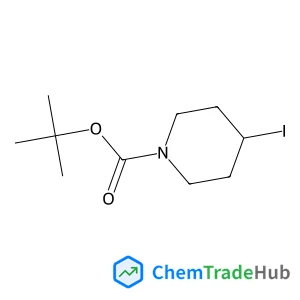
2-Methyl-2-propanyl 4-iodo-1-piperidinecarboxylate
CAS Number:
301673-14-3
Molecular Formula:
C10H18INO2
Recommended Suppliers






Disclaimer
This page provides academic journal information for reference and research purposes only. We are not affiliated with any journal publishers and do not handle publication submissions. For publication-related inquiries, please contact the respective journal publishers directly.
If you notice any inaccuracies in the information displayed, please contact us at support@chemtradehub.com. We will promptly review and address your concerns.