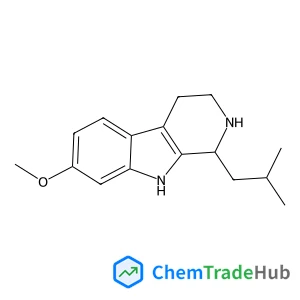
1-Isobutyl-7-methoxy-2,3,4,9-tetrahydro-1H-beta-carboline
CAS Number:
175975-76-5
Molecular Formula:
C16H22N2O
Nuttapan Promsampao, Nuwong Chollacoop, Adisak Pattiya
Ex situ catalytic fast pyrolysis (ex-CFP) of biomass applying ZSM-5 catalysts is an effective method for deoxygenating the pyrolysis vapour, thus producing low-oxygen bio-oil in a single step. The catalysts deactivate after reactions but can be regenerated to recover their performance. Most of the previous studies on catalyst regeneration applied modified ZSM-5 catalysts to produce partially deoxygenated bio-oil with an oxygen content of around 10–25 wt%. In the deep deoxygenation region with bio-oil oxygen content below 5 wt%, the regeneration of pristine HZSM-5 catalyst used in ex-CFP where filtered pyrolysis vapour is upgraded has not been elucidated. Therefore, it is the main purpose of the current study to demonstrate the deep-deoxygenation capability of an unmodified HZSM-5 catalyst that has been previously depreciated. In this work, eucalyptus wood was pyrolysed in a bench-scale bubbling fluidised-bed reactor close-coupled with a separate catalytic reactor containing a fixed bed of pristine HZSM-5 extrudates. The produced catalytic bio-oil appears in 3 phases: light bio-oil, medium aqueous phase and heavy bio-oil. The light bio-oil has a very low oxygen content of ∼1 wt%, containing mainly monocyclic aromatic hydrocarbons, especially benzene, toluene and xylene. The heavy liquid had an oxygen content of 5–8 wt%, containing mainly naphthalene derivatives. The average degree of deoxygenation achieved in this work was 91% throughout the 10 experiments using fresh and regenerated catalysts. The unmodified HZSM-5 extrudates can be considered regenerable for up to 9 cycles with minor catalyst deactivation. The yields of main products including total bio-oil, char and gas were unaffected by the catalyst regeneration. However, the yield of light bio-oil appeared to gradually decrease with regeneration cycles. The regenerated catalyst could retain its surface area, morphology and structural framework to a great extent, albeit with small changes occurring on the surface area and volume of the micropores as well as its crystallinity and crystalline size.
Cong Lin, Sai Chen, Yihua Wang, Fei Gao, Liang Shen
DOI: 10.1039/D1QO01579F
Huanyu Shan, Rihuang Pan, Xufeng Lin
DOI: 10.1039/C8OB01785A
Feng Liu, Guoqing Zhao, Weiqi Cai, Dongfang Xu, Baoguo Zhao
DOI: 10.1039/C8OB02000K
Amarender Manchoju, Ritesh A. Annadate, Lise Desquien, Sunil V. Pansare
DOI: 10.1039/C8OB01511B
Nungruethai Yoswathananont, Kazuki Sada, Mikiji Miyata, Shigendo Akita, Kazunori Nakano
DOI: 10.1039/B210544F
Michael Harding, Robert Hodgson, Tahir Majid, Kenneth J. McDowall
DOI: 10.1039/B208781B
Yuping Zhu, Tianqi Liu, Bingxin Liu, Houguang Shi, Qitao Tan
DOI: 10.1039/D1QO01574E
Vasiliy A. Bakulev, Vera S. Berseneva, Natalia P. Belskaia, Yury Yu. Morzherin, Andreiy Zaitsev, Wim Dehaen, Ingrid Luyten, Suzanne Toppet
DOI: 10.1039/B207854F
Ruby Nagelkerke, Gregory R. J. Thatcher, Erwin Buncel
DOI: 10.1039/B208408B
N-(4-Methoxybenzyl)-2-pyridinamine (CAS: 52818-63-0) is increasingly being used ...
When handling Ethyl 4-(2-chlorophenyl)-1,3-thiazole-2-carboxylate, appropriate p...
Diethyldiselane (CAS: 628-39-7) is classified under the Globally Harmonized Syst...
The market for oxocopper (CAS: 12053-18-8) is primarily driven by its use in cat...
The market for 5-{[(2-Methyl-2-propanyl)oxy]carbonyl}-5-azaspiro[2.4]heptane-7-c...
2-(1-Pyrrolidinyl)-4-pyridinamine is a chemical compound with the CAS number 359...
2-(3-Pyridinyl)-1-azabicyclo[2.2.2]octane (CAS: 91556-75-1) is a crystalline sol...
(S)-Alpha-allyl-proline hydrochloride is usually synthesized via a Wittig reacti...
3-Methyl-1,2-oxazole-5-carboxylic acid (CAS: 4857-42-5) is an organic compound w...
Lys-SMCC-DM1 is synthesized via a multi-step process involving the coupling of S...

Reaction Chemistry & Engineering is an interdisciplinary journal reporting cutting-edge research focused on enhancing the understanding and efficiency of reactions. Reaction engineering leverages the interface where fundamental molecular chemistry meets chemical engineering and technology. Challenges in chemistry can be overcome by the application of new technologies, while engineers may find improved solutions for process development from the latest developments in reaction chemistry. Reaction Chemistry & Engineering is a unique forum for researchers whose interests span the broad areas of chemical engineering and chemical sciences to come together in solving problems of importance to wider society. All papers should be written to be approachable by readers across the engineering and chemical sciences. Papers that consider multiple scales, from the laboratory up to and including plant scale, are particularly encouraged.