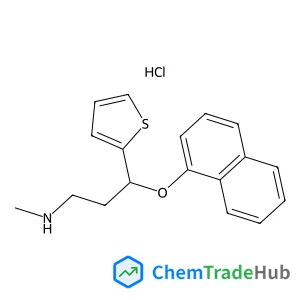
N-Methyl-3-(1-naphthyloxy)-3-(2-thienyl)-1-propanamine hydrochloride (1:1)
CAS Number:
1188266-11-6
Molecular Formula:
C18H20ClNOS
Ruby Nagelkerke, Gregory R. J. Thatcher, Erwin Buncel
We report on the catalytic effects by alkali-metal ions in the ethanolysis of p-nitrophenyl diphenyl phosphate, in continuation of our studies on alkali-metal ion catalysis and inhibition in nucleophilic displacement reactions at carbon, phosphorus and sulfur centres. The following selectivity order of catalytic reactivity was observed for nucleophilic displacement at the phosphorus center with p-nitrophenoxide as leaving group: Li+ > Na+ > K+ > Cs+. A minor reaction pathway with phenoxide leaving was also found. The kobs data have been dissected into reaction pathways by free ions (kEtO−) and by ion pairs (kMOEt), with the latter being dominant, in a 4-membered transition-state. Further analysis is given in terms of initial-state and transition-state stabilization by the alkali-metal ions in terms of the Eisenman model (electrostatic interaction vs. desolvation). Results of ab-initio MO calculations are presented based on interaction between M+ and a model bipyramidal phosphorane intermediate and compared with the sulfurane analogue.

Journal of Chemical Sciences

Journal of the Indian Institute of Science

Critical Reviews in Solid State and Materials Sciences

Atomization and Sprays

Polycyclic Aromatic Compounds

Herald of the Russian Academy of Sciences

Colloid Journal

Chinese Journal of Chemistry

Journal of Asian Natural Products Research

Biocatalysis and Biotransformation
Chris V. Galliford, Karl A. Scheidt
DOI: 10.1039/B801597J
Jeffrey B.-H. Tok, Nicholas O. Fischer
DOI: 10.1039/B717936G
Veronica Gonzalez, Tom Wilson, Izumi Kurihara, Arata Imai, Jim A. Thomas, Joe Otsuki
DOI: 10.1039/B802073F
Adrian Fegan, Pravin S. Shirude, Shankar Balasubramanian
DOI: 10.1039/B801629A
Matthew D. Helm, Peter Mayer, Paul Knochel
DOI: 10.1039/B802157K
Yue-Ling Bai, Jun Tao, Rong-Bin Huang, Lan-Sun Zheng, Shao-Liang Zheng, Kazuyoshi Oshida, Yasuaki Einaga
DOI: 10.1039/B718456E
Nicholas P. Power, John E. Warren, Jerry L. Atwood
DOI: 10.1039/B719769A
Yoshihiko Yamamoto, Naohiro Kirai, Yu Harada
DOI: 10.1039/B802231C
N-(4-Methoxybenzyl)-2-pyridinamine (CAS: 52818-63-0) is increasingly being used ...
When handling Ethyl 4-(2-chlorophenyl)-1,3-thiazole-2-carboxylate, appropriate p...
Diethyldiselane (CAS: 628-39-7) is classified under the Globally Harmonized Syst...
The market for oxocopper (CAS: 12053-18-8) is primarily driven by its use in cat...
The market for 5-{[(2-Methyl-2-propanyl)oxy]carbonyl}-5-azaspiro[2.4]heptane-7-c...
2-(1-Pyrrolidinyl)-4-pyridinamine is a chemical compound with the CAS number 359...
2-(3-Pyridinyl)-1-azabicyclo[2.2.2]octane (CAS: 91556-75-1) is a crystalline sol...
(S)-Alpha-allyl-proline hydrochloride is usually synthesized via a Wittig reacti...
3-Methyl-1,2-oxazole-5-carboxylic acid (CAS: 4857-42-5) is an organic compound w...
Lys-SMCC-DM1 is synthesized via a multi-step process involving the coupling of S...

Organic & Biomolecular Chemistry (OBC) publishes original and high impact research and reviews in organic chemistry. We welcome research that shows new or significantly improved protocols or methodologies in total synthesis, synthetic methodology or physical and theoretical organic chemistry as well as research that shows a significant advance in the organic chemistry or molecular design aspects of chemical biology, catalysis, supramolecular and macromolecular chemistry, theoretical chemistry, mechanism-oriented physical organic chemistry, medicinal chemistry or natural products. Articles published in the journal should report new work which makes a highly-significant impact in the field. Routine and incremental work is generally not suitable for publication in the journal. More details about key areas of our scope are below. In all cases authors should include in their article clear rationale for why their research has been carried out.