


Contents list
Literature Information
Publication Date
2021-11-02
DOI
10.1039/D1PY90142G
Impact Factor
5.582
Authors
View Original
Abstract
The first page of this article is displayed as the abstract.
Recommended Journals

Journal of Asian Natural Products Research

Atomization and Sprays

Journal of the Indian Institute of Science

NDT & E International

Electroanalysis

Acta Metallurgica Sinica-English Letters

Main Group Chemistry

Critical Reviews in Solid State and Materials Sciences

Topics in Catalysis

Bioorganic & Medicinal Chemistry
Related Literature
A total loss of innocence: double ortho-metallation of bis(triphenylphosphano)iminium cation, [N(PPh3)2]+, by tris(η-naphthalene)tantalate(1−)‡
Victor J. Sussman, John E. Ellis
2008-10-01
Communication
DOI: 10.1039/B811320C
Internal amide-triggered cycloaromatization of maduropeptin-like nine-membered enediyne
Yutaro Norizuki, Kazuo Komano, Itaru Sato, Masahiro Hirama
2008-09-15
Communication
DOI: 10.1039/B811355F
Rhodium-catalysed cyclisation reaction of allenynes with arylboronic acids
Tomoya Miura, Keita Ueda, Yusuke Takahashi, Masahiro Murakami
2008-09-16
Communication
DOI: 10.1039/B810665G
Templating effect of silk fibers in the oriented deposition of aragonite
Cheng Cheng, Yuhong Yang, Xin Chen, Zhengzhong Shao
2008-09-22
Communication
DOI: 10.1039/B810337B
(κ2-P,S)Pt(benzyl) complexes derived from 1/3-PiPr2-2-StBu-indene: facile synthesis of carbanion- and borate-containing zwitterions
Kevin D. Hesp, Robert McDonald, Michael J. Ferguson, Gabriele Schatte, Mark Stradiotto
2008-10-06
Communication
DOI: 10.1039/B813421A
A non-oxide sol–gel route to synthesise silicon imidonitride monolithic gels and high surface area aerogels
Shereen Hassan, Andrew L. Hector, Jason R. Hyde, Ali Kalaji, David C. Smith
2008-09-12
Communication
DOI: 10.1039/B810317H
An unexpected ruthenium complex and its unique behavior as catalyst in dynamic kinetic resolution of secondary alcohols‡
Qihui Chen, Chengye Yuan
2008-09-17
Communication
DOI: 10.1039/B811627J
Click chemistry assembly of G-quadruplex ligands incorporating a diarylurea scaffold and triazole linkers
William C. Drewe, Stephen Neidle
2008-09-30
Communication
DOI: 10.1039/B814576H
Ruthenium polypyridyl peptide conjugates: membrane permeable probes for cellular imaging
Ute Neugebauer, Yann Pellegrin, Marc Devocelle, William Signac, Niamh Moran
2008-09-12
Communication
DOI: 10.1039/B810403D
Molecular tectonics: control of pore size and polarity in 3-D hexagonal coordination networks based on porphyrins and a zinc cation
Elisabeth Kühn, Véronique Bulach, Mir Wais Hosseini
2008-09-24
Communication
DOI: 10.1039/B812831F
You might also like
Compound Q&A
What are the main uses of 1H-Indazole-6-carbonitrile (CAS: 141290-59-7)?
1H-Indazole-6-carbonitrile finds applications in pharmaceuticals, where it serve...
141290-59-71H-Indazole-6-carbon...
Compound Q&A
How should waste containing Dioctyl (2E)-2-butenedioate (CAS: 2997-85-5) be handled?
Waste containing Dioctyl (2E)-2-butenedioate (CAS: 2997-85-5) should be collecte...
2997-85-5Dioctyl (2E)-2-buten...
Compound Q&A
What industries use Sodium [(1,2-benzoxazol-3-ylmethyl)sulfonyl]azanide (CAS: 68291-98-5)?
Sodium [(1,2-benzoxazol-3-ylmethyl)sulfonyl]azanide is primarily used in pharmac...
68291-98-5Sodium [(1,2-benzoxa...
Compound Q&A
Are there alternatives to Dimethyl 4-(4,4,5,5-tetramethyl-1,3,2-dioxaborolan-2-yl)-2,6-pyridinedicarboxylate (CAS: 741709-66-0) in synthesis?
Dimethyl 4-(4,4,5,5-tetramethyl-1,3,2-dioxaborolan-2-yl)-2,6-pyridinedicarboxyla...
741709-66-0Dimethyl 4-(4,4,5,5-...
Compound Q&A
How should waste containing 2-Fluoro-6-hydrazinopyridine (CAS: 80714-39-2) be handled?
Waste containing 2-Fluoro-6-hydrazinopyridine (CAS: 80714-39-2) should be manage...
80714-39-22-Fluoro-6-hydrazino...
Compound Q&A
What is 6-Formyl-2-pyridinecarboxylic acid (CAS: 499214-11-8)?
6-Formyl-2-pyridinecarboxylic acid is an organic compound with the molecular for...
499214-11-86-Formyl-2-pyridinec...
Compound Q&A
What is the market or research trend for 3-(3,4-dimethoxyphenyl)-2,5-dimethyl-N-(2-morpholin-4-ylethyl)pyrazolo[1,5-a]pyrimidin-7-amine (CAS: 900874-91-1)?
Research trends for this compound indicate a focus on its potential applications...
900874-91-13-(3,4-dimethoxyphen...
Compound Q&A
How is 9H-Tribenzo[b,d,f]azepine (CAS: 29875-73-8) typically synthesized?
9H-Tribenzo[b,d,f]azepine is typically synthesized via a multi-step process invo...
29875-73-89H-Tribenzo[b,d,f]az...
Compound Q&A
How is 1-Cyclopropyl-7-ethoxy-6-fluoro-8-methoxy-4-oxo-1,4-dihydro-3-quinolinecarboxylic acid (CAS: 1797982-51-4) typically synthesized?
1-Cyclopropyl-7-ethoxy-6-fluoro-8-methoxy-4-oxo-1,4-dihydro-3-quinolinecarboxyli...
1797982-51-41-Cyclopropyl-7-etho...
Compound Q&A
How should waste containing Methyl 3-oxo-1,2,3,4-tetrahydro-6-quinoxalinecarboxylate (CAS: 671820-52-3) be handled?
Waste containing Methyl 3-oxo-1,2,3,4-tetrahydro-6-quinoxalinecarboxylate (CAS: ...
671820-52-3Methyl 3-oxo-1,2,3,4...
Source Journal
Polymer Chemistry

CiteScore:
8.6
Self-citation Rate:
7.3%
Articles per Year:
457
Polymer Chemistry welcomes submissions in all areas of polymer science that have a strong focus on macromolecular chemistry. Manuscripts may cover a broad range of fields, yet no direct application focus is required.
Recommended Compounds
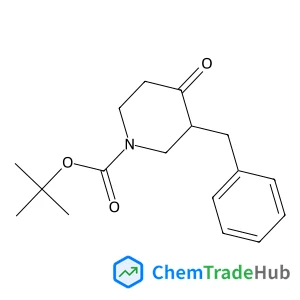
2-Methyl-2-propanyl 3-benzyl-4-oxo-1-piperidinecarboxylate
CAS Number:
193274-82-7
Molecular Formula:
C17H23NO3

Recommended Suppliers






Disclaimer
This page provides academic journal information for reference and research purposes only. We are not affiliated with any journal publishers and do not handle publication submissions. For publication-related inquiries, please contact the respective journal publishers directly.
If you notice any inaccuracies in the information displayed, please contact us at support@chemtradehub.com. We will promptly review and address your concerns.