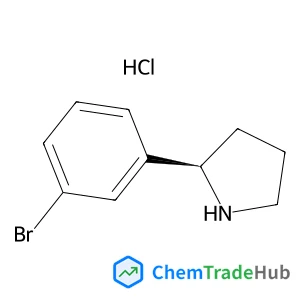
(2R)-2-(3-Bromophenyl)pyrrolidine hydrochloride (1:1)
CAS Number:
1391550-13-2
Molecular Formula:
C10H13BrClN
Sandeep Sharma, Konstantinos Ntetsikas, Viko Ladelta, Saibal Bhaumik, Nikos Hadjichristidis
The synthesis of cyclic polymers on a large scale is a challenging task for polymer scientists due to the requirement of ultra-high dilution conditions. In this paper, we demonstrate an alternative method to prepare cyclic polymers with moderate dilution and up to 1 gram scale. We employed a simple Williamson etherification reaction to prepare cyclic polymers with a good solvent/non-solvent combination. In this way, various polystyrene (PS) and polyethylene glycol (PEG) cyclic homopolymers were synthesized. Anionic polymerization using high vacuum techniques combined with the postpolymerization reaction was used to generate linear dihydroxy PS precursors. The synthesized linear and cyclic homopolymers were fully characterized using various spectroscopic and analytical techniques, such as size exclusion chromatography (SEC), matrix-assisted laser desorption/ionization time-of-flight mass spectroscopy (MALDI-TOF-MS), and differential scanning calorimetry (DSC). Detailed nuclear magnetic resonance (NMR) spectroscopic studies were also performed to obtain the complete structural information of the synthesized polymers.
DaeHan Ahn, JiYeong Lee, SangJun Moon, Taejoon Park
DOI: 10.1039/C8AN01056K
Genki Sakata, Minoru Mizuhata
DOI: 10.1039/C7AN00067G
Gerardo Gutiérrez-Juárez, David Cywiak, Rafael Pérez-Solano, Gary A. Baker
DOI: 10.1039/C6AN02662A
James Bonner, Lance E. Talbert, Nicholas Akkawi, Ryan R. Julian
DOI: 10.1039/C8AN01582A
Miguela Martin, David Perez-Guaita, Dean W. Andrew, Bayden R. Wood
DOI: 10.1039/C6AN02075E
Meng Wang, Xianwen Kan
DOI: 10.1039/C8AN01502C
Franck Bonnier, Clément Wasselet, Guillaume Brachet, Renaud Respaud, Luis Felipe C. S. Carvalho, Dominique Bertrand, Matthew J. Baker, Hugh J. Byrne, Igor Chourpa
DOI: 10.1039/C6AN01888B
Lok Nath Neupane, Pramod Kumar Mehta, Semin Oh, See-Hyoung Park, Keun-Hyeung Lee
DOI: 10.1039/C8AN01221K
Yinghong Zhang, Lijuan Li, Tao Li, Ying Xin, Junxiu Liu, Furong Ma, Lanqun Mao
DOI: 10.1039/C8AN01300D
N-(4-Methoxybenzyl)-2-pyridinamine (CAS: 52818-63-0) is increasingly being used ...
When handling Ethyl 4-(2-chlorophenyl)-1,3-thiazole-2-carboxylate, appropriate p...
Diethyldiselane (CAS: 628-39-7) is classified under the Globally Harmonized Syst...
The market for oxocopper (CAS: 12053-18-8) is primarily driven by its use in cat...
The market for 5-{[(2-Methyl-2-propanyl)oxy]carbonyl}-5-azaspiro[2.4]heptane-7-c...
2-(1-Pyrrolidinyl)-4-pyridinamine is a chemical compound with the CAS number 359...
2-(3-Pyridinyl)-1-azabicyclo[2.2.2]octane (CAS: 91556-75-1) is a crystalline sol...
(S)-Alpha-allyl-proline hydrochloride is usually synthesized via a Wittig reacti...
3-Methyl-1,2-oxazole-5-carboxylic acid (CAS: 4857-42-5) is an organic compound w...
Lys-SMCC-DM1 is synthesized via a multi-step process involving the coupling of S...

Polymer Chemistry welcomes submissions in all areas of polymer science that have a strong focus on macromolecular chemistry. Manuscripts may cover a broad range of fields, yet no direct application focus is required.
![N-{[(2-Methyl-2-propanyl)oxy]carbonyl}-L-methionylglycine structure](https://static.chemtradehub.com/structs/234/23446-03-9-e1e5.webp "N-{[(2-Methyl-2-propanyl)oxy]carbonyl}-L-methionylglycine structure")
![1-oxaspiro[4.4]nonan-6-one structure](https://static.chemtradehub.com/structs/134/134179-01-4-e051.webp "1-oxaspiro[4.4]nonan-6-one structure")