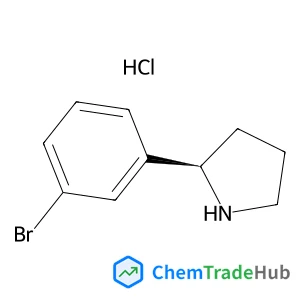
(2R)-2-(3-Bromophenyl)pyrrolidine hydrochloride (1:1)
CAS Number:
1391550-13-2
Molecular Formula:
C10H13BrClN
Meng Wang, Xianwen Kan
In this study, an exfoliated graphite paper (EGP) was employed as a supported electrode for prussian blue (PB) and gold nanoparticles (AuNPs) modification to fabricate a novel electrochemical sensor. The scanning electron microscopy image showed the multilayer structure of the sensor with PB and AuNPs uniform coating. Due to the high surface area and good conductivity of the multilayer structure, as well as the conductivity of AuNPs, the prepared sensor exhibited an obvious improvement for sensitive detection of nicotinamide adenine dinucleotide (NADH) with a linear range of 5.0 × 10⁻⁷ mol L−1–1.0 × 10⁻³ mol L−1. Moreover, the modified PB film endowed the sensor with good electrocatalytic activity for hydrogen peroxide (H2O2) sensing. Under the optimal conditions, the linear range and limit of detection for H2O2 sensitive detection were 5.0 × 10⁻⁸ mol L−1–1.0 × 10⁻³ mol L−1 and 4.8 × 10⁻⁹ mol L−1, respectively. The sensor can also be used for detection in real samples with satisfactory results. The advantages of low-cost, easy modification, multilayer structure, and good conductivity made the EGP an alternative candidate for supported electrode materials in the preparation and application of various electrochemical sensors.
Alister E. Inglesby, Kamran Yunus, Adrian C. Fisher
DOI: 10.1039/C3CP51076J
Chuan Shi, Christopher P. O'Grady, Andrew A. Peterson, Heine A. Hansen
DOI: 10.1039/C3CP50645B
Christoph Kölbl, Beate Stempfle
DOI: 10.1039/C3CP44693J
Xi Zhang, Xuezhen Huang
DOI: 10.1039/C3CP51071A
Viraj P. Modak, Harshad Pathak, Mitchell Thayer, Sherwin J. Singer
DOI: 10.1039/C3CP44490B
Peter Sebald, Rainer Oswald, Peter Botschwina, Kentarou Kawaguchi
DOI: 10.1039/C3CP44236E
Zhuang Liu, Hao Zhang, Jinghong Li, Junhong Chen
DOI: 10.1039/C3CP50647A
Andrew P. Ault, Defeng Zhao, Carlena J. Ebben, Michael J. Tauber, Franz M. Geiger, Vicki H. Grassian
DOI: 10.1039/C3CP43899F
Jan-Michael Mewes, Andreas Dreuw
DOI: 10.1039/C3CP44338H
Deepansh Srivastava, R. Venkata SubbaRao, Ramesh Ramachandran
DOI: 10.1039/C3CP44296A
N-(4-Methoxybenzyl)-2-pyridinamine (CAS: 52818-63-0) is increasingly being used ...
When handling Ethyl 4-(2-chlorophenyl)-1,3-thiazole-2-carboxylate, appropriate p...
Diethyldiselane (CAS: 628-39-7) is classified under the Globally Harmonized Syst...
The market for oxocopper (CAS: 12053-18-8) is primarily driven by its use in cat...
The market for 5-{[(2-Methyl-2-propanyl)oxy]carbonyl}-5-azaspiro[2.4]heptane-7-c...
2-(1-Pyrrolidinyl)-4-pyridinamine is a chemical compound with the CAS number 359...
2-(3-Pyridinyl)-1-azabicyclo[2.2.2]octane (CAS: 91556-75-1) is a crystalline sol...
(S)-Alpha-allyl-proline hydrochloride is usually synthesized via a Wittig reacti...
3-Methyl-1,2-oxazole-5-carboxylic acid (CAS: 4857-42-5) is an organic compound w...
Lys-SMCC-DM1 is synthesized via a multi-step process involving the coupling of S...

Analyst publishes analytical and bioanalytical research that reports premier fundamental discoveries and inventions, and the applications of those discoveries, unconfined by traditional discipline barriers.