













Quantitative NMR of quadrupolar nucleus as a novel analytical method: hydrolysis behaviour analysis of aluminum ion
Literature Information
Publication Date
2017-04-19
DOI
10.1039/C7AN00067G
Impact Factor
4.616
Authors
Genki Sakata, Minoru Mizuhata
View Original
Abstract
In this study, quantitative nuclear magnetic resonance (qNMR) spectroscopy of quadrupolar nuclei has been established. The complicated hydrolysis behavior of the Al3+ ion, which causes fish poisoning and inhibits the growth of plants in environmental water, was clarified by 27Al qNMR spectroscopy. Highly accurate simultaneous multicomponent quantitative analysis of various hydrolyzed forms of the Al ion was achieved in a non-destructive manner. The calibration curve of the external standard aqueous Al(NO3)3 solution showed excellent linearity over a very wide concentration range from 1 × 10⁻⁴ to 1 mol L−1 (an increase in concentration of 10 000 times), with a simple experimental and analytical procedure. Furthermore, the weaknesses of the conventional Ferron assay and the advantages of 27Al qNMR spectroscopy were considered. The quantitative determination error for the free [Al(H2O)6]3+ ion and the trinuclear complex, which has a high complexation rate, is higher in the Ferron assay than in the 27Al qNMR technique. The concentrations of four Al species were directly determined by 27Al qNMR, namely, free [Al(H2O)6]3+, the trinuclear complex, Al(OH)4−, and tridecameric hydrolyzed Al, which has a Keggin structure. The concentration of the tridecamer rapidly increased until 100 min after NaOH addition, and showed a local maximum after 1 week. In addition, the concentration of colloidal Al hydroxide, which cannot be detected by NMR spectroscopy, was determined by numerical analysis. This species was generated in the initial stage of reaction, and then the tridecamer formed very slowly.
Related Literature
Computing vibrational spectra from ab initio molecular dynamics
Martin Thomas, Martin Brehm, Reinhold Fligg, Peter Vöhringer, Barbara Kirchner
2013-01-23
Paper
DOI: 10.1039/C3CP44302G
QM/MM simulations of vibrational spectra of bacteriorhodopsin and channelrhodopsin-2
Kai Welke, Hiroshi C. Watanabe, Tino Wolter, Marcus Elstner
2013-01-17
Paper
DOI: 10.1039/C3CP44181D
Potential energy surfaces for ground and excited electronic states of the CF3I molecule and their relevance to its A-band photodissociation
Aleksey B. Alekseyev, Heinz-Peter Liebermann, Robert J. Buenker
2013-02-15
Paper
DOI: 10.1039/C3CP44237C
A statistical approach for analyzing the development of 1H multiple-quantum coherence in solids
Yuuki Mogami, Yasuto Noda, Hiroto Ishikawa, K. Takegoshi
2013-04-12
Paper
DOI: 10.1039/C3CP43778G
Hydrogen adsorption and desorption at the Pt(110)-(1×2) surface: experimental and theoretical study
Kees-Jan Weststrate, Ludo Juurlink
2013-03-05
Paper
DOI: 10.1039/C3CP44503H
Thermodynamics of oligomer formation: implications for secondary organic aerosol formation and reactivity
Joseph W. DePalma, Andrew J. Horan, Wiley A. Hall IV, Murray V. Johnston
2013-03-22
Paper
DOI: 10.1039/C3CP44586K
Modeling CO2reduction on Pt(111)
Chuan Shi, Christopher P. O'Grady, Andrew A. Peterson, Heine A. Hansen
2013-03-19
Paper
DOI: 10.1039/C3CP50645B
On the role of singlet versus triplet excited states in the uncaging of ortho-nitrobenzyl caged compounds
Jan-Michael Mewes, Andreas Dreuw
2013-03-01
Paper
DOI: 10.1039/C3CP44338H
Density-induced molecular arrangements of water inside carbon nanotubes
M. Sadeghi
2013-03-18
Paper
DOI: 10.1039/C3CP44563A
You might also like
Compound Q&A
What is the market or research trend for N-(4-Methoxybenzyl)-2-pyridinamine (CAS: 52818-63-0)?
N-(4-Methoxybenzyl)-2-pyridinamine (CAS: 52818-63-0) is increasingly being used ...
52818-63-0N-(4-Methoxybenzyl)-...
Compound Q&A
What precautions should be taken when handling Ethyl 4-(2-chlorophenyl)-1,3-thiazole-2-carboxylate (CAS: 1050507-06-6)?
When handling Ethyl 4-(2-chlorophenyl)-1,3-thiazole-2-carboxylate, appropriate p...
1050507-06-6Ethyl 4-(2-chlorophe...
Compound Q&A
What regulatory guidelines apply to diethyldiselane (CAS: 628-39-7)?
Diethyldiselane (CAS: 628-39-7) is classified under the Globally Harmonized Syst...
628-39-7Diethyldiselane
Compound Q&A
What is the market or research trend for oxocopper (CAS: 12053-18-8)?
The market for oxocopper (CAS: 12053-18-8) is primarily driven by its use in cat...
12053-18-8oxocopper; oxo-(oxoc...
Compound Q&A
What is the market or research trend for 5-{[(2-Methyl-2-propanyl)oxy]carbonyl}-5-azaspiro[2.4]heptane-7-carboxylic acid?
The market for 5-{[(2-Methyl-2-propanyl)oxy]carbonyl}-5-azaspiro[2.4]heptane-7-c...
1268519-54-55-{[(2-Methyl-2-prop...
Compound Q&A
What is 2-(1-Pyrrolidinyl)-4-pyridinamine (CAS: 35981-63-6)?
2-(1-Pyrrolidinyl)-4-pyridinamine is a chemical compound with the CAS number 359...
35981-63-62-(1-Pyrrolidinyl)-4...
Compound Q&A
What are the physical and chemical properties of 2-(3-Pyridinyl)-1-azabicyclo[2.2.2]octane (CAS: 91556-75-1)?
2-(3-Pyridinyl)-1-azabicyclo[2.2.2]octane (CAS: 91556-75-1) is a crystalline sol...
91556-75-12-(3-Pyridinyl)-1-az...
Compound Q&A
How is (S)-Alpha-allyl-proline hydrochloride (CAS: 129704-91-2) typically synthesized?
(S)-Alpha-allyl-proline hydrochloride is usually synthesized via a Wittig reacti...
129704-91-2(S)-Alpha-allyl-prol...
Compound Q&A
What is 3-Methyl-1,2-oxazole-5-carboxylic acid (CAS: 4857-42-5)?
3-Methyl-1,2-oxazole-5-carboxylic acid (CAS: 4857-42-5) is an organic compound w...
4857-42-53-Methyl-1,2-oxazole...
Compound Q&A
How is Lys-SMCC-DM1 (CAS: 1281816-04-3) typically synthesized?
Lys-SMCC-DM1 is synthesized via a multi-step process involving the coupling of S...
1281816-04-3Lys-SMCC-DM1
Source Journal
Analyst

CiteScore:
7.8
Self-citation Rate:
5.6%
Articles per Year:
653
Analyst publishes analytical and bioanalytical research that reports premier fundamental discoveries and inventions, and the applications of those discoveries, unconfined by traditional discipline barriers.
Recommended Compounds

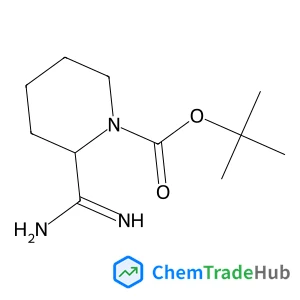
2-Methyl-2-propanyl 2-carbamimidoyl-1-piperidinecarboxylate
CAS Number:
1258640-98-0
Molecular Formula:
C11H21N3O2
Recommended Suppliers





Disclaimer
This page provides academic journal information for reference and research purposes only. We are not affiliated with any journal publishers and do not handle publication submissions. For publication-related inquiries, please contact the respective journal publishers directly.
If you notice any inaccuracies in the information displayed, please contact us at support@chemtradehub.com. We will promptly review and address your concerns.