












Tuning dispersity of linear polymers and polymeric brushes grown from nanoparticles by atom transfer radical polymerization
Literature Information
Publication Date
2021-10-13
DOI
10.1039/D1PY01178B
Impact Factor
5.582
Authors
Rongguan Yin, Zongyu Wang, Michael R. Bockstaller, Krzysztof Matyjaszewski
View Original
Abstract
Molecular weight distribution imposes considerable influence on the properties of polymers, making it an important parameter, impacting morphology and structural behavior of polymeric materials. Atom transfer radical polymerization (ATRP) has established itself as a powerful tool to prepare polymers with predetermined molecular weight, preserved chain-end functionality, and low dispersity. More recently, ATRP has also been shown to provide a means to deliberately broaden molecular weight distributions, and, via retaining living chain-ends, to enable the formation of block copolymers with designed block dispersity, featuring new microstructures and potentially attractive properties. Similar methodologies have been developed to facilitate tuning of the dispersity of polymeric brushes grown from nanoparticles thus resulting in hybrid materials with enhanced fracture toughness and high inorganic content. Recent advances have given access to brush architectures comprised of uni- and bimodal block copolymers with unique morphologies along with interesting mechanical, thermal, and optical properties.
Related Literature
Selective 1,3-complexation of p-tBu-calix[4]arene by [TiCp2Me2]
Colin L. Raston
2003-11-25
Communication
DOI: 10.1039/B309455C
Facile fabrication of composites of platinum nanoparticles and amorphous carbon films by catalyzed carbonization of cellulose fibers
Junhui He, Toyoki Kunitake, Aiko Nakao
2004-01-20
Communication
DOI: 10.1039/B314407K
Multiple active oxidants in competitive epoxidations catalyzed by porphyrins and corroles
James P. Collman, Li Zeng, Richard A. Decréau
2003-11-03
Communication
DOI: 10.1039/B310763A
VIII(OH){O2C–C6H4–CO2}.(HO2C–C6H4–CO2H)x(DMF)y(H2O)z (or MIL-68), a new vanadocarboxylate with a large pore hybrid topology : reticular synthesis with infinite inorganic building blocks?
K. Barthelet, J. Marrot, G. Férey, D. Riou
2004-02-05
Communication
DOI: 10.1039/B312589K
Mixed halo/hydroxy carborane anions: thermally stable platforms for hydronium ion isolation
Daniel J. Stasko, Kevin J. Perzynski, Mark A. Wasil
2004-02-16
Communication
DOI: 10.1039/B314475E
Modelling catalytic turnover frequencies in ionic liquids: the determination of the bimolecular rate constant for solvent displacement from [(C6H6)Cr(CO)2Solv] in 1-n-butyl-3-methylimidazolium hexafluorophosphate
Konrad Swiderski, Andrew McLean, Charles M. Gordon, D. H. Vaughan
2004-02-03
Communication
DOI: 10.1039/B315781D
Amine elimination synthesis of a titanium(IV) N-heterocyclic carbene complex with short intramolecular Cl⋯Ccarbene contacts
Colin D. Abernethy
2004-01-15
Communication
DOI: 10.1039/B314558A
Noncontact two-color luminescence thermometry based on intramolecular luminophore cyclization within an ionic liquid
Gary A. Baker, Sheila N. Baker, T. Mark McCleskey
2003-10-30
Communication
DOI: 10.1039/B310459C
First total synthesis of murisolin
Naoyoshi Maezaki, Hiroaki Tominaga, Naoto Kojima, Minori Yanai, Daisuke Urabe, Tetsuaki Tanaka
2004-01-19
Communication
DOI: 10.1039/B312362F
High quality CdSeS nanocrystals synthesized by facile single injection process and their electroluminescence
Eunjoo Jang, Shinae Jun, Lyongsun Pu
2003-11-07
Communication
DOI: 10.1039/B310853H
You might also like
Compound Q&A
What are the main uses of 1H-Indazole-6-carbonitrile (CAS: 141290-59-7)?
1H-Indazole-6-carbonitrile finds applications in pharmaceuticals, where it serve...
141290-59-71H-Indazole-6-carbon...
Compound Q&A
How should waste containing Dioctyl (2E)-2-butenedioate (CAS: 2997-85-5) be handled?
Waste containing Dioctyl (2E)-2-butenedioate (CAS: 2997-85-5) should be collecte...
2997-85-5Dioctyl (2E)-2-buten...
Compound Q&A
What industries use Sodium [(1,2-benzoxazol-3-ylmethyl)sulfonyl]azanide (CAS: 68291-98-5)?
Sodium [(1,2-benzoxazol-3-ylmethyl)sulfonyl]azanide is primarily used in pharmac...
68291-98-5Sodium [(1,2-benzoxa...
Compound Q&A
Are there alternatives to Dimethyl 4-(4,4,5,5-tetramethyl-1,3,2-dioxaborolan-2-yl)-2,6-pyridinedicarboxylate (CAS: 741709-66-0) in synthesis?
Dimethyl 4-(4,4,5,5-tetramethyl-1,3,2-dioxaborolan-2-yl)-2,6-pyridinedicarboxyla...
741709-66-0Dimethyl 4-(4,4,5,5-...
Compound Q&A
How should waste containing 2-Fluoro-6-hydrazinopyridine (CAS: 80714-39-2) be handled?
Waste containing 2-Fluoro-6-hydrazinopyridine (CAS: 80714-39-2) should be manage...
80714-39-22-Fluoro-6-hydrazino...
Compound Q&A
What is 6-Formyl-2-pyridinecarboxylic acid (CAS: 499214-11-8)?
6-Formyl-2-pyridinecarboxylic acid is an organic compound with the molecular for...
499214-11-86-Formyl-2-pyridinec...
Compound Q&A
What is the market or research trend for 3-(3,4-dimethoxyphenyl)-2,5-dimethyl-N-(2-morpholin-4-ylethyl)pyrazolo[1,5-a]pyrimidin-7-amine (CAS: 900874-91-1)?
Research trends for this compound indicate a focus on its potential applications...
900874-91-13-(3,4-dimethoxyphen...
Compound Q&A
How is 9H-Tribenzo[b,d,f]azepine (CAS: 29875-73-8) typically synthesized?
9H-Tribenzo[b,d,f]azepine is typically synthesized via a multi-step process invo...
29875-73-89H-Tribenzo[b,d,f]az...
Compound Q&A
How is 1-Cyclopropyl-7-ethoxy-6-fluoro-8-methoxy-4-oxo-1,4-dihydro-3-quinolinecarboxylic acid (CAS: 1797982-51-4) typically synthesized?
1-Cyclopropyl-7-ethoxy-6-fluoro-8-methoxy-4-oxo-1,4-dihydro-3-quinolinecarboxyli...
1797982-51-41-Cyclopropyl-7-etho...
Compound Q&A
How should waste containing Methyl 3-oxo-1,2,3,4-tetrahydro-6-quinoxalinecarboxylate (CAS: 671820-52-3) be handled?
Waste containing Methyl 3-oxo-1,2,3,4-tetrahydro-6-quinoxalinecarboxylate (CAS: ...
671820-52-3Methyl 3-oxo-1,2,3,4...
Source Journal
Polymer Chemistry

CiteScore:
8.6
Self-citation Rate:
7.3%
Articles per Year:
457
Polymer Chemistry welcomes submissions in all areas of polymer science that have a strong focus on macromolecular chemistry. Manuscripts may cover a broad range of fields, yet no direct application focus is required.
Recommended Compounds
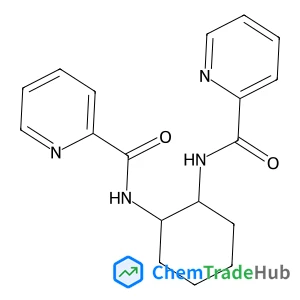
N,N'-(1R,2R)-1,2-Cyclohexanediyldi(2-pyridinecarboxamide)
CAS Number:
218290-24-5
Molecular Formula:
C18H20N4O2
Recommended Suppliers





Disclaimer
This page provides academic journal information for reference and research purposes only. We are not affiliated with any journal publishers and do not handle publication submissions. For publication-related inquiries, please contact the respective journal publishers directly.
If you notice any inaccuracies in the information displayed, please contact us at support@chemtradehub.com. We will promptly review and address your concerns.