












Imidazole based dual photo/thermal initiators for highly efficient radical polymerization under air with a metal-free approach‡
Literature Information
Publication Date
2021-10-22
DOI
10.1039/D1PY01079D
Impact Factor
5.582
Authors
View Original
Abstract
By virtue of remarkable spatial resolution, a metal-free visible LED photopolymerization process, initiated by imidazole based charge transfer complexes under mild conditions (room temperature, without an inert atmosphere, monomer purification or stabilizer removal), is reported. For two multifunctional acrylate monomers, an outstanding photoinitiating ability was proved (up to 80% of acrylate function conversion) by combining imidazoles (electron donors) and iodonium salts (electron acceptors) under 405 nm LED irradiation. 3D printing experiments using a low intensity 3D printer are reported to demonstrate the performance of this CTC approach. Meanwhile, the thermal polymerization features a relatively low thermal initiating temperature, making the process more pursuable and also easier to achieve for thick samples in practice and/or polymerization in shadow areas (where light does not penetrate). As a new dual photo/thermal initiator, it showcases tremendous potential for 3D printing with high resolution and high-tech composites. This dual initiating system represents a new type of thermal initiator toward a safer way (peroxide-free) and provides a new pathway for surface repairing or modifying of direct laser writing in a low toxicity, facile manner.
Related Literature
A facile AuNPs@aptamer-modified mercaptosiloxane-based hybrid affinity monolith with an unusually high coverage density of aptamer for on-column selective extraction of ochratoxin A
Maolin Chen, Lijun Deng, Xucong Lin, Zenghong Xie
2018-09-14
Paper
DOI: 10.1039/C8AN01531G
Desktop NMR for structure elucidation and identification of strychnine adulteration
Kawarpal Singh, Bernhard Blümich
2017-03-15
Paper
DOI: 10.1039/C7AN00020K
Spectrophotometric analysis at the single-cell level: elucidating dispersity within melanic immortalized cell populations
Gerardo Gutiérrez-Juárez, David Cywiak, Rafael Pérez-Solano, Gary A. Baker
2017-03-13
Paper
DOI: 10.1039/C6AN02662A
Size-dependent adsorption and its application in determining the number of surfactant molecule adsorbed on multimodal SiO2 particles by 2D-DCS
Guolan Tian, Lan Chen, Renxiao Liu, Guanglu Ge
2018-08-14
Paper
DOI: 10.1039/C8AN01068D
Digital enzyme assay using attoliter droplet array
Takao Ono, Takanori Ichiki
2018-09-17
Paper
DOI: 10.1039/C8AN01152D
A dual chemosensor for Cu2+ and Hg2+ based on a rhodamine-terminated water-soluble polymer in 100% aqueous solution
Guang Li, Liping Bai, Farong Tao, Aixia Deng, Liping Wang
2018-09-17
Paper
DOI: 10.1039/C8AN01130C
Infrared imaging of high density protein arrays
Joëlle De Meutter, Julie Vandenameele, André Matagne, Erik Goormaghtigh
2016-11-28
Paper
DOI: 10.1039/C6AN02048H
Recent advances in boronic acid-based optical chemosensors
Xuan-Xuan Chen, Yun-Bao Jiang
2017-04-04
Minireview
DOI: 10.1039/C7AN00439G
In vivo detection of drug-induced apoptosis in tumors using Raman spectroscopy
Oliver Jonas, Jeon Woong Kang, Surya P. Singh, Alex Lammers, Freddy T. Nguyen, Ramachandra R. Dasari, Peter T. C. So, Robert Langer
2018-07-30
Communication
DOI: 10.1039/C8AN00913A
Virtual staining of colon cancer tissue by label-free Raman micro-spectroscopy
D. Petersen, L. Mavarani, D. Niedieker, E. Freier, A. Tannapfel, C. Kötting, K. Gerwert, S. F. El-Mashtoly
2016-11-03
Paper
DOI: 10.1039/C6AN02072K
You might also like
Compound Q&A
What is the market or research trend for N-(4-Methoxybenzyl)-2-pyridinamine (CAS: 52818-63-0)?
N-(4-Methoxybenzyl)-2-pyridinamine (CAS: 52818-63-0) is increasingly being used ...
52818-63-0N-(4-Methoxybenzyl)-...
Compound Q&A
What precautions should be taken when handling Ethyl 4-(2-chlorophenyl)-1,3-thiazole-2-carboxylate (CAS: 1050507-06-6)?
When handling Ethyl 4-(2-chlorophenyl)-1,3-thiazole-2-carboxylate, appropriate p...
1050507-06-6Ethyl 4-(2-chlorophe...
Compound Q&A
What regulatory guidelines apply to diethyldiselane (CAS: 628-39-7)?
Diethyldiselane (CAS: 628-39-7) is classified under the Globally Harmonized Syst...
628-39-7Diethyldiselane
Compound Q&A
What is the market or research trend for oxocopper (CAS: 12053-18-8)?
The market for oxocopper (CAS: 12053-18-8) is primarily driven by its use in cat...
12053-18-8oxocopper; oxo-(oxoc...
Compound Q&A
What is the market or research trend for 5-{[(2-Methyl-2-propanyl)oxy]carbonyl}-5-azaspiro[2.4]heptane-7-carboxylic acid?
The market for 5-{[(2-Methyl-2-propanyl)oxy]carbonyl}-5-azaspiro[2.4]heptane-7-c...
1268519-54-55-{[(2-Methyl-2-prop...
Compound Q&A
What is 2-(1-Pyrrolidinyl)-4-pyridinamine (CAS: 35981-63-6)?
2-(1-Pyrrolidinyl)-4-pyridinamine is a chemical compound with the CAS number 359...
35981-63-62-(1-Pyrrolidinyl)-4...
Compound Q&A
What are the physical and chemical properties of 2-(3-Pyridinyl)-1-azabicyclo[2.2.2]octane (CAS: 91556-75-1)?
2-(3-Pyridinyl)-1-azabicyclo[2.2.2]octane (CAS: 91556-75-1) is a crystalline sol...
91556-75-12-(3-Pyridinyl)-1-az...
Compound Q&A
How is (S)-Alpha-allyl-proline hydrochloride (CAS: 129704-91-2) typically synthesized?
(S)-Alpha-allyl-proline hydrochloride is usually synthesized via a Wittig reacti...
129704-91-2(S)-Alpha-allyl-prol...
Compound Q&A
What is 3-Methyl-1,2-oxazole-5-carboxylic acid (CAS: 4857-42-5)?
3-Methyl-1,2-oxazole-5-carboxylic acid (CAS: 4857-42-5) is an organic compound w...
4857-42-53-Methyl-1,2-oxazole...
Compound Q&A
How is Lys-SMCC-DM1 (CAS: 1281816-04-3) typically synthesized?
Lys-SMCC-DM1 is synthesized via a multi-step process involving the coupling of S...
1281816-04-3Lys-SMCC-DM1
Source Journal
Polymer Chemistry

CiteScore:
8.6
Self-citation Rate:
7.3%
Articles per Year:
457
Polymer Chemistry welcomes submissions in all areas of polymer science that have a strong focus on macromolecular chemistry. Manuscripts may cover a broad range of fields, yet no direct application focus is required.
Recommended Compounds
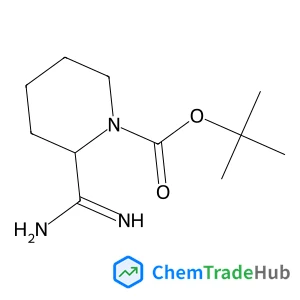
2-Methyl-2-propanyl 2-carbamimidoyl-1-piperidinecarboxylate
CAS Number:
1258640-98-0
Molecular Formula:
C11H21N3O2
Recommended Suppliers



Disclaimer
This page provides academic journal information for reference and research purposes only. We are not affiliated with any journal publishers and do not handle publication submissions. For publication-related inquiries, please contact the respective journal publishers directly.
If you notice any inaccuracies in the information displayed, please contact us at support@chemtradehub.com. We will promptly review and address your concerns.