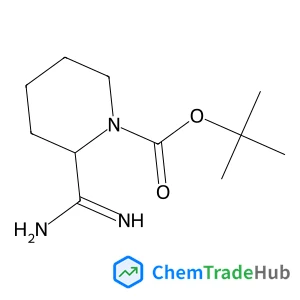
2-Methyl-2-propanyl 2-carbamimidoyl-1-piperidinecarboxylate
CAS Number:
1258640-98-0
Molecular Formula:
C11H21N3O2
Guolan Tian, Lan Chen, Renxiao Liu, Guanglu Ge
Quantitative analysis using surfactant–particles interaction is the basis for many applications. In situ measurements of surfactant adsorption on nanoparticles are important to understanding adsorption kinetics. However, it is quite difficult to determine the individual numbers for each monomodal particles in a multimodal mixture system by current technologies. To cope with this problem, a new method, i.e. 2D differential centrifugal sedimentation (2D-DCS), has been developed and applied in situ to measure the number of CTAB molecules adsorbed on the surface of silica particles, assuming that the adlayer is composed of a compact CTAB monolayer. Results show that 2D-DCS can measure the adsorption amount for particles not only with single size distribution but also with multiple size distributions. The number of adsorbed CTAB per nm2 on silica particles determined by 2D-DCS are 1.4 and 3.9 for the monomodal particles of 210 and 1000 nm, respectively, which is similar to that measured by ζ-potential, DLS and UV-vis spectrometry, and 1.4, 2.3 and 2.5 for 210, 430 and 700 nm particles, respectively, for a trimodal particle system, where the size-dependent adsorption is difficult to be simultaneously measured by other technologies.
Shinji Aono, Takashi Hosoya, Shigeyoshi Sakaki
DOI: 10.1039/C3CP43892A
Kai Welke, Hiroshi C. Watanabe, Tino Wolter, Marcus Elstner
DOI: 10.1039/C3CP44181D
Alex Domingo, Martin Vérot, Fernando Mota, Juan J. Novoa, Vincent Robert
DOI: 10.1039/C3CP44647F
Giuseppe Graziano
DOI: 10.1039/C3CP50616A
Yimin Cui, Wei Liu, Rongming Wang
DOI: 10.1039/C3CP00132F
M. Sadeghi
DOI: 10.1039/C3CP44563A
Martin Thomas, Martin Brehm, Reinhold Fligg, Peter Vöhringer, Barbara Kirchner
DOI: 10.1039/C3CP44302G
Christoph Kölbl, Beate Stempfle
DOI: 10.1039/C3CP44693J
R. E. Ovcharenko, I. I. Tupitsyn, E. P. Savinov, E. N. Voloshina, B. Paulus, Yu. S. Dedkov, A. S. Shulakov
DOI: 10.1039/C3CP44304C
N-(4-Methoxybenzyl)-2-pyridinamine (CAS: 52818-63-0) is increasingly being used ...
When handling Ethyl 4-(2-chlorophenyl)-1,3-thiazole-2-carboxylate, appropriate p...
Diethyldiselane (CAS: 628-39-7) is classified under the Globally Harmonized Syst...
The market for oxocopper (CAS: 12053-18-8) is primarily driven by its use in cat...
The market for 5-{[(2-Methyl-2-propanyl)oxy]carbonyl}-5-azaspiro[2.4]heptane-7-c...
2-(1-Pyrrolidinyl)-4-pyridinamine is a chemical compound with the CAS number 359...
2-(3-Pyridinyl)-1-azabicyclo[2.2.2]octane (CAS: 91556-75-1) is a crystalline sol...
(S)-Alpha-allyl-proline hydrochloride is usually synthesized via a Wittig reacti...
3-Methyl-1,2-oxazole-5-carboxylic acid (CAS: 4857-42-5) is an organic compound w...
Lys-SMCC-DM1 is synthesized via a multi-step process involving the coupling of S...

Analyst publishes analytical and bioanalytical research that reports premier fundamental discoveries and inventions, and the applications of those discoveries, unconfined by traditional discipline barriers.
![1-[6-(1H-Imidazol-1-yl)-3-pyridinyl]methanamine structure](https://static.chemtradehub.com/structs/914/914637-08-4-8825.webp "1-[6-(1H-Imidazol-1-yl)-3-pyridinyl]methanamine structure")