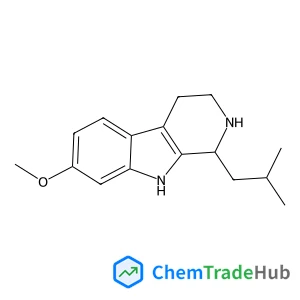
1-Isobutyl-7-methoxy-2,3,4,9-tetrahydro-1H-beta-carboline
CAS Number:
175975-76-5
Molecular Formula:
C16H22N2O
A graphical abstract is available for this content
Oleg M. Sarkisov, Fedor E. Gostev, Vladimir I. Novoderezhkin, Oxana A. Gopta, Mahir D. Mamedov, Alexey Yu. Semenov
DOI: 10.1039/B605660A
Alexander Kyrychenko, Randolph P. Thummel, Jacek Waluk, Bernhard Brutschy, Jerzy Herbich
DOI: 10.1039/B703908E
Enrico Di Cera, Michael J. Page, Alaji Bah, Leslie A. Bush-Pelc, Laura C. Garvey
DOI: 10.1039/B616819A
A. E. Boguslavskiy, J. P. Maier
DOI: 10.1039/B613109C
Bradley F. Parsons, Sean M. Sheehan, Terry A. Yen, Daniel M. Neumark, Nadine Wehres, Rainer Weinkauf
DOI: 10.1039/B703045B
Vytautas Balevicius, Ruta Bariseviciute, Kestutis Aidas, Ingrid Svoboda, Helmut Ehrenberg, Hartmut Fuess
DOI: 10.1039/B701775H
DOI: 10.1039/B614121H
A. K. Soper
DOI: 10.1039/B701855J
Ilko Bald, Iwona Dąbkowska, Eugen Illenberger, Oddur Ingólfsson
DOI: 10.1039/B702482G
N-(4-Methoxybenzyl)-2-pyridinamine (CAS: 52818-63-0) is increasingly being used ...
When handling Ethyl 4-(2-chlorophenyl)-1,3-thiazole-2-carboxylate, appropriate p...
Diethyldiselane (CAS: 628-39-7) is classified under the Globally Harmonized Syst...
The market for oxocopper (CAS: 12053-18-8) is primarily driven by its use in cat...
The market for 5-{[(2-Methyl-2-propanyl)oxy]carbonyl}-5-azaspiro[2.4]heptane-7-c...
2-(1-Pyrrolidinyl)-4-pyridinamine is a chemical compound with the CAS number 359...
2-(3-Pyridinyl)-1-azabicyclo[2.2.2]octane (CAS: 91556-75-1) is a crystalline sol...
(S)-Alpha-allyl-proline hydrochloride is usually synthesized via a Wittig reacti...
3-Methyl-1,2-oxazole-5-carboxylic acid (CAS: 4857-42-5) is an organic compound w...
Lys-SMCC-DM1 is synthesized via a multi-step process involving the coupling of S...

Physical Chemistry Chemical Physics (PCCP) is an international journal co-owned by 19 physical chemistry and physics societies from around the world. This journal publishes original, cutting-edge research in physical chemistry, chemical physics and biophysical chemistry. To be suitable for publication in PCCP, articles must include significant innovation and/or insight into physical chemistry; this is the most important criterion that reviewers and Editors will judge against when evaluating submissions. The journal has a broad scope and welcomes contributions spanning experiment, theory, computation and data science. Topical coverage includes spectroscopy, dynamics, kinetics, statistical mechanics, thermodynamics, electrochemistry, catalysis, surface science, quantum mechanics, quantum computing and machine learning. Interdisciplinary research areas such as polymers and soft matter, materials, nanoscience, energy, surfaces/interfaces, and biophysical chemistry are welcomed if they demonstrate significant innovation and/or insight into physical chemistry. Joined experimental/theoretical studies are particularly appreciated when complementary and based on up-to-date approaches.
![N-{[(2-Methyl-2-propanyl)oxy]carbonyl}-L-methionylglycine structure](https://static.chemtradehub.com/structs/234/23446-03-9-e1e5.webp "N-{[(2-Methyl-2-propanyl)oxy]carbonyl}-L-methionylglycine structure")