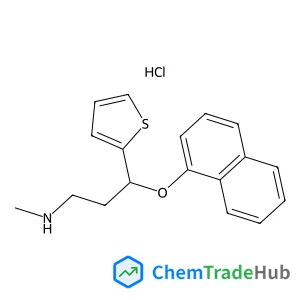
N-Methyl-3-(1-naphthyloxy)-3-(2-thienyl)-1-propanamine hydrochloride (1:1)
CAS Number:
1188266-11-6
Molecular Formula:
C18H20ClNOS
Vytautas Balevicius, Ruta Bariseviciute, Kestutis Aidas, Ingrid Svoboda, Helmut Ehrenberg, Hartmut Fuess
In this work the role of higher molecular aggregation in the proton transfer processes within hydrogen bond (H-bond) is investigated. The H-bonded complex consisting of 4-cyanopyridine (CyPy) with trichloroacetic acid (TCA) has been studied in the solutions of acetonitrile, carbon tetrachloride, chloroform and dichloroethane as solvent by FTIR spectroscopy and quantum chemical DFT calculations. In order to illustrate the effect of increasing H-bond strength FTIR investigations have also been performed on solutions of CyPy with H2O, acetic-, trifluoroacetic- and methanesulfonic acids. Proton states in the H-bond have been monitored using vibrational CyPy ring modes in FTIR spectra. The stabilization of the CyPy/TCA complex in its protonated form upon increasing polarity of the solvent has been evidenced. It was shown that formation of the CyPy/(TCA)2 aggregates in the solutions favors the proton transfer process. An X-ray diffraction study has been performed on a single 1 : 2 co-crystal of pyridine/3,5-dinitrobenzoic acid. The H-bond motif found in this system exhibits the same connectivity by strong hydrogen bonds N–H+⋯O− and O–H⋯O as that in the CyPy/(TCA)2 complex predicted by DFT calculation. Certain discrepancies are observed in C–H⋯O connectivity only. The networks of H-bonds in both assemblies differ from those usually pictured for 1 : 2 base/carboxylic acid complexes in the literature.
Jiraya Kiriratnikom, Xin-Chen Yue, Jia-Liang Yang, Ying Wang, Shuo-Hong Chen, Ke-Ke Zhang, Cheng-Jian Zhang, Munir Ullah Khan
DOI: 10.1039/D1PY01013A
Pedro Salas-Ambrosio, Ségolène Antoine, Emmanuel Ibarboure, Olivier Sandre, Mark W. Grinstaff, Sébastien Lecommandoux, Colin Bonduelle
DOI: 10.1039/D1PY00995H
Gabriel Duaux, Etienne Fleury, Daniel Portinha
DOI: 10.1039/D1PY00990G
Jiajia Tan, Jinming Hu, Shiyong Liu
DOI: 10.1039/D1PY01095F
Alicja Balcerak, Dominika Kwiatkowska, Katarzyna Iwińska, Janina Kabatc
DOI: 10.1039/D0PY00763C
Taijun He, Zhenyu Xing, Yixing Wang, Difeng Wu, Yang Liu, Xiangyang Liu
DOI: 10.1039/D0PY00860E
Priscila Quiñonez-Angulo, Robin A. Hutchinson, Ángel Licea-Claveríe, Enrique Saldívar-Guerra, Iván Zapata-González
DOI: 10.1039/D1PY00750E
Heli A. Brahmbhatt, Alexander Surtees, Cavan Tierney, Oluwabukunmi A. Ige, Elena V. Piletska, Thomas Swift
DOI: 10.1039/D0PY00921K
N-(4-Methoxybenzyl)-2-pyridinamine (CAS: 52818-63-0) is increasingly being used ...
When handling Ethyl 4-(2-chlorophenyl)-1,3-thiazole-2-carboxylate, appropriate p...
Diethyldiselane (CAS: 628-39-7) is classified under the Globally Harmonized Syst...
The market for oxocopper (CAS: 12053-18-8) is primarily driven by its use in cat...
The market for 5-{[(2-Methyl-2-propanyl)oxy]carbonyl}-5-azaspiro[2.4]heptane-7-c...
2-(1-Pyrrolidinyl)-4-pyridinamine is a chemical compound with the CAS number 359...
2-(3-Pyridinyl)-1-azabicyclo[2.2.2]octane (CAS: 91556-75-1) is a crystalline sol...
(S)-Alpha-allyl-proline hydrochloride is usually synthesized via a Wittig reacti...
3-Methyl-1,2-oxazole-5-carboxylic acid (CAS: 4857-42-5) is an organic compound w...
Lys-SMCC-DM1 is synthesized via a multi-step process involving the coupling of S...

Physical Chemistry Chemical Physics (PCCP) is an international journal co-owned by 19 physical chemistry and physics societies from around the world. This journal publishes original, cutting-edge research in physical chemistry, chemical physics and biophysical chemistry. To be suitable for publication in PCCP, articles must include significant innovation and/or insight into physical chemistry; this is the most important criterion that reviewers and Editors will judge against when evaluating submissions. The journal has a broad scope and welcomes contributions spanning experiment, theory, computation and data science. Topical coverage includes spectroscopy, dynamics, kinetics, statistical mechanics, thermodynamics, electrochemistry, catalysis, surface science, quantum mechanics, quantum computing and machine learning. Interdisciplinary research areas such as polymers and soft matter, materials, nanoscience, energy, surfaces/interfaces, and biophysical chemistry are welcomed if they demonstrate significant innovation and/or insight into physical chemistry. Joined experimental/theoretical studies are particularly appreciated when complementary and based on up-to-date approaches.
![1,10-bis(3,5-dimethylphenyl)-12-hydroxy-4,5,6,7-tetrahydroiindeno[7,1-de:1',7'-fg][1,3,2]dioxaphosphocine 12-oxide structure](https://static.chemtradehub.com/structs/141/1412439-82-7-b9a9.webp "1,10-bis(3,5-dimethylphenyl)-12-hydroxy-4,5,6,7-tetrahydroiindeno[7,1-de:1',7'-fg][1,3,2]dioxaphosphocine 12-oxide structure")