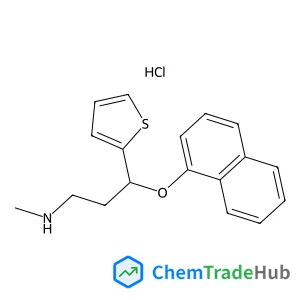
N-Methyl-3-(1-naphthyloxy)-3-(2-thienyl)-1-propanamine hydrochloride (1:1)
CAS Number:
1188266-11-6
Molecular Formula:
C18H20ClNOS
Oleg M. Sarkisov, Fedor E. Gostev, Vladimir I. Novoderezhkin, Oxana A. Gopta, Mahir D. Mamedov, Alexey Yu. Semenov
The pulsed excitation of electronic levels coupled to specific nuclear modes by a 26 fs laser pulse at 706 nm creates a wavepacket in the nuclear space of photopystem I (PS I) of Synechocystis sp. strain PCC 6803 both in the ground state and in the one-exciton manifold. Fourier transform of transient decay curves shows several low frequency peaks. The most prominent Power Spectral Density (PSD) peaks are at ω = 49 cm−1 and ω = 88 cm−1. The peculiarity of the coherent wavepacket in the PS I of S. sp. strain PCC 6803 is the unique, long-lived 49 cm−1 and 88 cm−1 oscillations with decay times up to 10 ps. It was suggested that such a long-lived coherence is determined by a contribution of the ground state wavepacket. The dependence of these two PSD peaks on the probe wavelength resembles the profile of the transient absorption spectra of PS I. The pump–probe signal in the Soret region reflects the dynamics of the ground state wavepacket created by pulsed excitation of the Qy-band. It was shown that the multimode Brownian oscillator model allows a quantitative fit of the oscillatory patterns of the pump–probe signal to be obtained.

Journal of Peptide Science

Russian Journal of Organic Chemistry

Russian Journal of Bioorganic Chemistry

Journal of Saudi Chemical Society

Russian Journal of Coordination Chemistry

Russian Journal of General Chemistry

Crystallography Reports

Russian Chemical Bulletin

Russian Journal of Applied Chemistry

Chemistry Education Research and Practice
Heli A. Brahmbhatt, Alexander Surtees, Cavan Tierney, Oluwabukunmi A. Ige, Elena V. Piletska, Thomas Swift
DOI: 10.1039/D0PY00921K
Prantik Mondal, Gourhari Jana, Tuhin Subhra Pal, Nikhil K. Singha
DOI: 10.1039/D1PY00910A
Jiajia Tan, Jinming Hu, Shiyong Liu
DOI: 10.1039/D1PY01095F
Shenzhen Li, Guang Han
DOI: 10.1039/D0PY00627K
Ge-Ge Gu, Li-Yang Wang, Rong Zhang, Tian-Jun Yue, Bai-Hao Ren, Wei-Min Ren
DOI: 10.1039/D1PY01085A
Khalaf A. Jasim, Ibrahim F. Waheed
DOI: 10.1039/D1PY00964H
Zhaofan Yang, Shijie Liang, Baiqiao Liu, Jing Wang, Fan Yang, Qiaomei Chen, Chengyi Xiao, Zheng Tang, Weiwei Li
DOI: 10.1039/D1PY01188J
Kostas Parkatzidis, Manon Rolland, Nghia P. Truong, Athina Anastasaki
DOI: 10.1039/D1PY01044A
N-(4-Methoxybenzyl)-2-pyridinamine (CAS: 52818-63-0) is increasingly being used ...
When handling Ethyl 4-(2-chlorophenyl)-1,3-thiazole-2-carboxylate, appropriate p...
Diethyldiselane (CAS: 628-39-7) is classified under the Globally Harmonized Syst...
The market for oxocopper (CAS: 12053-18-8) is primarily driven by its use in cat...
The market for 5-{[(2-Methyl-2-propanyl)oxy]carbonyl}-5-azaspiro[2.4]heptane-7-c...
2-(1-Pyrrolidinyl)-4-pyridinamine is a chemical compound with the CAS number 359...
2-(3-Pyridinyl)-1-azabicyclo[2.2.2]octane (CAS: 91556-75-1) is a crystalline sol...
(S)-Alpha-allyl-proline hydrochloride is usually synthesized via a Wittig reacti...
3-Methyl-1,2-oxazole-5-carboxylic acid (CAS: 4857-42-5) is an organic compound w...
Lys-SMCC-DM1 is synthesized via a multi-step process involving the coupling of S...

Physical Chemistry Chemical Physics (PCCP) is an international journal co-owned by 19 physical chemistry and physics societies from around the world. This journal publishes original, cutting-edge research in physical chemistry, chemical physics and biophysical chemistry. To be suitable for publication in PCCP, articles must include significant innovation and/or insight into physical chemistry; this is the most important criterion that reviewers and Editors will judge against when evaluating submissions. The journal has a broad scope and welcomes contributions spanning experiment, theory, computation and data science. Topical coverage includes spectroscopy, dynamics, kinetics, statistical mechanics, thermodynamics, electrochemistry, catalysis, surface science, quantum mechanics, quantum computing and machine learning. Interdisciplinary research areas such as polymers and soft matter, materials, nanoscience, energy, surfaces/interfaces, and biophysical chemistry are welcomed if they demonstrate significant innovation and/or insight into physical chemistry. Joined experimental/theoretical studies are particularly appreciated when complementary and based on up-to-date approaches.