


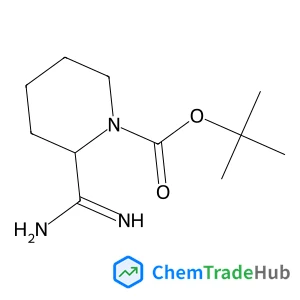
2-Methyl-2-propanyl 2-carbamimidoyl-1-piperidinecarboxylate
CAS Number:
1258640-98-0
Molecular Formula:
C11H21N3O2
Tatsuo Shibata, Nobuyuki Sakai, Katsutoshi Fukuda, Yasuo Ebina, Takayoshi Sasaki
We examined the photochemical properties of well-ordered multilayer films of titania nanosheets prepared on quartz-glass substrate using the layer-by-layer deposition method. The photocatalytic decomposition of gaseous 2-propanol and bleaching of Methylene Blue dye under UV light illumination were measured to evaluate the photocatalytic oxidation ability. Photoinduced hydrophilicity was also studied by measuring the contact angle of water droplets on the film. The results indicated that titania nanosheets had good photoinduced hydrophilicity. The monolayer film of titania nanosheets showed almost identical activity compared with well investigated sol-gel derived anatase TiO2 film, while its photocatalytic oxidation activity was low by more than an order of magnitude. This fact suggests that photoinduced hydrophilicity could not be explained simply in terms of the photocatalytic removal of hydrophobic organic species adsorbed on the surface. The photocatalytic oxidation activity and the photoinduced hydrophilic conversion rate decreased with increasing number of nanosheet layers, suggesting that photogenerated carriers produced in the internal part of the multilayer films can hardly diffuse to the surface layer. Photochemical properties of ultrathin anatase films obtained simply by heating the titania nanosheet films were evaluated as well, and also revealed high photoinduced hydrophilicity.

Russian Journal of Coordination Chemistry

Russian Journal of Organic Chemistry

Chemical Communications

Crystallography Reports

Journal of Natural Medicines

Drug Discovery Today

Russian Journal of Applied Chemistry

Russian Journal of Bioorganic Chemistry

Chemistry Education Research and Practice

Journal of Saudi Chemical Society
Jonny J. Blaker, Constantinos Soutis, François Tournilhac, Matthieu Gresil
DOI: 10.1039/D0PY00342E
Hideto Tsuji, Kazumasa Iguchi, Kohji Tashiro, Yuki Arakawa
DOI: 10.1039/D0PY01115K
Heli A. Brahmbhatt, Alexander Surtees, Cavan Tierney, Oluwabukunmi A. Ige, Elena V. Piletska, Thomas Swift
DOI: 10.1039/D0PY00921K
Shuang Zhu, Lianlei Wen, Yan Xiao, Meidong Lang
DOI: 10.1039/D0PY00865F
Khalaf A. Jasim, Ibrahim F. Waheed
DOI: 10.1039/D1PY00964H
Shenzhen Li, Guang Han
DOI: 10.1039/D0PY00627K
David K. Tran, Ahmed Z. Rashad, Donald J. Darensbourg
DOI: 10.1039/D1PY00784J
Gabriel Duaux, Etienne Fleury, Daniel Portinha
DOI: 10.1039/D1PY00990G
Matthias Rohmer, Özgün Ucak, Rahul Fredrick, Wolfgang H. Binder
DOI: 10.1039/D1PY01021B
Yoshihiko Kimura, Makoto Ouchi, Takaya Terashima
DOI: 10.1039/D0PY00685H
N-(4-Methoxybenzyl)-2-pyridinamine (CAS: 52818-63-0) is increasingly being used ...
When handling Ethyl 4-(2-chlorophenyl)-1,3-thiazole-2-carboxylate, appropriate p...
Diethyldiselane (CAS: 628-39-7) is classified under the Globally Harmonized Syst...
The market for oxocopper (CAS: 12053-18-8) is primarily driven by its use in cat...
The market for 5-{[(2-Methyl-2-propanyl)oxy]carbonyl}-5-azaspiro[2.4]heptane-7-c...
2-(1-Pyrrolidinyl)-4-pyridinamine is a chemical compound with the CAS number 359...
2-(3-Pyridinyl)-1-azabicyclo[2.2.2]octane (CAS: 91556-75-1) is a crystalline sol...
(S)-Alpha-allyl-proline hydrochloride is usually synthesized via a Wittig reacti...
3-Methyl-1,2-oxazole-5-carboxylic acid (CAS: 4857-42-5) is an organic compound w...
Lys-SMCC-DM1 is synthesized via a multi-step process involving the coupling of S...

Physical Chemistry Chemical Physics (PCCP) is an international journal co-owned by 19 physical chemistry and physics societies from around the world. This journal publishes original, cutting-edge research in physical chemistry, chemical physics and biophysical chemistry. To be suitable for publication in PCCP, articles must include significant innovation and/or insight into physical chemistry; this is the most important criterion that reviewers and Editors will judge against when evaluating submissions. The journal has a broad scope and welcomes contributions spanning experiment, theory, computation and data science. Topical coverage includes spectroscopy, dynamics, kinetics, statistical mechanics, thermodynamics, electrochemistry, catalysis, surface science, quantum mechanics, quantum computing and machine learning. Interdisciplinary research areas such as polymers and soft matter, materials, nanoscience, energy, surfaces/interfaces, and biophysical chemistry are welcomed if they demonstrate significant innovation and/or insight into physical chemistry. Joined experimental/theoretical studies are particularly appreciated when complementary and based on up-to-date approaches.
![(2R,6S)-6-[(Benzyloxy)methyl]-4-{[(2-methyl-2-propanyl)oxy]carbonyl}-2-morpholinecarboxylic acid structure](https://static.chemtradehub.com/structs/109/1093085-91-6-3382.webp "(2R,6S)-6-[(Benzyloxy)methyl]-4-{[(2-methyl-2-propanyl)oxy]carbonyl}-2-morpholinecarboxylic acid structure")
![N-{[(2-Methyl-2-propanyl)oxy]carbonyl}-L-methionylglycine structure](https://static.chemtradehub.com/structs/234/23446-03-9-e1e5.webp "N-{[(2-Methyl-2-propanyl)oxy]carbonyl}-L-methionylglycine structure")




