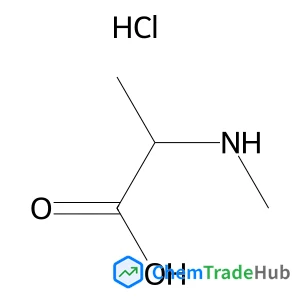
(R)-2-(Methylamino)propanoic acid hydrochloride
CAS Number:
1155878-14-0
Molecular Formula:
C4H10ClNO2
A graphical abstract is available for this content
Yang Li, Xumei Wang, Shuping Xu, Weiqing Xu
DOI: 10.1039/C3CP44309D
Jennifer M. Pringle
DOI: 10.1039/C2CP43267F
Jean-Pierre Veder, Kunal Patel, Junqiao Lee, Muhammad Tanzirul Alam, Andrew Nelson, Roland De Marco
DOI: 10.1039/C2CP43333H
Vaibhav S. Prabhudesai, E. Krishnakumar
DOI: 10.1039/C2CP42966G
Xuelu Ma, Xin Zhang, Wenchao Zhang
DOI: 10.1039/C2CP43401F
Kęstutis Aidas, Hans Ågren, Jacob Kongsted
DOI: 10.1039/C2CP41993A
Alvaro Muñoz-Castro, Slavi C. Sevov
DOI: 10.1039/C2CP43196C
Gernot Engler, Kai Seefeld, Michael Schmitt, Jörg Tatchen, Oliver Grotkopp, Thomas J. J. Müller, Karl Kleinermanns
DOI: 10.1039/C2CP42859H
Angel A. J. Torriero, Jaka Sunarso, Maria Forsyth, Cristina Pozo-Gonzalo
DOI: 10.1039/C2CP43177G
Weiqi Li, Xin Zhou, Wei Quan Tian, Xiudong Sun
DOI: 10.1039/C2CP43536E
6-(3-Fluorophenyl)picolinic acid is generally considered safe for laboratory use...
(3R)-3-Pyrrolidinol is used in the pharmaceutical industry as a precursor for dr...
When handling (4R,5R)-4,5-Diethoxycarbonyl-2,2-dimethyldioxolane (CAS: 59779-75-...
1-(6-Chloroimidazo[1,2-b]pyridazin-3-yl)ethanone is often synthesized via a mult...
The market for N-Ethyl-3,4-dimethylbenzylamine (CAS: 39180-83-1) remains steady,...
Tert-butyl 3-(pyrrolidin-1-yl)azetidine-1-carboxylate is a chemical compound wit...
1-Bromo-3-chloro-2,4-dimethoxybenzene (CAS: 1228956-93-1) falls under the classi...
The safety of 8-Bromo-2-methyl-3,4-dihydroisoquinolin-1(2H)-one (CAS: 1368622-07...
Benzyl [(3S)-2,6-dioxo-3-piperidinyl]carbamate is generally safe when handled wi...
1-{[4-(4,4,5,5-Tetramethyl-1,3,2-dioxaborolan-2-yl)phenyl]sulfonyl}pyrrolidine s...

Physical Chemistry Chemical Physics (PCCP) is an international journal co-owned by 19 physical chemistry and physics societies from around the world. This journal publishes original, cutting-edge research in physical chemistry, chemical physics and biophysical chemistry. To be suitable for publication in PCCP, articles must include significant innovation and/or insight into physical chemistry; this is the most important criterion that reviewers and Editors will judge against when evaluating submissions. The journal has a broad scope and welcomes contributions spanning experiment, theory, computation and data science. Topical coverage includes spectroscopy, dynamics, kinetics, statistical mechanics, thermodynamics, electrochemistry, catalysis, surface science, quantum mechanics, quantum computing and machine learning. Interdisciplinary research areas such as polymers and soft matter, materials, nanoscience, energy, surfaces/interfaces, and biophysical chemistry are welcomed if they demonstrate significant innovation and/or insight into physical chemistry. Joined experimental/theoretical studies are particularly appreciated when complementary and based on up-to-date approaches.
![2-Methyl-2-propanyl [(2S)-1-hydroxy-3-(4-hydroxyphenyl)-2-propanyl]carbamate structure](https://static.chemtradehub.com/structs/833/83345-46-4-eec2.webp "2-Methyl-2-propanyl [(2S)-1-hydroxy-3-(4-hydroxyphenyl)-2-propanyl]carbamate structure")