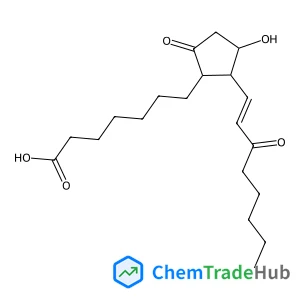
(11alpha,13E)-11-Hydroxy-9,15-dioxoprost-13-en-1-oic acid
CAS Number:
22973-19-9
Molecular Formula:
C20H32O5
Yang Li, Xumei Wang, Shuping Xu, Weiqing Xu
The solvent effect on the luminescence properties of highly stable water-soluble silver nanoclusters is discussed in this study. The polymer nanosphere templates swollen by organic solvents lead to the changes in the surrounding environments of silver nanoclusters, thus resulting in a significant influence on their luminescence.
B. Muthuraj, Sameer Hussain, Parameswar Krishnan Iyer
DOI: 10.1039/C3PY00680H
Venkata S. Pavan K. Neti, Xiaofei Wu, Shuguang Deng, Luis Echegoyen
DOI: 10.1039/C3PY00798G
Xiao Jiang, Wei Shao, Kun Jiang, Meijing Zhang, Huanhuan Liu, Chunnuan Ye, Youliang Zhao
DOI: 10.1039/C3PY00217A
Denis H. Seuyep N., Gerrit A. Luinstra, Patrick Theato
DOI: 10.1039/C3PY00109A
Wenbo Wu, Shaohui Xin, Zhen Xu, Cheng Ye, Jingui Qin, Zhen Li
DOI: 10.1039/C3PY00257H
Wen Guo, Hui Zou
DOI: 10.1039/C3PY00478C
6-(3-Fluorophenyl)picolinic acid is generally considered safe for laboratory use...
(3R)-3-Pyrrolidinol is used in the pharmaceutical industry as a precursor for dr...
When handling (4R,5R)-4,5-Diethoxycarbonyl-2,2-dimethyldioxolane (CAS: 59779-75-...
1-(6-Chloroimidazo[1,2-b]pyridazin-3-yl)ethanone is often synthesized via a mult...
The market for N-Ethyl-3,4-dimethylbenzylamine (CAS: 39180-83-1) remains steady,...
Tert-butyl 3-(pyrrolidin-1-yl)azetidine-1-carboxylate is a chemical compound wit...
1-Bromo-3-chloro-2,4-dimethoxybenzene (CAS: 1228956-93-1) falls under the classi...
The safety of 8-Bromo-2-methyl-3,4-dihydroisoquinolin-1(2H)-one (CAS: 1368622-07...
Benzyl [(3S)-2,6-dioxo-3-piperidinyl]carbamate is generally safe when handled wi...
1-{[4-(4,4,5,5-Tetramethyl-1,3,2-dioxaborolan-2-yl)phenyl]sulfonyl}pyrrolidine s...

Physical Chemistry Chemical Physics (PCCP) is an international journal co-owned by 19 physical chemistry and physics societies from around the world. This journal publishes original, cutting-edge research in physical chemistry, chemical physics and biophysical chemistry. To be suitable for publication in PCCP, articles must include significant innovation and/or insight into physical chemistry; this is the most important criterion that reviewers and Editors will judge against when evaluating submissions. The journal has a broad scope and welcomes contributions spanning experiment, theory, computation and data science. Topical coverage includes spectroscopy, dynamics, kinetics, statistical mechanics, thermodynamics, electrochemistry, catalysis, surface science, quantum mechanics, quantum computing and machine learning. Interdisciplinary research areas such as polymers and soft matter, materials, nanoscience, energy, surfaces/interfaces, and biophysical chemistry are welcomed if they demonstrate significant innovation and/or insight into physical chemistry. Joined experimental/theoretical studies are particularly appreciated when complementary and based on up-to-date approaches.