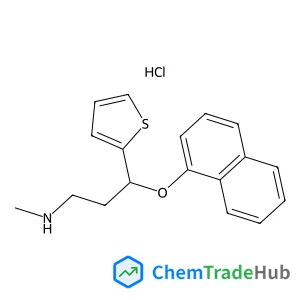
N-Methyl-3-(1-naphthyloxy)-3-(2-thienyl)-1-propanamine hydrochloride (1:1)
CAS Number:
1188266-11-6
Molecular Formula:
C18H20ClNOS
Jonny J. Blaker, Constantinos Soutis, François Tournilhac, Matthieu Gresil
The present study explores a broad range of stoichiometry, with the [epoxy]/[acyl] ratio ranging from excess to unity for commercial diepoxide/sebacic acid vitrimer formulations, with 1,5,7-triazabicyclo[4.4.0]dec-5-ene (TBD) used as the catalyst. In particular, it investigates to what extent side reactions promoted by off-stoichiometry mixtures can help achieve desirable thermomechanical properties (i.e. glass transition Tα, Young's modulus, strain at break, and strength) for an optimised vitrimer that behaves like a stiff material at room temperature, retaining its capacity to flow at high temperature while remaining insoluble. The possible role of TBD as an anionic initiator is tested in the homopolymerisation of epoxy and compared to a known anionic initiator, 2-phenylimidazole (2-PI). Attenuated total reflection infrared (ATR-IR) spectroscopy reveals different reaction speeds, but an identical scenario for either 2-PI or TBD. The acid + epoxy addition occurs first, then epoxy homopolymerisation takes place after di-carboxylic acid consumption; an ester typically forms in less than 20 min at 125 °C with TBD, while the formation of ether takes several hours. For all [epoxy]/[acyl] ratios ranging from 1 : 1 to 1 : 0.3, it is found that the integrity of the network is retained when subjected to 1,2,4 trichlorobenzene (TCB) solvent treatment. From the 1 : 1 to 1 : 0.75 epoxy to acyl ratio, the material retains full ability to flow and relax stresses under thermal stimulation, showing a 10 fold increase in viscosity and unchanged activation energy of about 100 kJ mol−1. Beyond 1 : 0.6 stoichiometry, a gradual transition from vitrimer to non-exchangeable crosslinked materials is observed as these networks show only partial stress relaxation due to interpenetration in the polyether network.
Philip J. R. Roche, Mohamed Najih, Seung S. Lee, Lenore K. Beitel, Matthew L. Carnevale, Andrew G. Kirk
DOI: 10.1039/C7AN00304H
Sang-Yong Lee, Xihuan Luo, Vigneshwaran Namasivayam, Jennifer Geiss, Salahuddin Mirza, Julie Pelletier, Holger Stephan, Christa E. Müller
DOI: 10.1039/C8AN01108G
Zanying Peng, Jin Lu, Ling Zhang, Yang Liu, Jinghong Li
DOI: 10.1039/C8AN01534A
D. Willingham, E. E. Groopman, K. S. Grabowski, L. Sangely
DOI: 10.1039/C8AN01451E
Takao Ono, Takanori Ichiki
DOI: 10.1039/C8AN01152D
Sofia Moriam, Muhammad Umer, Nam-Trung Nguyen
DOI: 10.1039/C8AN01348A
Michael J. Pilling, Alex Henderson, Jonathan H. Shanks, Michael D. Brown, Noel W. Clarke, Peter Gardner
DOI: 10.1039/C6AN02224C
Lin Ma, Mengyue Zhang, Aijun Yang, Qin Wang, Fei Qu, Fengli Qu, Rong-Mei Kong
DOI: 10.1039/C8AN01556B
Hong-Ya Wang, Jin-Liang Ma, Bin-Cheng Yin
DOI: 10.1039/C7AN00293A
N-(4-Methoxybenzyl)-2-pyridinamine (CAS: 52818-63-0) is increasingly being used ...
When handling Ethyl 4-(2-chlorophenyl)-1,3-thiazole-2-carboxylate, appropriate p...
Diethyldiselane (CAS: 628-39-7) is classified under the Globally Harmonized Syst...
The market for oxocopper (CAS: 12053-18-8) is primarily driven by its use in cat...
The market for 5-{[(2-Methyl-2-propanyl)oxy]carbonyl}-5-azaspiro[2.4]heptane-7-c...
2-(1-Pyrrolidinyl)-4-pyridinamine is a chemical compound with the CAS number 359...
2-(3-Pyridinyl)-1-azabicyclo[2.2.2]octane (CAS: 91556-75-1) is a crystalline sol...
(S)-Alpha-allyl-proline hydrochloride is usually synthesized via a Wittig reacti...
3-Methyl-1,2-oxazole-5-carboxylic acid (CAS: 4857-42-5) is an organic compound w...
Lys-SMCC-DM1 is synthesized via a multi-step process involving the coupling of S...

Polymer Chemistry welcomes submissions in all areas of polymer science that have a strong focus on macromolecular chemistry. Manuscripts may cover a broad range of fields, yet no direct application focus is required.
![N-{[(2-Methyl-2-propanyl)oxy]carbonyl}-L-methionylglycine structure](https://static.chemtradehub.com/structs/234/23446-03-9-e1e5.webp "N-{[(2-Methyl-2-propanyl)oxy]carbonyl}-L-methionylglycine structure")