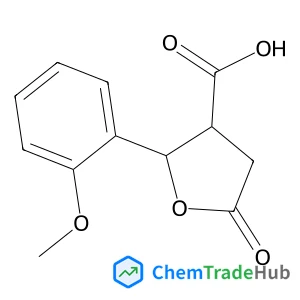
trans-2-(2-Methoxyphenyl)-5-oxotetrahydrofuran-3-carboxylic acid
CAS Number:
99226-02-5
Molecular Formula:
C12H12O5
Alessandra Candian, Joost M. Bakker, Giel Berden, John R. Eyler, Jos Oomens, Alexander G. G. M. Tielens
We present the gas-phase infrared spectra of the phenyl cation, phenylium, in its perprotio (C6H5+) and perdeutero (C6D5+) forms, in the 260–1925 cm−1 (5.2–38 μm) spectral range, and investigate the observed photofragmentation. The spectral and fragmentation data were obtained using Infrared Multiple Photon Dissociation (IRMPD) spectroscopy within a Fourier Transform Ion Cyclotron Resonance Mass Spectrometer (FTICR MS) located inside the cavity of the free electron laser FELICE (Free Electron Laser for Intra-Cavity Experiments). The 1A1 singlet nature of the phenylium ion is ascertained by comparison of the observed IR spectrum with DFT calculations, using both harmonic and anharmonic frequency calculations. To investigate the observed loss of predominantly [2C,nH] (n = 2–4) fragments, we explored the potential energy surface (PES) to unravel possible isomerization and fragmentation reaction pathways. The lowest energy pathways toward fragmentation include direct H elimination, and a combination of facile ring-opening mechanisms (≤2.4 eV), followed by elimination of H or CCH2. Energetically, all H-loss channels found are more easily accessible than CCH2-loss. Calculations of the vibrational density of states for the various intermediates show that at high internal energies, ring opening is thermodynamically the most advantageous, eliminating direct H-loss as a competing process. The observed loss of primarily [2C,2H] can be explained through entropy calculations that show favored loss of [2C,2H] at higher internal energies.
Deniz Sezer
DOI: 10.1039/C2CP42430D
Eliane M. de Oliveira, Romarly F. da Costa, Sergio d'A. Sanchez, Alexandra P. P. Natalense, Márcio H. F. Bettega, Márcio T. do N. Varella
DOI: 10.1039/C2CP43375C
Yufan He, Maolin Lu, H. Peter Lu
DOI: 10.1039/C2CP42944F
Aleix Comas-Vives, Jochen Bandlow, Timo Jacob
DOI: 10.1039/C2CP43054A
James M. R. Kirkbride, Sarah K. Causier, Elin A. McCormack, Grant A. D. Ritchie
DOI: 10.1039/C2CP44116K
Xuelu Ma, Xin Zhang, Wenchao Zhang
DOI: 10.1039/C2CP43401F
Xiangjie Bo, Liping Guo
DOI: 10.1039/C2CP43541A
Hirotaka Uji, Tomoyuki Morita, Shunsaku Kimura
DOI: 10.1039/C2CP43499G
Yang Li, Xumei Wang, Shuping Xu, Weiqing Xu
DOI: 10.1039/C3CP44309D
Walid M. I. Hassan, Yehea Ismail, Nageh K. Allam
DOI: 10.1039/C2CP43492J
6-(3-Fluorophenyl)picolinic acid is generally considered safe for laboratory use...
(3R)-3-Pyrrolidinol is used in the pharmaceutical industry as a precursor for dr...
When handling (4R,5R)-4,5-Diethoxycarbonyl-2,2-dimethyldioxolane (CAS: 59779-75-...
1-(6-Chloroimidazo[1,2-b]pyridazin-3-yl)ethanone is often synthesized via a mult...
The market for N-Ethyl-3,4-dimethylbenzylamine (CAS: 39180-83-1) remains steady,...
Tert-butyl 3-(pyrrolidin-1-yl)azetidine-1-carboxylate is a chemical compound wit...
1-Bromo-3-chloro-2,4-dimethoxybenzene (CAS: 1228956-93-1) falls under the classi...
The safety of 8-Bromo-2-methyl-3,4-dihydroisoquinolin-1(2H)-one (CAS: 1368622-07...
Benzyl [(3S)-2,6-dioxo-3-piperidinyl]carbamate is generally safe when handled wi...
1-{[4-(4,4,5,5-Tetramethyl-1,3,2-dioxaborolan-2-yl)phenyl]sulfonyl}pyrrolidine s...

Physical Chemistry Chemical Physics (PCCP) is an international journal co-owned by 19 physical chemistry and physics societies from around the world. This journal publishes original, cutting-edge research in physical chemistry, chemical physics and biophysical chemistry. To be suitable for publication in PCCP, articles must include significant innovation and/or insight into physical chemistry; this is the most important criterion that reviewers and Editors will judge against when evaluating submissions. The journal has a broad scope and welcomes contributions spanning experiment, theory, computation and data science. Topical coverage includes spectroscopy, dynamics, kinetics, statistical mechanics, thermodynamics, electrochemistry, catalysis, surface science, quantum mechanics, quantum computing and machine learning. Interdisciplinary research areas such as polymers and soft matter, materials, nanoscience, energy, surfaces/interfaces, and biophysical chemistry are welcomed if they demonstrate significant innovation and/or insight into physical chemistry. Joined experimental/theoretical studies are particularly appreciated when complementary and based on up-to-date approaches.
![(2E)-4-[(1R,2S,8R,19S,21R)-14-Hydroxy-11-isopropenyl-8,23,23-trimethyl-5-(3-methyl-2-buten-1-yl)-16,20-dioxo-3,7,22-trioxaheptacyclo[17.4.1.1~8,12~.0~2,17~.0~2,21~.0~4,15~.0~6,13~]pentacosa-4(15),5,13
,17-tetraen-21-yl]-2-methyl-2-butenoic acid structure](https://static.chemtradehub.com/structs/173/173867-04-4-d2d3.webp "(2E)-4-[(1R,2S,8R,19S,21R)-14-Hydroxy-11-isopropenyl-8,23,23-trimethyl-5-(3-methyl-2-buten-1-yl)-16,20-dioxo-3,7,22-trioxaheptacyclo[17.4.1.1~8,12~.0~2,17~.0~2,21~.0~4,15~.0~6,13~]pentacosa-4(15),5,13
,17-tetraen-21-yl]-2-methyl-2-butenoic acid structure")