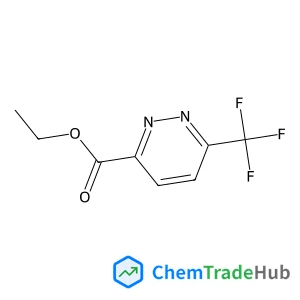
Ethyl 6-(trifluoromethyl)pyridazine-3-carboxylate
CAS Number:
1192155-06-8
Molecular Formula:
C8H7F3N2O2
Deniz Sezer
Dynamic nuclear polarization (DNP) employs paramagnetic species to increase the NMR signal of nuclear spins. In liquids, the efficiency of the effect depends on the strength of the interaction between the electron and nuclear spins and the time scales on which this interaction is modulated by the physical motion of the spin-bearing molecules. An approach to quantitatively predict the contribution of molecular motions to the DNP enhancement using molecular dynamics (MD) simulations is developed and illustrated for the nitroxide radical TEMPOL in liquid toluene. A multi-resolution strategy that combines explicit treatment of the solvent at short distances from the free radical with implicit description at large intermolecular distances is adopted. Novel analytical expressions are obtained to correct for the finite spatial extent of the MD simulations. The atomistic and analytical descriptions are sewn seamlessly together by ensuring that for molecular trajectories that start in the near (explicit) region and end in the distant (implicit) region the analytical dipolar spectral densities reproduce the MD estimates. The spectral densities obtained from the developed approach are used to calculate DNP coupling factors separately for the ring and methyl protons of toluene. The agreement with previously reported experimental DNP data at a magnetic field of 3.4 T is noteworthy and encouraging. Maximum obtainable DNP enhancements at other magnetic fields are predicted.
Kai-Steffen Krannig, Jin Huang, Andreas Heise, Helmut Schlaad
DOI: 10.1039/C3PY00428G
Johnathan N. Brantley, Constance B. Bailey, Kelly M. Wiggins
DOI: 10.1039/C3PY00001J
Chun Du, Weiwei Li, Yan Duan, Cuihong Li, Huanli Dong, Jia Zhu, Wenping Hu, Zhishan Bo
DOI: 10.1039/C3PY00177F
Jiang Yuan, Xiaobo Huang, Pengfei Li, Li Li
DOI: 10.1039/C3PY00565H
Ali Ghadban, Eric Reynaud, Marguerite Rinaudo, Luca Albertin
DOI: 10.1039/C3PY00730H
Xiuyu Jiang, Guolin Lu, Chun Feng, Yongjun Li, Xiaoyu Huang
DOI: 10.1039/C3PY00415E
6-(3-Fluorophenyl)picolinic acid is generally considered safe for laboratory use...
(3R)-3-Pyrrolidinol is used in the pharmaceutical industry as a precursor for dr...
When handling (4R,5R)-4,5-Diethoxycarbonyl-2,2-dimethyldioxolane (CAS: 59779-75-...
1-(6-Chloroimidazo[1,2-b]pyridazin-3-yl)ethanone is often synthesized via a mult...
The market for N-Ethyl-3,4-dimethylbenzylamine (CAS: 39180-83-1) remains steady,...
Tert-butyl 3-(pyrrolidin-1-yl)azetidine-1-carboxylate is a chemical compound wit...
1-Bromo-3-chloro-2,4-dimethoxybenzene (CAS: 1228956-93-1) falls under the classi...
The safety of 8-Bromo-2-methyl-3,4-dihydroisoquinolin-1(2H)-one (CAS: 1368622-07...
Benzyl [(3S)-2,6-dioxo-3-piperidinyl]carbamate is generally safe when handled wi...
1-{[4-(4,4,5,5-Tetramethyl-1,3,2-dioxaborolan-2-yl)phenyl]sulfonyl}pyrrolidine s...

Physical Chemistry Chemical Physics (PCCP) is an international journal co-owned by 19 physical chemistry and physics societies from around the world. This journal publishes original, cutting-edge research in physical chemistry, chemical physics and biophysical chemistry. To be suitable for publication in PCCP, articles must include significant innovation and/or insight into physical chemistry; this is the most important criterion that reviewers and Editors will judge against when evaluating submissions. The journal has a broad scope and welcomes contributions spanning experiment, theory, computation and data science. Topical coverage includes spectroscopy, dynamics, kinetics, statistical mechanics, thermodynamics, electrochemistry, catalysis, surface science, quantum mechanics, quantum computing and machine learning. Interdisciplinary research areas such as polymers and soft matter, materials, nanoscience, energy, surfaces/interfaces, and biophysical chemistry are welcomed if they demonstrate significant innovation and/or insight into physical chemistry. Joined experimental/theoretical studies are particularly appreciated when complementary and based on up-to-date approaches.
![2-[({[(2-Methyl-2-propanyl)oxy]carbonyl}amino)methyl]isonicotinic acid structure](https://static.chemtradehub.com/structs/473/473924-63-9-973b.webp "2-[({[(2-Methyl-2-propanyl)oxy]carbonyl}amino)methyl]isonicotinic acid structure")