












Magnetism and electronic structures of bismuth (stannum) films at the CrI3 (CrBr3) interface
Literature Information
Publication Date
2021-01-26
DOI
10.1039/D0CP05531J
Impact Factor
3.676
Authors
Chuan Jiang, Maoyou Yang, Tao Hu, Yan Meng, Jie Lei, Mingjian Zhang
View Original
Abstract
From first-principles calculations, the magnetism and electronic structures of bilayer bismuth (stannum) films at the monolayer CrI3 (CrBr3) interface are studied. The Curie temperature (TC) of CrX3 (X = Br, I) can be enhanced by coupling bilayer bismuth (Bi) with van der Waals (vdW) heterostructures. The n-doping of CrX3, induced by interlayer charge-transfer from the Bi film, leads to the enhancement of TC. The quantum spin Hall phases of bilayer bismuth and stannum films are destroyed by the magnetic substrate. Although the interface system of the bilayer stannum (Sn) film on a CrBr3 monolayer shows a band gap (57 meV), the inexistence of edge states with valence and conduction bands connected across the insulating gap is a manifestation of the trivial state without the feature of quantized anomalous Hall effect in the interface. The percentage reduction of the corresponding work function is 22.6%, 12.7%, 25.4% and 16.5% for Bi/CrI3, Sn/CrI3, Bi/CrBr3 and Sn/CrBr3 interface systems, respectively. Our findings demonstrate that the Bi(Sn)–CrI3(CrBr3) interface system with vdW engineering is an efficient way to tune magnetism and electronic structures, which is of importance for future applications in spintronics and nanoelectronics devices.
Related Literature
Dark excitons and tunable optical gap in graphene nanodots
Yingjie Zhang, Yang Li
2017-08-08
Paper
DOI: 10.1039/C7CP04591C
The mechanism of excimer formation: an experimental and theoretical study on the pyrene dimer
Joscha Hoche, Hans-Christian Schmitt, Alexander Humeniuk, Ingo Fischer, Roland Mitrić, Merle I. S. Röhr
2017-08-30
Paper
DOI: 10.1039/C7CP03990E
Temperature dependence of ion diffusion coefficients in NaCl electrolyte confined within graphene nanochannels
Jing Kong, Zheng Bo, Huachao Yang, Jinyuan Yang, Xiaorui Shuai, Jianhua Yan, Kefa Cen
2017-02-20
Paper
DOI: 10.1039/C6CP08752C
Trapping and sensing of hazardous insecticides by chemically modified single walled carbon nanotubes
Arkamita Bandyopadhyay, Dibyajyoti Ghosh
2017-08-16
Paper
DOI: 10.1039/C7CP04980C
First principles study of the Mn-doping effect on the physical and chemical properties of mullite-family Al2SiO5
Chaoping Liang, Yongping Zheng, Nickolas Ashburn, Young Jun Oh, Fantai Kong, Chenxi Zhang, Yifan Nie, Jian Sun, Kaihua He, Yu Ye, Rong Chen, Kyeongjae Cho
2017-08-29
Paper
DOI: 10.1039/C7CP04611A
Tunable phenol remediation from wastewater using SWCNT-based, sub-nanometer porous membranes: reactive molecular dynamics simulations and DFT calculations
F. Moradi, M. Darvish Ganji, Y. Sarrafi
2017-02-23
Paper
DOI: 10.1039/C6CP08525C
Near-infrared photochemistry at interfaces based on upconverting nanoparticles
Si Wu, Hans-Jürgen Butt
2017-05-03
Perspective
DOI: 10.1039/C7CP01838J
Ultrafast exciton dynamics in 2D in-plane hetero-nanostructures: delocalization and charge transfer
E. Cassette, S. Pedetti, B. Mahler, S. Ithurria, B. Dubertret, G. D. Scholes
2017-02-24
Paper
DOI: 10.1039/C6CP08689F
Modelling pH and potential in dynamic structures of the water/Pt(111) interface on the atomic scale
Martin Hangaard Hansen, Anders Nilsson, Jan Rossmeisl
2017-08-15
Paper
DOI: 10.1039/C7CP03576D
Pd-P nanoparticles supported on PxOy-incorporated carbon nanotubes for enhanced methanol oxidation in an alkaline medium
Yanan Xie, Weizhen Yu, Juan Wang, Yifei Wu, Shuo Niu, Wenyao Guo, Tsungwu Lin, Lidong Shao
2017-08-18
Paper
DOI: 10.1039/C7CP04540A
You might also like
Compound Q&A
Is 6-(3-Fluorophenyl)picolinic acid (CAS: 887982-40-3) safe?
6-(3-Fluorophenyl)picolinic acid is generally considered safe for laboratory use...
887982-40-36-(3-Fluorophenyl)pi...
Compound Q&A
What industries use (3R)-3-Pyrrolidinol (CAS: 2799-21-5)?
(3R)-3-Pyrrolidinol is used in the pharmaceutical industry as a precursor for dr...
2799-21-5(3R)-3-Pyrrolidinol
Compound Q&A
What precautions should be taken when handling (4R,5R)-4,5-Diethoxycarbonyl-2,2-dimethyldioxolane (CAS: 59779-75-8)?
When handling (4R,5R)-4,5-Diethoxycarbonyl-2,2-dimethyldioxolane (CAS: 59779-75-...
59779-75-8(4R,5R)-4,5-Diethoxy...
Compound Q&A
How is 1-(6-Chloroimidazo[1,2-b]pyridazin-3-yl)ethanone (CAS: 90734-71-7) typically synthesized?
1-(6-Chloroimidazo[1,2-b]pyridazin-3-yl)ethanone is often synthesized via a mult...
90734-71-71-(6-Chloroimidazo[1...
Compound Q&A
What is the market or research trend for N-Ethyl-3,4-dimethylbenzylamine (CAS: 39180-83-1)?
The market for N-Ethyl-3,4-dimethylbenzylamine (CAS: 39180-83-1) remains steady,...
39180-83-1N-Ethyl-3,4-dimethyl...
Compound Q&A
What is Tert-butyl 3-(pyrrolidin-1-yl)azetidine-1-carboxylate (CAS: 1019008-21-9)?
Tert-butyl 3-(pyrrolidin-1-yl)azetidine-1-carboxylate is a chemical compound wit...
1019008-21-9Tert-butyl 3-(pyrrol...
Compound Q&A
What regulatory guidelines apply to 1-Bromo-3-chloro-2,4-dimethoxybenzene (CAS: 1228956-93-1)?
1-Bromo-3-chloro-2,4-dimethoxybenzene (CAS: 1228956-93-1) falls under the classi...
1228956-93-11-Bromo-3-chloro-2,4...
Compound Q&A
Is 8-Bromo-2-methyl-3,4-dihydroisoquinolin-1(2H)-one (CAS: 1368622-07-4) safe?
The safety of 8-Bromo-2-methyl-3,4-dihydroisoquinolin-1(2H)-one (CAS: 1368622-07...
1368622-07-48-Bromo-2-methyl-3,4...
Compound Q&A
Is Benzyl [(3S)-2,6-dioxo-3-piperidinyl]carbamate (CAS: 22785-43-9) safe?
Benzyl [(3S)-2,6-dioxo-3-piperidinyl]carbamate is generally safe when handled wi...
22785-43-9Benzyl [(3S)-2,6-dio...
Compound Q&A
How should 1-{[4-(4,4,5,5-Tetramethyl-1,3,2-dioxaborolan-2-yl)phenyl]sulfonyl}pyrrolidine (CAS: 928657-21-0) be stored?
1-{[4-(4,4,5,5-Tetramethyl-1,3,2-dioxaborolan-2-yl)phenyl]sulfonyl}pyrrolidine s...
928657-21-01-{[4-(4,4,5,5-Tetra...
Source Journal
Physical Chemistry Chemical Physics

CiteScore:
5.5
Self-citation Rate:
10.3%
Articles per Year:
3036
Physical Chemistry Chemical Physics (PCCP) is an international journal co-owned by 19 physical chemistry and physics societies from around the world. This journal publishes original, cutting-edge research in physical chemistry, chemical physics and biophysical chemistry. To be suitable for publication in PCCP, articles must include significant innovation and/or insight into physical chemistry; this is the most important criterion that reviewers and Editors will judge against when evaluating submissions. The journal has a broad scope and welcomes contributions spanning experiment, theory, computation and data science. Topical coverage includes spectroscopy, dynamics, kinetics, statistical mechanics, thermodynamics, electrochemistry, catalysis, surface science, quantum mechanics, quantum computing and machine learning. Interdisciplinary research areas such as polymers and soft matter, materials, nanoscience, energy, surfaces/interfaces, and biophysical chemistry are welcomed if they demonstrate significant innovation and/or insight into physical chemistry. Joined experimental/theoretical studies are particularly appreciated when complementary and based on up-to-date approaches.
Recommended Compounds


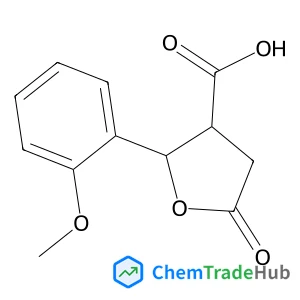
trans-2-(2-Methoxyphenyl)-5-oxotetrahydrofuran-3-carboxylic acid
CAS Number:
99226-02-5
Molecular Formula:
C12H12O5
Recommended Suppliers



Disclaimer
This page provides academic journal information for reference and research purposes only. We are not affiliated with any journal publishers and do not handle publication submissions. For publication-related inquiries, please contact the respective journal publishers directly.
If you notice any inaccuracies in the information displayed, please contact us at support@chemtradehub.com. We will promptly review and address your concerns.