












The mechanism of excimer formation: an experimental and theoretical study on the pyrene dimer
Literature Information
Publication Date
2017-08-30
DOI
10.1039/C7CP03990E
Impact Factor
3.676
Authors
Joscha Hoche, Hans-Christian Schmitt, Alexander Humeniuk, Ingo Fischer, Roland Mitrić, Merle I. S. Röhr
View Original
Abstract
The understanding of excimer formation in organic materials is of fundamental importance, since excimers profoundly influence their functional performance in applications such as light-harvesting, photovoltaics or organic electronics. We present a joint experimental and theoretical study of the ultrafast dynamics of excimer formation in the pyrene dimer in a supersonic jet, which is the archetype of an excimer forming system. We perform simulations of the nonadiabatic photodynamics in the frame of TDDFT that reveal two distinct excimer formation pathways in the gas-phase dimer. The first pathway involves local excited state relaxation close to the initial Franck–Condon geometry that is characterized by a strong excitation of the stacking coordinate exhibiting damped oscillations with a period of 350 fs that persist for several picoseconds. The second excimer forming pathway involves large amplitude oscillations along the parallel shift coordinate with a period of ≈900 fs that after intramolecular vibrational energy redistribution leads to the formation of a perfectly stacked dimer. The electronic relaxation within the excitonic manifold is mediated by the presence of intermolecular conical intersections formed between fully delocalized excitonic states. Such conical intersections may generally arise in stacked π-conjugated aggregates due to the interplay between the long-range and short-range electronic coupling. The simulations are supported by picosecond photoionization experiments in a supersonic jet that provide a time-constant for the excimer formation of around 6–7 ps, in good agreement with theory. Finally, in order to explore how the crystal environment influences the excimer formation dynamics we perform large scale QM/MM nonadiabatic dynamics simulations on a pyrene crystal in the framework of the long-range corrected tight-binding TDDFT. In contrast to the isolated dimer, the excimer formation in the crystal follows a single reaction pathway in which the initially excited parallel slip motion is strongly damped by the interaction with the surrounding molecules leading to the slow excimer stabilization on a picosecond time scale.
Related Literature
PMMA based soluble polymeric temperature sensors based on UCST transition and solvatochromic dyes
2010-06-12
Communication
DOI: 10.1039/C0PY00162G
Facile polyisobutylene functionalization viathiol–ene click chemistry‡
Andrew J. D. Magenau, Justin W. Chan, Charles E. Hoyle, Robson F. Storey
2010-05-10
Communication
DOI: 10.1039/C0PY00094A
Organic support for ethylenepolymerization based on the self-assembly in heptane of end-functionalized polyisoprene
Jan Merna
2010-05-28
Paper
DOI: 10.1039/C0PY00072H
Non-viral siRNA delivery vectors: dendritic molecular transporter and molecular transporter nanovectors for target gene silencing‡
Sharon K. Hamilton, Artez L. Sims, Jenna Donavan, Eva Harth
2010-11-18
Paper
DOI: 10.1039/C0PY00342E
Self-healing and self-mendable polymers
Jay A. Syrett, C. Remzi Becer, David M. Haddleton
2010-05-13
Review Article
DOI: 10.1039/C0PY00104J
Synthetic polymers for biopharmaceutical delivery
Johannes Pall Magnusson, Aram Omer Saeed, Francisco Fernández-Trillo, Cameron Alexander
2010-10-04
Review Article
DOI: 10.1039/C0PY00210K
Light driven asymmetric polymerization: an approach for tele-control reaction
Hiromasa Goto, Kohsuke Kawabata
2011-03-26
Paper
DOI: 10.1039/C0PY00396D
You might also like
Compound Q&A
Is 6-(3-Fluorophenyl)picolinic acid (CAS: 887982-40-3) safe?
6-(3-Fluorophenyl)picolinic acid is generally considered safe for laboratory use...
887982-40-36-(3-Fluorophenyl)pi...
Compound Q&A
What industries use (3R)-3-Pyrrolidinol (CAS: 2799-21-5)?
(3R)-3-Pyrrolidinol is used in the pharmaceutical industry as a precursor for dr...
2799-21-5(3R)-3-Pyrrolidinol
Compound Q&A
What precautions should be taken when handling (4R,5R)-4,5-Diethoxycarbonyl-2,2-dimethyldioxolane (CAS: 59779-75-8)?
When handling (4R,5R)-4,5-Diethoxycarbonyl-2,2-dimethyldioxolane (CAS: 59779-75-...
59779-75-8(4R,5R)-4,5-Diethoxy...
Compound Q&A
How is 1-(6-Chloroimidazo[1,2-b]pyridazin-3-yl)ethanone (CAS: 90734-71-7) typically synthesized?
1-(6-Chloroimidazo[1,2-b]pyridazin-3-yl)ethanone is often synthesized via a mult...
90734-71-71-(6-Chloroimidazo[1...
Compound Q&A
What is the market or research trend for N-Ethyl-3,4-dimethylbenzylamine (CAS: 39180-83-1)?
The market for N-Ethyl-3,4-dimethylbenzylamine (CAS: 39180-83-1) remains steady,...
39180-83-1N-Ethyl-3,4-dimethyl...
Compound Q&A
What is Tert-butyl 3-(pyrrolidin-1-yl)azetidine-1-carboxylate (CAS: 1019008-21-9)?
Tert-butyl 3-(pyrrolidin-1-yl)azetidine-1-carboxylate is a chemical compound wit...
1019008-21-9Tert-butyl 3-(pyrrol...
Compound Q&A
What regulatory guidelines apply to 1-Bromo-3-chloro-2,4-dimethoxybenzene (CAS: 1228956-93-1)?
1-Bromo-3-chloro-2,4-dimethoxybenzene (CAS: 1228956-93-1) falls under the classi...
1228956-93-11-Bromo-3-chloro-2,4...
Compound Q&A
Is 8-Bromo-2-methyl-3,4-dihydroisoquinolin-1(2H)-one (CAS: 1368622-07-4) safe?
The safety of 8-Bromo-2-methyl-3,4-dihydroisoquinolin-1(2H)-one (CAS: 1368622-07...
1368622-07-48-Bromo-2-methyl-3,4...
Compound Q&A
Is Benzyl [(3S)-2,6-dioxo-3-piperidinyl]carbamate (CAS: 22785-43-9) safe?
Benzyl [(3S)-2,6-dioxo-3-piperidinyl]carbamate is generally safe when handled wi...
22785-43-9Benzyl [(3S)-2,6-dio...
Compound Q&A
How should 1-{[4-(4,4,5,5-Tetramethyl-1,3,2-dioxaborolan-2-yl)phenyl]sulfonyl}pyrrolidine (CAS: 928657-21-0) be stored?
1-{[4-(4,4,5,5-Tetramethyl-1,3,2-dioxaborolan-2-yl)phenyl]sulfonyl}pyrrolidine s...
928657-21-01-{[4-(4,4,5,5-Tetra...
Source Journal
Physical Chemistry Chemical Physics

CiteScore:
5.5
Self-citation Rate:
10.3%
Articles per Year:
3036
Physical Chemistry Chemical Physics (PCCP) is an international journal co-owned by 19 physical chemistry and physics societies from around the world. This journal publishes original, cutting-edge research in physical chemistry, chemical physics and biophysical chemistry. To be suitable for publication in PCCP, articles must include significant innovation and/or insight into physical chemistry; this is the most important criterion that reviewers and Editors will judge against when evaluating submissions. The journal has a broad scope and welcomes contributions spanning experiment, theory, computation and data science. Topical coverage includes spectroscopy, dynamics, kinetics, statistical mechanics, thermodynamics, electrochemistry, catalysis, surface science, quantum mechanics, quantum computing and machine learning. Interdisciplinary research areas such as polymers and soft matter, materials, nanoscience, energy, surfaces/interfaces, and biophysical chemistry are welcomed if they demonstrate significant innovation and/or insight into physical chemistry. Joined experimental/theoretical studies are particularly appreciated when complementary and based on up-to-date approaches.
Recommended Compounds
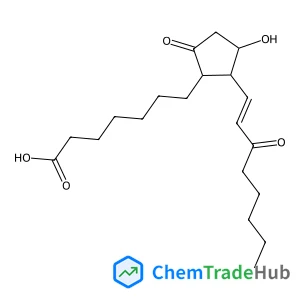
(11alpha,13E)-11-Hydroxy-9,15-dioxoprost-13-en-1-oic acid
CAS Number:
22973-19-9
Molecular Formula:
C20H32O5
Recommended Suppliers






Disclaimer
This page provides academic journal information for reference and research purposes only. We are not affiliated with any journal publishers and do not handle publication submissions. For publication-related inquiries, please contact the respective journal publishers directly.
If you notice any inaccuracies in the information displayed, please contact us at support@chemtradehub.com. We will promptly review and address your concerns.