












Strengthening mechanism of Si, V and Ti atoms to the Ag/AlN interface: a study from first-principles calculations
Literature Information
Publication Date
2020-11-16
DOI
10.1039/D0CP05102K
Impact Factor
3.676
Authors
Wenshan Bian, Runlin Li, Haitao Xue, Xiaoming Zhang
View Original
Abstract
Active elements play key roles in improving the interfacial bonding between Ag-based fillers and AlN ceramics. An understanding of the influence mechanism of active elements to interfacial adhesion can help us optimize the composition of active filler metals. In this paper, Ag(111)/AlN(0001) interfaces with different terminations and stacking sequences were constructed first. The N-terminated A-site interface was found to have the largest work of adhesion (Wad). Then, the effects of Si, Ti and V dopants on the Ag/AlN interfacial bonding were investigated via first-principles calculations. The results reveal that the Ti and V dopants can increase the values of Wad significantly. Electronic structure analysis reveals that the Si–N, Ti–N and V–N bonds formed at the interface are mainly ionic, and with some composition of covalent. Ti and V atoms can form strong bonds with not only the AlN slab, but also the neighboring Ag layers. It can be concluded that Ag–Ti and Ag–V active fillers are more suited to braze AlN. Ti–N and V–N compounds formed at the interface can greatly improve the interfacial bonding strength.
Related Literature
Protocol for disentangling the thermally activated contribution to the tunneling-assisted charge transport. Analytical results and experimental relevance
2017-04-06
Paper
DOI: 10.1039/C7CP01103B
Revisiting the definition of local hardness and hardness kernel
Carlos A. Polanco-Ramírez, Javier Carmona-Espíndola, José L. Gázquez, Paul W. Ayers
2017-03-31
Paper
DOI: 10.1039/C7CP00691H
Mapping the ionic fingerprints of molecular monolayers
Joshua Lehr, Justin R. Weeks, Adriano Santos, Gustavo T. Feliciano, Melany I. G. Nicholson, Jason J. Davis, Paulo R. Bueno
2017-05-12
Paper
DOI: 10.1039/C7CP01500C
The effect of pressure on the crystallization of rapidly supercooled zirconium melts
Zean Tian, Rangsu Liu, Lili Zhou, Zhaoyang Hou
2017-04-13
Paper
DOI: 10.1039/C7CP00865A
A promising single atom catalyst for CO oxidation: Ag on boron vacancies of h-BN sheets
Peng Lv, Shuo Li, Dongwei Ma, Ruqian Wu
2017-06-02
Paper
DOI: 10.1039/C7CP02430D
Decoupling diffusion from the bimolecular photoinduced electron transfer reaction: a combined ultrafast spectroscopic and kinetic analysis
Puspal Mukherjee, Pratik Sen
2017-03-31
Paper
DOI: 10.1039/C7CP01387F
The effect of chemical ordering and lattice mismatch on structural transitions in phase segregating nanoalloys
Kevin Rossi, Francesca Baletto
2017-04-03
Paper
DOI: 10.1039/C7CP01397C
Femtosecond time-resolved photoelectron spectroscopy of the benzyl radical
L. Poisson
2017-04-12
Paper
DOI: 10.1039/C7CP01437F
The effect of hydroxyl on the solution behavior of a quaternary ammonium gemini surfactant
Xuepeng Wu, Caili Dai, Sisi Fang, Hao Li, Yining Wu, Xin Sun, Mingwei Zhao
2017-05-30
Paper
DOI: 10.1039/C7CP00131B
Theoretical study of one-electron-oxidized salen complexes of group 7 (Mn(iii), Tc(iii), and Re(iii)) and group 10 metals (Ni(ii), Pd(ii), and Pt(ii)) with the 3D-RISM-GMC-QDPT method: localized vs. delocalized ground and excited states in solution
Shinji Aono, Masayuki Nakagaki, Shigeyoshi Sakaki
2017-05-30
Paper
DOI: 10.1039/C7CP02992F
You might also like
Compound Q&A
Are there alternatives to 1-(4-Chlorophenyl)-N-hydroxymethanimine (CAS: 3848-36-0) in synthesis?
When considering alternatives to 1-(4-Chlorophenyl)-N-hydroxymethanimine (CAS: 3...
3848-36-01-(4-Chlorophenyl)-N...
Compound Q&A
How should (1R,9S,10S,12S,14E,16S,19R,20R,21S,22R)-3,9,21-Trihydroxy-5,10,12,14,16,20,22-heptamethyl-23,24-dioxatetracyclo[17.3.1.1~6,9~.0~2,7~]tetracosa-2,5,7,14-tetraen-4-one (CAS: 183202-73-5) be stored?
This compound should be stored in a cool, dry place away from direct sunlight. I...
183202-73-5(1R,9S,10S,12S,14E,1...
Compound Q&A
How is 3-(4-Bromophenyl)-5-(2-fluorophenyl)-1,2,4-oxadiazole (CAS: 419553-16-5) typically synthesized?
3-(4-Bromophenyl)-5-(2-fluorophenyl)-1,2,4-oxadiazole is synthesized through a m...
419553-16-53-(4-Bromophenyl)-5-...
Compound Q&A
How is 5-Chloro-2-(4-chlorophenyl)-4-methyl-6-[3-(1-piperidinyl)propoxy]pyrimidine (CAS: 1639220-19-1) typically synthesized?
5-Chloro-2-(4-chlorophenyl)-4-methyl-6-[3-(1-piperidinyl)propoxy]pyrimidine (CAS...
1639220-19-15-Chloro-2-(4-chloro...
Compound Q&A
What industries use 2-Chloro-4-(difluoromethoxy)pyridine (CAS: 1206978-15-5)?
2-Chloro-4-(difluoromethoxy)pyridine is used in the pharmaceutical industry for ...
1206978-15-52-Chloro-4-(difluoro...
Compound Q&A
What regulatory guidelines apply to 3-Chloro-6-methylpyridazine (CAS: 1121-79-5)?
3-Chloro-6-methylpyridazine (CAS: 1121-79-5) is classified under the Globally Ha...
1121-79-53-Chloro-6-methylpyr...
Compound Q&A
Are there alternatives to Methyl 4,5-dimethyl-2-nitrobenzoate in synthesis?
Several alternatives can be used in the synthesis of Methyl 4,5-dimethyl-2-nitro...
90922-74-0Methyl 4,5-dimethyl-...
Compound Q&A
Are there alternatives to (2E,2'E)-3,3'-(1,4-Phenylene)bisacrylaldehyde in synthesis?
Alternatives to (2E,2'E)-3,3'-(1,4-Phenylene)bisacrylaldehyde include other acry...
63405-68-5(2E,2'E)-3,3'-(1,4-P...
Compound Q&A
What is 3-Amino-5-chloropyridin-2-ol hydrochloride (CAS: 1261906-29-9)?
3-Amino-5-chloropyridin-2-ol hydrochloride is an organic compound with the CAS n...
1261906-29-93-Amino-5-chloropyri...
Compound Q&A
What precautions should be taken when handling 6,7-Difluoro-2,3-dihydro-4H-chromen-4-one (CAS: 1092349-93-3)?
When handling 6,7-Difluoro-2,3-dihydro-4H-chromen-4-one, it is essential to wear...
1092349-93-36,7-Difluoro-2,3-dih...
Source Journal
Physical Chemistry Chemical Physics

CiteScore:
5.5
Self-citation Rate:
10.3%
Articles per Year:
3036
Physical Chemistry Chemical Physics (PCCP) is an international journal co-owned by 19 physical chemistry and physics societies from around the world. This journal publishes original, cutting-edge research in physical chemistry, chemical physics and biophysical chemistry. To be suitable for publication in PCCP, articles must include significant innovation and/or insight into physical chemistry; this is the most important criterion that reviewers and Editors will judge against when evaluating submissions. The journal has a broad scope and welcomes contributions spanning experiment, theory, computation and data science. Topical coverage includes spectroscopy, dynamics, kinetics, statistical mechanics, thermodynamics, electrochemistry, catalysis, surface science, quantum mechanics, quantum computing and machine learning. Interdisciplinary research areas such as polymers and soft matter, materials, nanoscience, energy, surfaces/interfaces, and biophysical chemistry are welcomed if they demonstrate significant innovation and/or insight into physical chemistry. Joined experimental/theoretical studies are particularly appreciated when complementary and based on up-to-date approaches.
Recommended Compounds
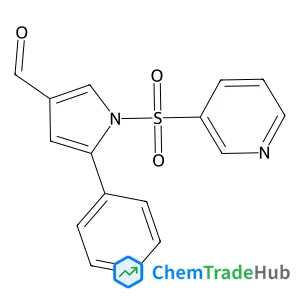
5-Phenyl-1-(pyridin-3-ylsulfonyl)-1H-pyrrole-3-carbaldehyde
CAS Number:
881676-90-0
Molecular Formula:
C16H12N2O3S
Recommended Suppliers






Disclaimer
This page provides academic journal information for reference and research purposes only. We are not affiliated with any journal publishers and do not handle publication submissions. For publication-related inquiries, please contact the respective journal publishers directly.
If you notice any inaccuracies in the information displayed, please contact us at support@chemtradehub.com. We will promptly review and address your concerns.