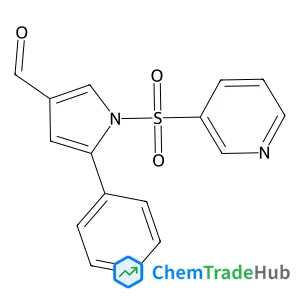
5-Phenyl-1-(pyridin-3-ylsulfonyl)-1H-pyrrole-3-carbaldehyde
CAS Number:
881676-90-0
Molecular Formula:
C16H12N2O3S
Xuepeng Wu, Caili Dai, Sisi Fang, Hao Li, Yining Wu, Xin Sun, Mingwei Zhao
The adsorption and viscoelastic properties of a micellar solution of 2-hydroxyl-propanediyl-1,3-bis(hexadecyldimethylammonium bromide), abbreviated as 16-3OH-16, have been investigated by surface tension and rheological measurements. Meanwhile, an aqueous solution of propanediyl-1,3-bis(hexadecyldimethylammonium bromide), abbreviated as 16-3-16, was also examined. From the steady state and oscillatory rheological results, a notable difference in shear viscosities between the two systems was observed. Zeta potentials and size distributions confirm the change in the potentials and hydrodynamic diameters, and these results are in good agreement with the rheological results. The differences of the two solutions were attributed to the effect of the hydroxyl group on the spacer of 16-3OH-16. Molecular dynamic simulations and density functional theory (DFT) calculations were performed to investigate the non-covalent interactions in the solution and the difference between the molecular orbitals and the electrostatic potentials. Our research shows that a more uniform distribution of positive charges around the spacer could result in a more effective electrostatic screening effect between the charged headgroups, and promote the formation of a worm-like micelle. Also, hyperconjugation becomes stronger when the hydroxyl group is introduced on the spacer of the gemini molecule.

Organic Process Research & Development

Nature Medicine

Journal of Saudi Chemical Society

Crystallography Reports

Russian Journal of General Chemistry

Russian Journal of Organic Chemistry

Russian Journal of Coordination Chemistry

Current Opinion in Solid State & Materials Science

Acta Materialia

Journal of Peptide Science
Stephan Barcikowski, Giuseppe Compagnini
DOI: 10.1039/C2CP90132C
Yiyin Mao, Wei Cao, Junwei Li, Yu Liu, Yulong Ying, Luwei Sun
DOI: 10.1039/C3TA12402A
Vina R. Aldilla, Shashidhar Nizalapur, Christopher E. Marjo, Anne M. Rich, Kitty K. K. Ho, David StC. Black
DOI: 10.1039/C8TB01290C
Alexandre Simula, Fernando Ruipérez, Nicholas Ballard, José R. Leiza, José M. Asua
DOI: 10.1039/C8PY00900G
Natalia N. Shlenskaya, Nikolai A. Belich, Michael Grätzel
DOI: 10.1039/C7TA10217H
Sebastian Schaubach, Xiao-Yan Wang, Jun-Fang Li, Xiu-Li Sun, Sunewang R. Wang, Yong Tang
DOI: 10.1039/C8PY00953H
Christophe Detrembleur, Antoine Debuigne, Ozcan Altintas, Matthias Conradi, Edgar H. H. Wong, Christine Jérôme, Christopher Barner-Kowollik, Tanja Junkers
DOI: 10.1039/C1PY00297J
When considering alternatives to 1-(4-Chlorophenyl)-N-hydroxymethanimine (CAS: 3...
This compound should be stored in a cool, dry place away from direct sunlight. I...
3-(4-Bromophenyl)-5-(2-fluorophenyl)-1,2,4-oxadiazole is synthesized through a m...
5-Chloro-2-(4-chlorophenyl)-4-methyl-6-[3-(1-piperidinyl)propoxy]pyrimidine (CAS...
2-Chloro-4-(difluoromethoxy)pyridine is used in the pharmaceutical industry for ...
3-Chloro-6-methylpyridazine (CAS: 1121-79-5) is classified under the Globally Ha...
Several alternatives can be used in the synthesis of Methyl 4,5-dimethyl-2-nitro...
Alternatives to (2E,2'E)-3,3'-(1,4-Phenylene)bisacrylaldehyde include other acry...
3-Amino-5-chloropyridin-2-ol hydrochloride is an organic compound with the CAS n...
When handling 6,7-Difluoro-2,3-dihydro-4H-chromen-4-one, it is essential to wear...

Physical Chemistry Chemical Physics (PCCP) is an international journal co-owned by 19 physical chemistry and physics societies from around the world. This journal publishes original, cutting-edge research in physical chemistry, chemical physics and biophysical chemistry. To be suitable for publication in PCCP, articles must include significant innovation and/or insight into physical chemistry; this is the most important criterion that reviewers and Editors will judge against when evaluating submissions. The journal has a broad scope and welcomes contributions spanning experiment, theory, computation and data science. Topical coverage includes spectroscopy, dynamics, kinetics, statistical mechanics, thermodynamics, electrochemistry, catalysis, surface science, quantum mechanics, quantum computing and machine learning. Interdisciplinary research areas such as polymers and soft matter, materials, nanoscience, energy, surfaces/interfaces, and biophysical chemistry are welcomed if they demonstrate significant innovation and/or insight into physical chemistry. Joined experimental/theoretical studies are particularly appreciated when complementary and based on up-to-date approaches.