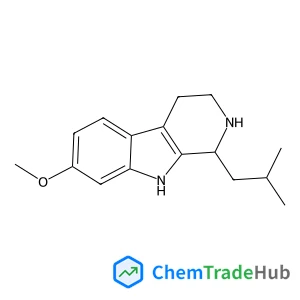
1-Isobutyl-7-methoxy-2,3,4,9-tetrahydro-1H-beta-carboline
CAS Number:
175975-76-5
Molecular Formula:
C16H22N2O
Min He, Chidozie Onwudinanti, Yaoting Zheng, Xiaomei Wu, Zaoxiao Zhang, Shuxia Tao
2.25Cr1Mo0.25V is a state-of the-art alloy used in the fabrication of modern hydrogenation reactors. Compared to the conventional 2.25Cr1Mo steel, the 2.25Cr1Mo0.25V steel exhibits a better performance, in particular higher hydrogen damage resistance. Previous experimental studies indicate that carbides in steels may be responsible for the hydrogen-induced damage. To gain a better understanding of the mechanism of such damage, it is essential to study hydrogen uptake in metal carbides. In this study, Density Functional Theory (DFT) is used to investigate the stability of chromium, molybdenum and vanadium carbides (CrxCy, MoxCy and VxCy) in the 2.25Cr1Mo0.25V steel. The stability of their corresponding interstitial hydrides was also explored. The results showed that Cr7C3, Mo2C and V6C5 are the most stable carbides in their respective metal–carbon (Cr–C, Mo–C and V–C) binary systems. Specifically, V6C5 shows the strongest hydrogen absorption ability because of its strong V–H and C–H ionic bonds. On the other hand, V4C3, whose presence in the alloy was established in experimental studies, is predicted to be stable as well, along with V6C5. Our findings indicate that the hydrogen absorption ability of V4C3 is higher than that of V6C5. Additionally, the charge and chemical bonding analyses reveal that the stability of the metal carbide hydrides strongly depends on the electronegativity of the metal. Due to the high electronegativity of V, vanadium carbides form the strongest ionic bonds with hydrogen, compared to those of Mo and Cr. The results from this study suggest that the unique capacity of accommodating hydrogen in the vanadium carbides plays an important role in improved hydrogen damage resistance of the 2.25Cr1Mo0.25V alloy in hydrogenation reactors.
Kinga Góra-Marek, Adam Stępniewski, Mariusz Radoń, Ewa Broclawik
DOI: 10.1039/C4CP03350G
Athira K. V. Raj, P. Prabhakar Rao, T. S. Sreena, S. Sameera, Vineetha James, U. A. Renju
DOI: 10.1039/C4CP03311F
Natcha Injan, Jakkapan Sirijaraensre
DOI: 10.1039/C4CP02728K
Qiang Zhang, Yanghua Deng, Zhonghua Hu, Yafei Liu, Mingming Yao, Peipei Liu
DOI: 10.1039/C4CP02928C
Philipp Furler, Jonathan Scheffe, Daniel Marxer, Michal Gorbar
DOI: 10.1039/C4CP01172D
Leszek Niedzicki, Ewelina Karpierz, Maciej Zawadzki, Maciej Dranka, Marta Kasprzyk, Aldona Zalewska, Marek Marcinek, Janusz Zachara, Urszula Domańska, Władysław Wieczorek
DOI: 10.1039/C3CP55354J
Yuesheng Wang, Pin Liu, Lin Gu, Yong-Sheng Hu, Hong Li, George P. Demopoulos, Liquan Chen
DOI: 10.1039/C4CP02957G
Swati Vartak, Anatoly Golovnev, Ata Roudgar, Michael Eikerling
DOI: 10.1039/C4CP02937B
Jianru Wang, Yan Zhao, Xiaoyan Qiao
DOI: 10.1039/C4CP02298J
N-(4-Methoxybenzyl)-2-pyridinamine (CAS: 52818-63-0) is increasingly being used ...
When handling Ethyl 4-(2-chlorophenyl)-1,3-thiazole-2-carboxylate, appropriate p...
Diethyldiselane (CAS: 628-39-7) is classified under the Globally Harmonized Syst...
The market for oxocopper (CAS: 12053-18-8) is primarily driven by its use in cat...
The market for 5-{[(2-Methyl-2-propanyl)oxy]carbonyl}-5-azaspiro[2.4]heptane-7-c...
2-(1-Pyrrolidinyl)-4-pyridinamine is a chemical compound with the CAS number 359...
2-(3-Pyridinyl)-1-azabicyclo[2.2.2]octane (CAS: 91556-75-1) is a crystalline sol...
(S)-Alpha-allyl-proline hydrochloride is usually synthesized via a Wittig reacti...
3-Methyl-1,2-oxazole-5-carboxylic acid (CAS: 4857-42-5) is an organic compound w...
Lys-SMCC-DM1 is synthesized via a multi-step process involving the coupling of S...

Physical Chemistry Chemical Physics (PCCP) is an international journal co-owned by 19 physical chemistry and physics societies from around the world. This journal publishes original, cutting-edge research in physical chemistry, chemical physics and biophysical chemistry. To be suitable for publication in PCCP, articles must include significant innovation and/or insight into physical chemistry; this is the most important criterion that reviewers and Editors will judge against when evaluating submissions. The journal has a broad scope and welcomes contributions spanning experiment, theory, computation and data science. Topical coverage includes spectroscopy, dynamics, kinetics, statistical mechanics, thermodynamics, electrochemistry, catalysis, surface science, quantum mechanics, quantum computing and machine learning. Interdisciplinary research areas such as polymers and soft matter, materials, nanoscience, energy, surfaces/interfaces, and biophysical chemistry are welcomed if they demonstrate significant innovation and/or insight into physical chemistry. Joined experimental/theoretical studies are particularly appreciated when complementary and based on up-to-date approaches.